 Retro Replay Retro Replay gaming reviews, news, emulation, geek stuff and more!
Retro Replay Review
Gameplay
The first hour of The Return of Medusa feels like being handed a kingdom’s military budget, a travel schedule, and a dungeon expedition all at once. You are pursuing thirteen keys scattered through dungeons, but getting there means raising cash, building an army, and deciding how to spend time while the world map runs in real time. It is an immediately distinctive loop: you are not simply marching from battle to battle, because every detour for money can matter.
Trade is the central, dependable way to get your campaign moving, while world-map treasure hunts and casino roulette offer riskier alternatives. That makes money more than a number to watch rise; it dictates how aggressively you can search, recruit, and prepare for the final push against Medusa’s city. The city screens pause time, which gives you room to think through management decisions, but travelling does not grant that luxury. You need to make plans before heading out rather than treating the map as a harmless route between chores.
Army composition is where the strategy starts to click. Multiple races, classes, and weapons let you shape a force instead of relying on one fixed answer, and the game clearly expects you to care about that preparation. The friction comes from its breadth. Trading, recruiting, travelling, dungeon exploration, puzzles, real-time firearm combat, and occasional arcade sequences ask for different instincts. If you want one polished action or strategy system, the shifts can feel scattered; if you enjoy wrestling a large, eccentric campaign into submission, they give the journey texture.
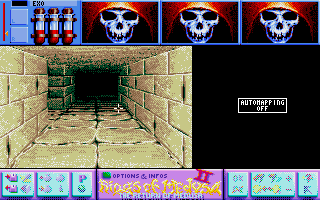
The dungeons are the strongest argument for the sequel’s changed setting. You can bring up to three companions into first-person passages, solve puzzles, and fight enemies in real time with firearms. After the broader management game, this is a useful change of pace: the money and army-building work finally lead to a hands-on expedition. It also raises the stakes of preparation, since a dungeon run is not just another menu transaction.
Graphics
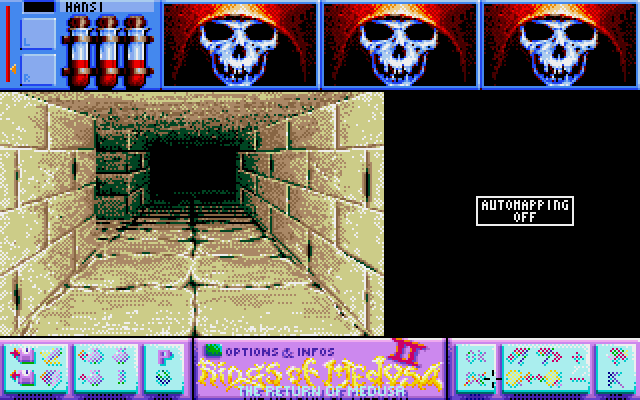
The clearest visual contrast is between the first-person dungeons and the strategic travel and city-management portions. Dungeon exploration puts you directly into corridors with up to three companions at your side, while the future setting brings firearms and technology into a series that began in a medieval world. It is a deliberately odd collision of swords-and-sorcery stakes with a year-2200 backdrop.
Story
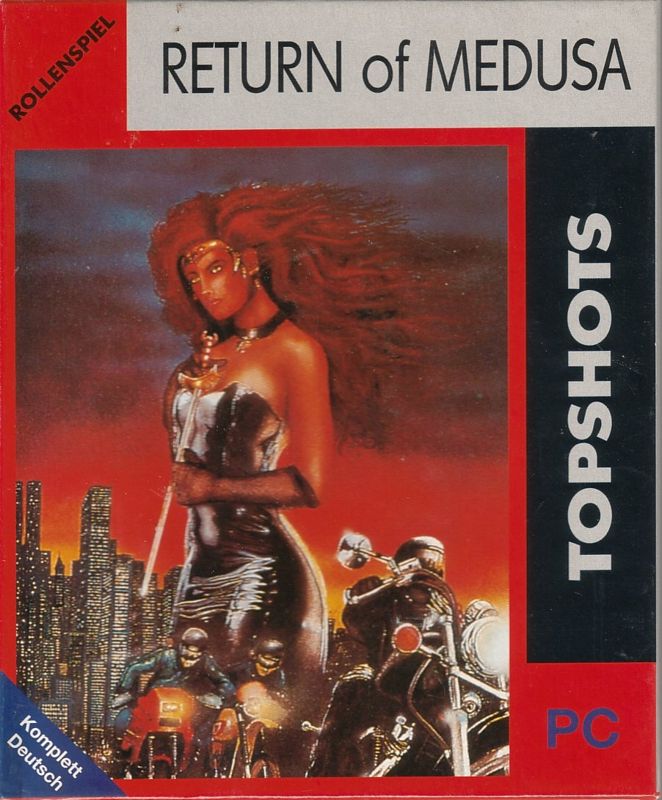
This sequel starts from a wonderfully direct piece of villain logic. Prince Cirion defeated Medusa when she threatened Morenor, so she escapes to the year 2200, a time when he should be long dead. Cirion follows anyway. The premise is pulpy, but it has real momentum: Medusa has not merely returned; she has tried to make the original victory irrelevant.
The thirteen-key hunt gives the campaign a concrete spine. Each key sits in a dungeon somewhere across the country, turning the story into a long pursuit rather than a vague mandate to become stronger. Your trading and recruitment are therefore tied to Cirion’s chase, even when the moment-to-moment focus is on raising enough money to continue.
The setting change is the memorable hook. Modern weaponry and technology alter the tools at Cirion’s disposal without abandoning the fantasy conflict or Medusa herself. For a little more background on this unusual follow-up, see the game’s history and release information. Do not expect the narrative to carry the game on its own; its main job is to give all that travel, preparation, and dungeon delving a suitably bizarre target.
Overall Experience
The Return of Medusa earns its reputation as a seven-out-of-ten curiosity: ambitious, compelling in patches, and unmistakably rough around the joins. Its strongest quality is that every major activity points toward the same objective. Money supports the army, the army and companions support dungeon expeditions, and the keys bring you closer to Medusa’s city.
Patience is the admission price. You have to tolerate real-time pressure on the map and accept that the game changes gears often, sometimes from strategic planning to first-person shooting or a brief arcade challenge. That variety can create frustration when you are settled into one mode and the game demands another. Yet it also prevents the long key search from becoming a single-note march.
Give it a chance if you enjoy early-1990s games that are willing to combine big strategic goals with strange side activities and let you find your own financial path forward. Skip it if you need a streamlined campaign with one consistent style of play. For the right gamer, Cirion’s trip to 2200 is a messy but rewarding expedition—one where the satisfaction comes less from elegance than from finally mastering a system that keeps finding new ways to test you.


Reviews
There are no reviews yet.