 Retro Replay Retro Gaming History, Reviews & Emulation



Retro Replay Review
Gameplay
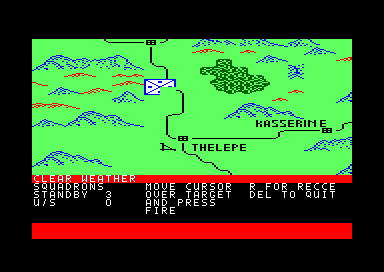
The first hour of Vulcan asks you to slow down and think like a commander rather than a fast-clicking conqueror. You select units on a scrolling map, issue orders, and move across rectangular grid cells one turn at a time. That basic structure is familiar, but the game finds its bite in terrain and timing. A river can shut down the route you expected to use, while mountains can permit hidden movement. You are constantly weighing a direct advance against safer positioning.
What starts to click is the importance of the map as more than a board. Getting troops toward Tunis is not simply a matter of marching forward; landscape objects shape where an army can realistically go and how exposed that move may be. The air-attack phase between turns adds another layer to consider, especially when you are trying to create an opening before committing units on the ground. It is a measured sort of tension, built from consequences rather than spectacle.
The scenario structure helps a great deal. Five scenarios cover the wider 1942–43 campaign as well as Kasserine and Mareth, and their alternate preconditions can materially alter the starting problem. Axis control of Malta, French neutrality, the destruction of the DAK, and delayed desert armies are not just decorative historical labels; they give you reasons to revisit the same conflict from a different strategic position.
Frustration can set in if you want immediate feedback or quick, decisive action. Turn-based hex-and-counter-style thinking—even on this rectangular grid—demands patience, and an error in route planning can take time to correct. But that is also why the victories land. When a difficult advance works because you respected the terrain and anticipated the enemy’s response, it feels earned rather than handed over.

Graphics
The action is viewed from above on a scrolling campaign map, with units moving cell by cell through North African terrain. Mountains and rivers are especially important sights because they directly affect your plans, making the battlefield itself the clearest visual information on screen.

Story
This is history presented as a campaign problem, not a character-led war story. You begin with the arrival of the Torch Task Force and the race for Tunis, then work through a conflict that ends at Operation Vulcan. The game’s narrative weight comes from the sequence of military situations and shifting conditions rather than scripted drama.
That focus suits the subject. Kasserine and Mareth carry their own historical pull, and the alternate starting conditions encourage you to consider how much a changed assumption might reshape the campaign. You are not being asked to watch the Tunisian Campaign unfold; you are being asked to take responsibility for one side of it.
The included historical notes, maps, and photographs deepen that context, particularly if you enjoy knowing what the scenarios are drawing from before you begin. The detailed instruction booklet matters too: this is the kind of design that benefits from meeting it on its own terms instead of trying to guess every rule from the opening turns.
Overall Experience
Vulcan: The Tunisian Campaign is a worthwhile historical wargame for anyone who gets satisfaction from careful map play and plausible military constraints. Its strongest quality is that it turns the Tunisian theatre into a sequence of decisions with real shape: routes matter, terrain matters, and the initial political and military conditions matter.
The limited number of scenarios is offset by their different preconditions and the option to face either the computer or another person. A human opponent is likely where the game’s deliberate order-giving and positional feints have the most room to breathe, but the computer option still gives you a practical way to learn the campaign’s demands.
It will not convert you if you need strategy games to be rapid, flashy, or full of personal drama. Give it a chance if you are happy to consult a manual, study a scrolling map, and live with the consequences of a cautious or reckless turn. For that audience, the payoff is a focused World War II campaign game with enough historical variation to stay interesting after the first hard-fought run.


Reviews
There are no reviews yet.