 Retro Replay Retro Gaming History, Reviews & Emulation
Retro Replay Review
Gameplay
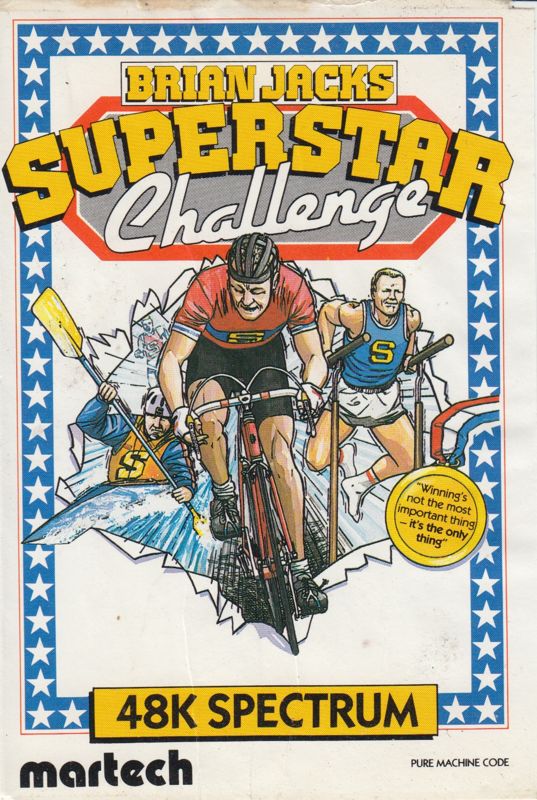
The first few events quickly establish the game’s central bargain: you take on Brian Jacks across eight sports and fitness contests, earning points from your performance rather than clearing a single fixed qualification mark. That is a smart setup for an old sports compilation. A poor showing does not immediately eject you from the action; you keep competing, knowing every point may matter when the level totals are compared.
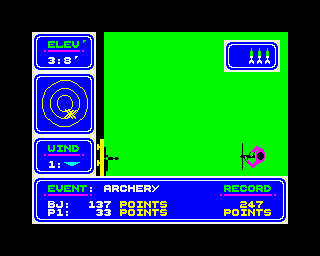
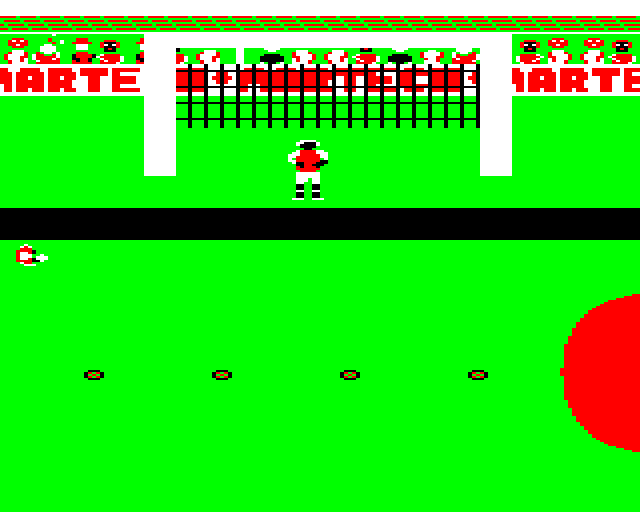
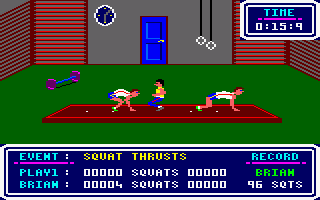
The tension comes from that comparison. Beat Brian’s score for a level and you advance to repeat the gauntlet; let him finish ahead and the challenge ends there. It turns Running, Archery, Cycling, Football, Swimming, Squat Thrusts, Canoeing, and Arm Dips into parts of one longer contest instead of disconnected diversions. You are not just testing whether you can manage a sport—you are trying to build enough of a cushion to survive the events that do not suit you.
Its weakest quality is also inseparable from its era: eight very different events means you will probably have favorites and events you simply endure. The game does not let you dodge the latter, since every contest is part of every level. That can make a frustrating discipline feel disproportionately important, particularly when a level loss wipes out your momentum. Still, the all-events format gives success some weight, because winning means you performed broadly well enough to beat the named star.
The Commodore 64 version has the clearest extra hook with its two-player option, letting you compete against a friend as well as tackle the Brian Jacks challenge. On ZX Spectrum and Amstrad CPC, the program is divided across two sides: Running, Archery, Cycling, and Football on side A, then Swimming, Squat Thrusts, Canoeing, and Arm Dips on side B. That split makes the full run feel less immediate, but it also naturally breaks the contest into two distinct sessions.
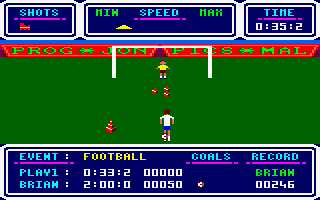
Graphics
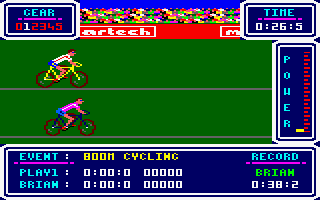
The game switches between side-view and top-down sports action according to the event. That variety suits a multi-event format: races and athletic challenges can be framed differently from football or canoeing, so you are not staring at one repeated screen layout for the whole challenge.
Story
There is no elaborate story to carry you from event to event. Brian Jacks, the British judoka and 1972 Olympic bronze medallist, is the licensed opponent and the reason the contest has a face rather than being a generic points table.
The loose connection to the BBC’s Superstars format is enough to establish the fantasy: you are an all-round competitor trying to outperform a celebrated athlete across wildly different disciplines. It is simple, but it fits. A sports game like this benefits more from a recognizable rival than from forced narrative dressing.
That also means the game lives or dies on your willingness to make your own drama out of the scoreboard. A narrow points lead before the final event can feel meaningful because the entire challenge is built around that one question: can you finish ahead of Jacks this time?
Overall Experience
Brian Jacks Superstar Challenge is a tough, plainspoken 8-bit sports compilation with a better competitive spine than its event list initially suggests. The recurring level structure and cumulative scoring give you a reason to care about improvement, while the risk of losing the whole challenge to Brian prevents it from becoming a casual tour of eight activities.
It is not an easy recommendation for anyone who wants a deep simulation of any one sport. The point is variety, repeated attempts, and the satisfaction of turning an uneven set of performances into a winning total. If that older score-attack rhythm sounds appealing, the game has enough structure to hold your attention beyond a single novelty round.
Go in ready to accept some uneven events and the occasional annoyance of being forced through every discipline. In return, you get a direct contest with a clear goal and a decent reason to come back after a loss. For more background on the game, its release history and context are worth a look.


Reviews
There are no reviews yet.