 Retro Replay Retro Gaming History, Reviews & Emulation

Retro Replay Review
Gameplay
Cluedo starts exactly where the board game starts: with a roll to decide who goes first, a shuffled deal, and a mystery that will not yield to a lucky guess. Your job is to identify Dr Black’s killer, the room, and the weapon by moving around the board, entering rooms, and making suggestions. The first few turns can feel almost overly familiar if you know Clue already, but the deduction loop still has teeth. Every revealed card closes off one possibility, and each unanswered combination becomes more interesting.
The best part is the note-taking. You can inspect your own clue cards and use Notes to track suspicions and eliminations, which is exactly the sort of housekeeping this game needs. Once your notes begin to fill up, the rhythm clicks: make a suggestion that tests several open questions, watch which opponent can disprove it, then revise your theory. It is not flashy detective work, but it is satisfyingly methodical.
Movement remains tied to dice rolls, so frustration can set in when you need a particular room and the roll refuses to cooperate. The secret passages offer a useful alternative, though taking one costs your turn. Suggestions and accusations also preserve the board game’s tension: suggest too broadly and you may learn little; accuse too early and you risk ending the game on a bad hunch.
For solo play, the computer handling five other participants is the conversion’s practical advantage. You get the full six-player structure without needing to gather anyone around a table. The trade-off is that Cluedo still moves at the deliberate pace of turn-based board play, including passing control after a roll. It rewards concentration and a willingness to let small pieces of evidence accumulate.
Graphics
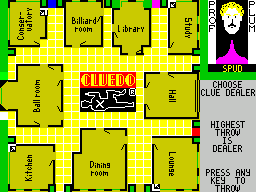
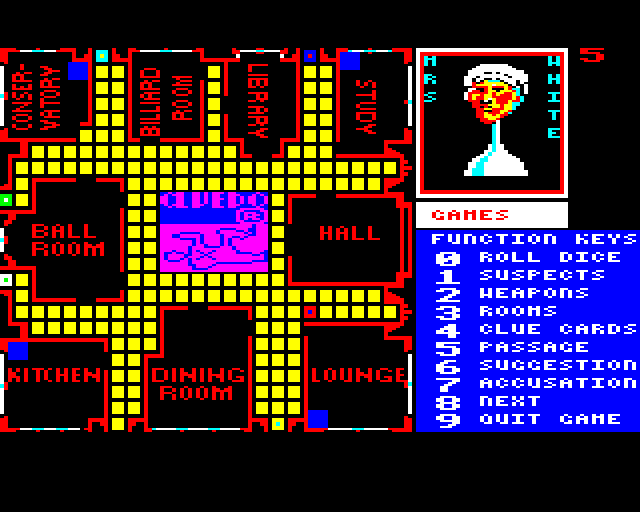
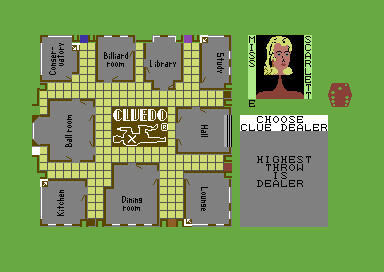
The game uses a top-down, fixed-screen board-game view built around moving pieces through the mansion layout. Its most useful visual quality is simple clarity: you can follow where everyone is and focus on the rooms that matter to your next suggestion.

Story
There is only one story Cluedo needs: Dr Black has been murdered, and you must name the culprit, location, and weapon. Rather than unfolding through scenes or dialogue, that mystery emerges from the cards nobody can account for. The case gains shape as your list of possibilities shrinks.
That makes the narrative payoff personal. You are not being led to a solution; you build it from partial information, suspiciously timed revelations, and careful notes. When your final accusation is right, it feels earned because you have watched the alternatives disappear one by one.
Do not expect character drama or a richly told whodunit. The familiar suspects and murder setup function as a frame for the puzzle. Still, the structure is strong enough that every round can create its own tiny tale of bluffing, deduction, and one player deciding they finally know the answer.
Overall Experience
Cluedo is a faithful, no-nonsense digital board game. It does not try to reinvent the original; it puts its rules, cards, dice, passages, suggestions, and accusations on a computer and lets the elimination puzzle do the work. That restraint works if the original game’s slow-burn reasoning is what you came for.
The optional music is a small bit of charm, including a Colonel Bogey cue for Colonel Mustard. More importantly, the computer opponents make it viable when you want a full game alone. You can settle in for a quiet case without assigning five friends to suspect each other.
Give it a chance if you enjoy writing down clues, testing theories, and accepting that a dice roll can temporarily derail a careful plan. Skip it if you want an action-heavy detective game or a more expressive mystery. As a computerized Cluedo board, it is competent and pleasantly focused, even if its strictly faithful approach leaves little room for surprise beyond the solution itself.


Reviews
There are no reviews yet.