 Retro Replay Retro Gaming History, Reviews & Emulation


Retro Replay Review
Gameplay
The hook is immediate if you have any affection for early text adventures: you are a robot loose on an enemy battlecruiser, a princess is imprisoned, and a damaged Millennium Falcon needs attention. There is a clear purpose behind every direction you type, which gives the game more momentum than a purely abstract treasure hunt. You are not merely collecting objects; you are trying to turn a hostile ship into a route to a rescue.
Play follows the familiar parser-adventure rhythm. You move from location to location, read the descriptions, carry items in an inventory, and work out where each object belongs. That structure is easy to understand, but it asks for patience. Progress depends on careful exploration and a willingness to stop, reconsider a room description, and try a different use for what you are carrying.
The Roche Soldiers—or Stormtroopers in versions that retain more of the original inspiration—add pressure to the search. They give the battlecruiser a sense of danger rather than making it feel like an empty maze. If you enjoy drawing maps, taking notes, and gradually piecing together a workable plan, that tension helps the game click. If you want fast feedback or a forgiving flow, the command-by-command pace can wear thin before the rescue comes together.

Graphics
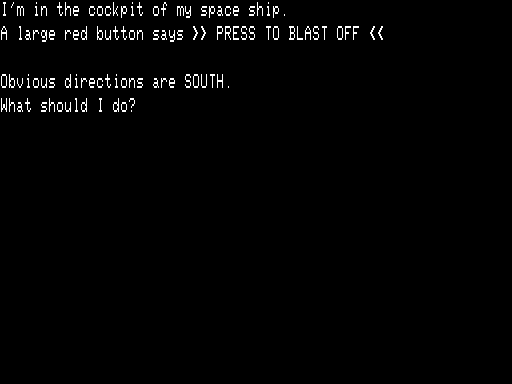
This is a text adventure, so you see the battlecruiser and its dangers through location descriptions rather than illustrated characters, ships, or action scenes. The imagination has to supply the Falcon, the princess, and the enemy patrols.

Story
The story is a direct, lean space-rescue setup: Leia, or Leya in the renamed commercial release, has been captured and held aboard the Empire’s battlecruiser. As the robot hero, you must restore the Falcon and get her out. It is a straightforward goal, but it is a strong fit for interactive fiction because every discovered room and useful item can feel like one more piece of an escape plan.
The game’s relationship to Star Wars is part of its charm. The commercial TRS-80 release changes famous names into near-equivalents: Darth Vader becomes General Doom, Stormtroopers become Roche Soldiers, and the Rebel Alliance becomes the Forces of Freedom. The Commodore PET conversion restores many, though not all, of the more recognizable references.
That name-swapping gives Dog Star Adventure an oddly charming bootleg-space-opera flavor rather than a fully distinct universe. The plot will not surprise you if you know its inspiration, but the familiar rescue stakes make the sparse text easier to inhabit. You already understand why the ship matters and why getting the prisoner out is urgent.
Overall Experience
Dog Star Adventure is most rewarding as a compact encounter with the earliest style of home-computer adventure design. Its appeal lies in the combination of a recognizable sci-fi chase, a concrete repair-and-rescue objective, and the old ritual of exploring one typed direction at a time. The premise gets you in the door; the satisfaction comes from making sense of the ship yourself.
It also carries the usual friction of parser-driven exploration. You need to be comfortable with slow, methodical progress, inventory experimentation, and the possibility that a useful clue is sitting in a location you have not examined closely enough. This is not a game built for someone who wants the story to sweep them along without resistance.
Give it a chance if you like historical text adventures and can enjoy a Star Wars-inspired mission filtered through a tiny, hands-on puzzle game. The payoff is modest but genuine: you take a familiar cinematic escape fantasy and earn it through navigation, observation, and persistence. For everyone else, it is more interesting as an early artifact of fan-driven interactive fiction than as a modern evening’s entertainment.


Reviews
There are no reviews yet.