 Retro Replay Retro Gaming History, Reviews & Emulation


Retro Replay Review
Gameplay
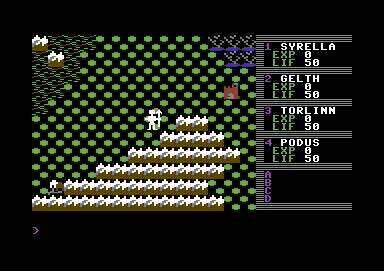
The first hour of Mandragore asks you to meet it on its own terms. You assemble a four-person party, either from the ready-made group or through a tightly limited character-creation system, then head into a kingdom ruled by Yarod-Nor. From there, the goal is clear but far away: explore nine chateaux, solve the problem inside each, gather clues, grow stronger, and eventually take the fight to the tyrant in his castle.
Its command system is the biggest hurdle and, oddly, much of its personality. Movement is reduced to single-letter directions, while combat has you select a numbered party member, enter a brief command such as AT for attack, and choose a lettered target. Once you understand the rhythm, it is efficient in a stern, computer-like way. Early on, though, you will spend more energy remembering the game’s shorthand than making grand tactical decisions.
The party format gives the journey more texture than a lone-hero crawl. Syrela the minstrel, Podus the dwarf thief, Gelth the elf wizard, and Torlin the mi-orc ranger offer a ready-made starting team, while custom characters let you distribute up to 80 points among constitution, strength, knowledge, wisdom, dexterity, and appearance. That limit matters: nobody begins as a master of everything, so your group’s strengths are choices rather than freebies.
Mandragore’s structure rewards persistence. Villages offer trade, monsters create regular danger, and each chateau holds information needed for the broader quest. The payoff is not rapid-fire excitement; it is the satisfaction of slowly turning an initially hostile kingdom into a place you understand. Players who enjoy deciphering old RPG systems will find that progression compelling. Anyone unwilling to wrestle with terse input will probably bounce off before it clicks.
Graphics
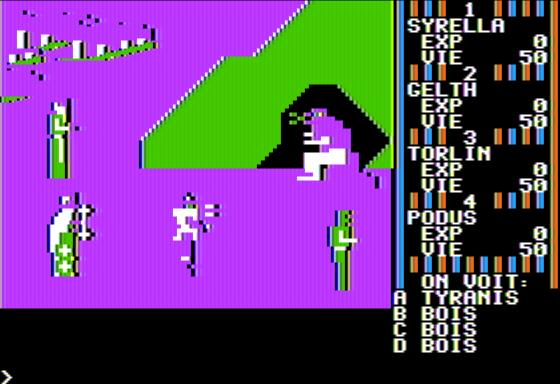
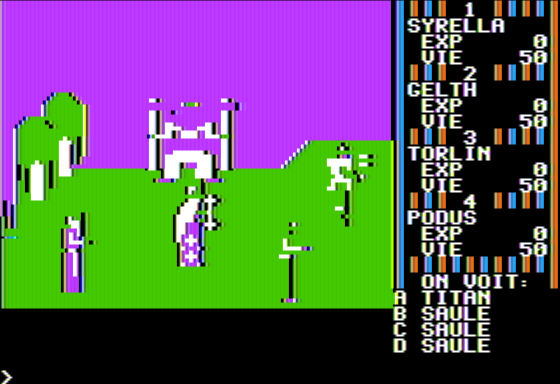
Mandragore uses a diagonal-down fantasy viewpoint for its exploration, with side-view encounters when conflict begins. That split gives the game a practical shape: you navigate the land from above at an angle, then focus on the immediate clash when monsters block the party’s path.
Story
The story starts with a simple but effective wound: King Jorian dies in a freak accident, peace ends, and Lord Yarod-Nor takes the throne through tyranny and evil. You are not wandering without purpose. From the outset, the party has a tangible enemy and a final destination in Yarod-Nor’s castle.
What helps is that the narrative is tied directly to the journey. The nine chateaux are not merely stops on a map; each contains a problem and clues useful later. That gives exploration a sense of investigation, even when the writing is operating in broad fantasy strokes. You move forward because every discovery may matter when the road finally leads to the usurper.
The predefined party adds a little flavor without demanding that you invent everyone yourself. A human minstrel, dwarf thief, elf wizard, and mi-orc ranger make for a classic fantasy spread, and choosing them lets you get straight into the kingdom’s troubles. Creating your own quartet is the better fit if you care more about tailoring statistics than traveling with that established group.
Overall Experience
Mandragore is rough-edged, methodical fantasy role-playing built for gamers who do not mind learning a private little language before the adventure opens up. Its score of 5.8 feels fair: there is a solid quest framework here, but the control scheme is a substantial barrier rather than a quaint footnote.
Give it a chance if you like mapping, gradual character development, and games that make you earn familiarity. The combination of village trading, chateau exploration, monster fights, and clue gathering creates a full journey rather than a straight march to a boss. Just be prepared to make the interface part of the challenge.
For the right retro RPG fan, that friction can become the attraction. Commands become habits, the party begins to feel like a working unit, and each solved location pulls the final castle a little closer. Mandragore will not charm everyone, but patient adventurers can find a thoughtful, unusually structured quest beneath its demanding exterior.



Reviews
There are no reviews yet.