 Retro Replay Retro Gaming History, Reviews & Emulation
Retro Replay Review
Gameplay
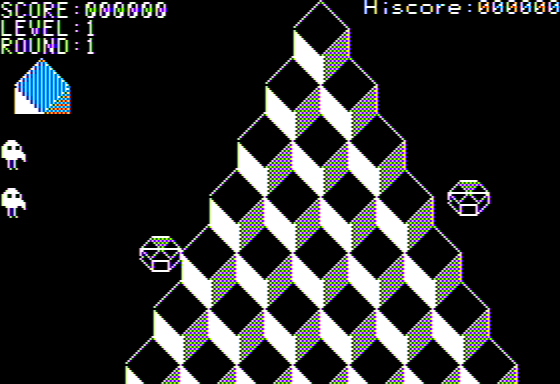
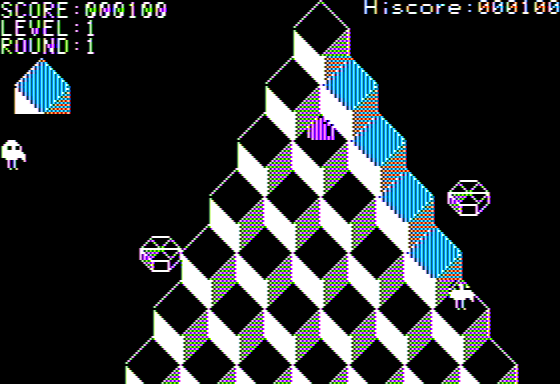
Cubit starts simply enough: land on the cubes in its large pyramid and change them to the required color. That first stretch is satisfying because you can see the whole job in front of you and immediately understand the risk. A careless jump can send you off the structure to your death, so even a basic route feels like a small commitment rather than mindless hopping.
The stronger levels arrive when cubes need two jumps instead of one. Suddenly, you are not merely clearing a path; you are remembering which squares need another visit and finding a way back without trapping yourself. That added layer gives the familiar Q*bert formula real bite, especially once bouncing eggs are disrupting the routes you thought were safe.
The eggs becoming snakes is where Cubit turns from a brisk puzzle into a scramble. You have to keep changing cubes while watching the threats that are chasing you and preserving a legal landing spot. It is not an expansive game, and it does not need to be: its best moments come from narrowly finishing a pyramid after a plan has fallen apart. If you enjoy arcade pressure more than elaborate progression, that tension is the reason to play.
Graphics
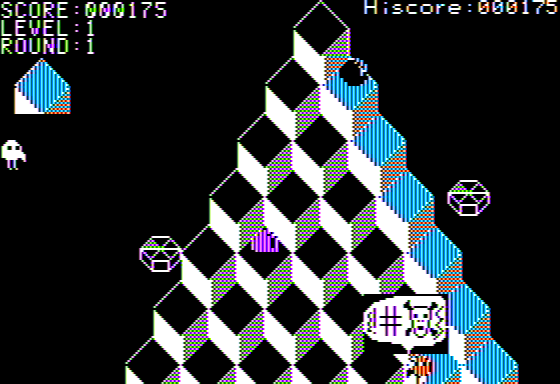
The isometric battle screen is built around a big cube pyramid, making every diagonal jump and dangerous edge easy to read. Changing cube colors gives you a direct view of your progress, while the bouncing eggs and hatched snakes add clear moving hazards to watch as you plan your next landing.
Story
Cubit uses its tiny arcade scenario as motivation rather than a narrative destination. You are on a pyramid of cubes, trying to finish the color pattern before its hazards overwhelm you. That is all the context the game needs to make each round understandable at a glance.
The eggs and the snakes that hatch from them give the action a small escalation that works well. An egg is already something to avoid, but seeing that danger develop into a snake makes the pressure feel less random and more like a worsening situation you have allowed to continue.
There is no room for character drama here, and that suits the format. The only story that matters is the one you create through a run: a clean opening route, a mistake, a desperate recovery, and either a completed pyramid or a fatal jump off its side.
Overall Experience
Cubit is an unapologetically close take on Q*bert, but it understands why that setup works. The rules are immediate, the board turns into a maze under pressure, and the two-jump cubes prevent the action from staying too comfortable. It is the kind of game that can look straightforward until you are mentally mapping several return trips while snakes force you to abandon the obvious route.
Its limitations are also plain. You are returning to one central arcade challenge rather than discovering a broad range of situations, so enjoyment depends heavily on whether that challenge hooks you. If the basic act of clearing a pyramid one diagonal jump at a time feels repetitive after a few rounds, Cubit will not convert you.
For fans of compact early-arcade action, though, there is a worthwhile bit of cruelty in its design. Give it a chance if you like games that reward route memory, quick decisions, and staying calm when a simple color-changing task becomes a survival problem. The payoff is not variety; it is mastering a deceptively nasty board.



Reviews
There are no reviews yet.