 Retro Replay Retro Gaming History, Reviews & Emulation
Game Overview
Gameplay
The first few rooms make a strong case for Mystery House. You type a plain command, receive a terse response, and stare at the drawing for details the text has not fully explained. Finding a useful object feels less like ticking off an inventory checklist and more like noticing something hidden in the architecture. That basic loop remains its best idea.
It is also a very old-fashioned parser adventure, and you need patience for its demands. Short verb-and-noun inputs such as “get knife,” “read note,” and “open door” are the language of the house, but the game asks you to infer a great deal from its pictures. A passage, object, or exit can be easy to overlook, and progress through locked doors, concealed routes, the maze, and hazards can turn into trial and error.
Deaths add pressure, especially as the other visitors are being picked off, but they can make experimentation feel costly. The detective framing does not lead to suspect interviews or a formal case to assemble. You are mainly an explorer with a small set of possessions, searching for the next practical solution. If you enjoy mapping spaces, taking notes, and wrestling with early adventure logic, there is real satisfaction in making headway. If you want a mystery that lets you reason through people and motives, this is likely too blunt.

Graphics
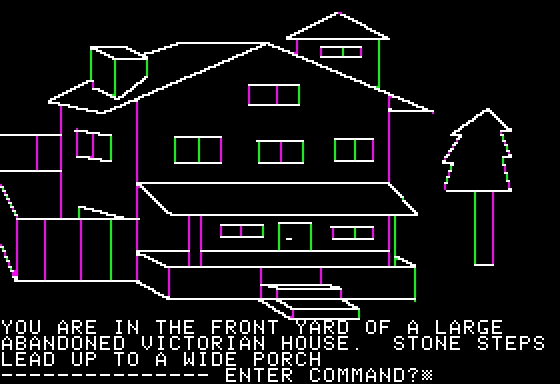
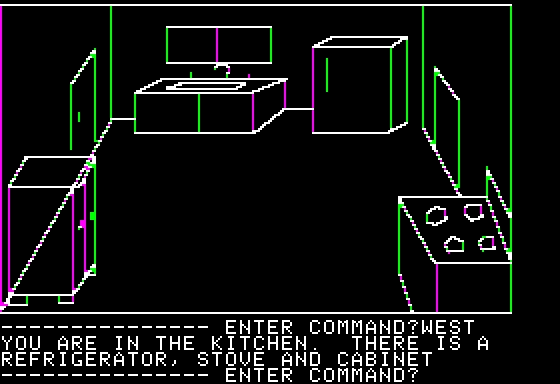
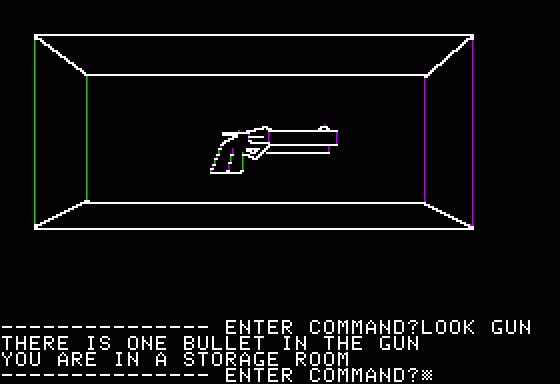
The Apple II screens are stark black fields traced in white, green, and magenta lines. The opening view of the mansion has a surprisingly recognizable porch, roofline, windows, and looming tree, while interiors reduce rooms to sharp perspective boxes with a stove, refrigerator, cabinets, or furniture placed like clues.
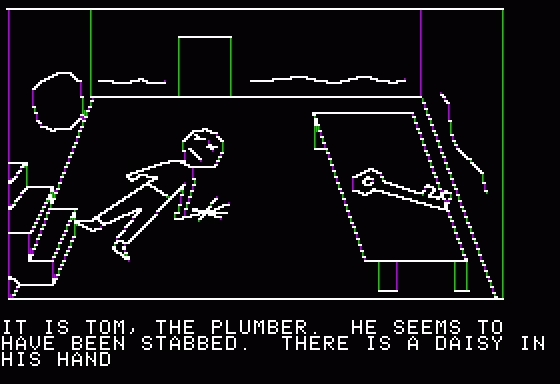
The figures are primitive sticklike shapes, yet the murder scenes land because the body and weapon are impossible to miss once you enter the room. A gun hangs alone against the walls of a storage room, and a huge key sits beside a corpse in another scene. These drawings are rough, but their changing objects are central to the search.
Story
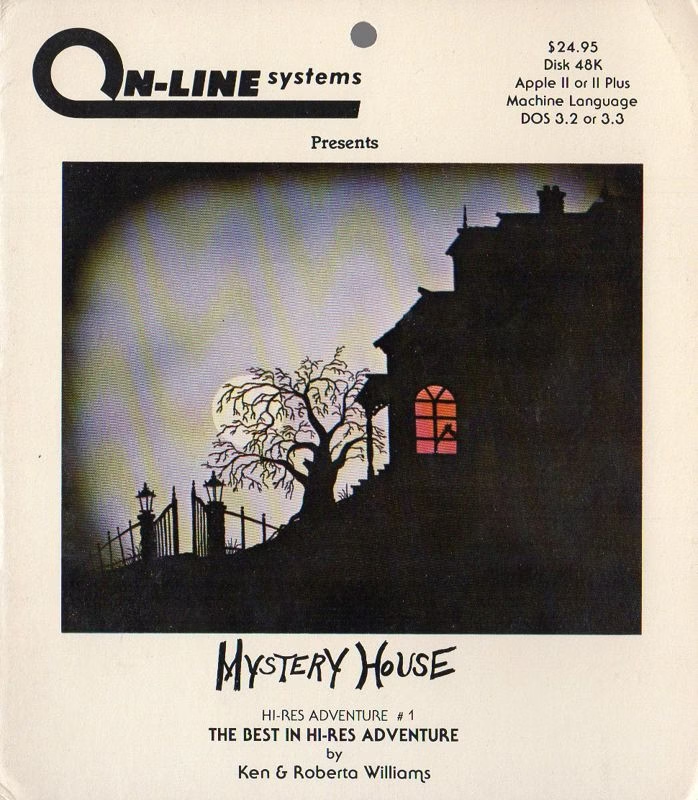
The premise is clean and effective: seven visitors enter an apparently abandoned mansion chasing a rumored jewel cache, the doors lock, and the group begins to die. That immediate trap gives every newly opened room a little dread. You are not simply looting an old house. You are trying to stay alive long enough to learn what it is hiding.
The murders give Mystery House its pulp-horror bite. Walking into a room and finding another victim changes the tone from treasure hunt to survival, while the killer remains an active threat behind the puzzle solving. The final confrontation gives the journey a needed destination beyond collecting jewels.
Still, the story is more framework than fully developed detective drama. The house and its obstacles receive the real attention, not the personalities of the visitors or a web of evidence to debate. That is not a flaw if you want a compact horror-flavored escape puzzle, but do not expect the kind of layered investigation its title might suggest.
Overall Experience
Mystery House earns its reputation as an important early graphic adventure because the pictures are not decorative. They force you to look closely, and picking up or dropping an object changes what you see in the room. That connection between image, space, and parser command is simple now, but it still feels clever.
As a game to play today, it is tougher to recommend without the right mindset. The visuals are severely limited, the writing is functional, and the puzzle hunt can become frustrating when the game expects you to notice a tiny line-drawn possibility or phrase an action correctly. A willingness to make a map and test ideas is practically part of the experience.
Give it a chance if you enjoy interactive-fiction archaeology and want to feel the moment graphics began changing what an adventure game could ask of you. For everyone else, it is more compelling as a brief, tense encounter with game history than as a polished mystery. Its best moments are genuinely eerie, even when the path to them is stubborn.


Reviews
There are no reviews yet.