 Retro Replay Retro Gaming History, Reviews & Emulation
Retro Replay Review
Gameplay
Napoleon at Waterloo opens with a pleasingly direct challenge: take command of Napoleon’s army and beat the opposing force before the battle’s eleven in-game hours run out. There is no long lesson to absorb before you can start making decisions. Select a unit, point to its destination, and live with the consequences. In a genre often built around dense commands and tables, that simplicity is refreshing.
The catch is that orders do not happen on your schedule. Movement takes time, with terrain and unit type affecting how long a formation needs to reach its destination. That makes the game’s modest control scheme more demanding than it first appears. Send troops the wrong way and you cannot instantly undo the lost ground; wait too long and a nearby enemy can pull your unit into automatic combat before you have arranged the position you wanted.
Combat itself is deliberately hands-off. Units that close with hostiles exchange blows until one side has lost all its soldiers, while fatigue and morale also matter. This puts the emphasis squarely on the lead-up: where you move, when you commit, and whether you can avoid wasting strength on a bad engagement. It can frustrate if you want to actively manage every clash, but that restraint gives the map a tense, chess-like rhythm.
Each match lasts 30 real-time minutes, so the campaign is compact rather than sprawling. Victory depends on a casualty-based score, not merely the feeling that you pushed the enemy around. That can make the final minutes nervy, especially when preserving your own army matters as much as inflicting losses. It is an economical design that asks you to learn from your mistakes instead of burying you in options.
Graphics
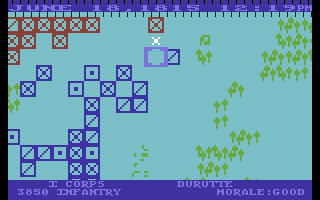
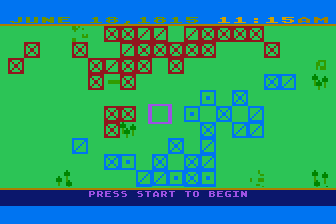
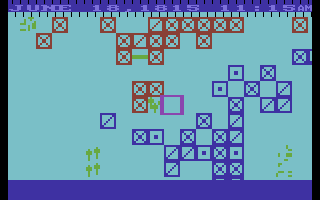
The battlefield is a top-down map drawn in the familiar wargame style, with abstract symbols for troops and terrain rather than animated soldiers. It is a functional look: you spend your time watching formations shift across the map and gauging distances to enemy units, not admiring battlefield detail.
Story
This is a historical battle game, not a character-driven retelling. You command Napoleon Bonaparte’s army at Waterloo in 1815, and the story comes from trying to alter the result through your own battlefield decisions.
That narrow focus suits the design. Rather than interrupting the match with a broader campaign narrative, it keeps you fixed on the pressure of a single famous confrontation: limited time, opposing armies, and the cost of every commitment.
If you want background on the game itself, the Napoleon at Waterloo history and release information is useful context. In play, though, the historical hook works chiefly as a reason to care about the outcome of an austere, focused scenario.
Overall Experience
Napoleon at Waterloo is easy to underestimate because it offers so little surface complexity. Yet its real-time clock and delayed movement create a steady sense of pressure. You are not issuing elaborate orders; you are trying to make a few basic orders early enough, and in the right places, that the battle does not force your hand later.
The trade-off is obvious. Automatic battles and sparse controls deny you the satisfying micromanagement found in more elaborate strategy games. When a unit is caught badly positioned, the game can feel unforgiving because there is no tactical flourish waiting to rescue it. Success comes from anticipation, not improvisation.
Give it a chance if you enjoy concise historical strategy and can appreciate a wargame boiled down to movement, timing, attrition, morale, and score. Its 30-minute battles make it an approachable curiosity for strategy fans, while its rigid abstraction will likely wear out anyone looking for a richer simulation of Waterloo. It is limited, but its limits are purposeful enough to make the best matches genuinely tense.


Reviews
There are no reviews yet.