 Retro Replay Retro Gaming History, Reviews & Emulation

Retro Replay Review
Gameplay
Trix earns its name as a Tetris variant only long enough to get you through the first few drops. Instead of trying to complete broad horizontal lines, you are guiding falling columns filled with different elements and hunting for sets of three. Match them in a horizontal, vertical, or diagonal row and they vanish. That one diagonal option gives the board a more interesting texture than the usual falling-block cleanup routine.
The first hour is about unlearning the instinct to flatten everything. A jagged pile is not automatically a disaster here. Sometimes the ugly-looking column is exactly what you need to finish a diagonal, while a tidy stack leaves you one item short. You can move elements sideways or down, which makes each decision feel committed. There is no broad freedom to spin a bad situation into a good one at the last second; you need to read the column and choose its lane early.
That restriction is both Trix’s strength and its point of friction. The game rewards steady board awareness, especially when you are planning vertical and diagonal matches at once, but it can feel stern when a falling layout refuses to cooperate with the shape you have built. Clearing a match is satisfying because it usually comes from seeing a small pattern in the clutter, not merely reacting faster.
Progression is simple and demanding: place 50 layouts to move on. That makes levels feel like endurance tests rather than brief rounds, and it suits anyone who likes settling into a puzzle board and gradually imposing order. If you want constant new rules or dramatic reversals, Trix may feel spare. If a compact ruleset becoming tougher through repetition sounds inviting, its pressure has real bite.
Graphics
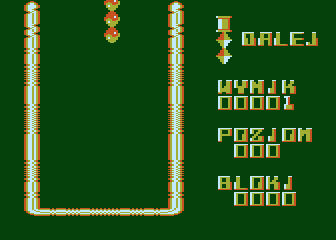
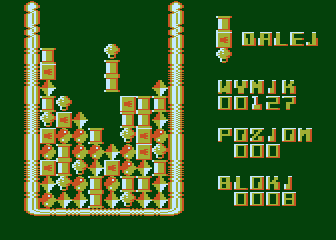
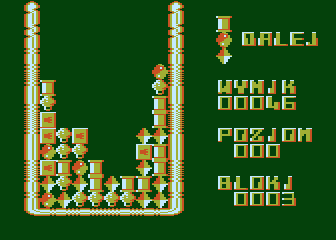
Trix uses a side-view well where the falling columns and accumulated elements remain the focus. The important visual task is following the different items well enough to spot horizontal, vertical, and diagonal groups of three, and the fixed playfield keeps your attention there.

Story
There is no story framing to carry Trix from one stage to the next. Its momentum comes entirely from the board: a useful match appears, space opens up, and you decide whether to cash in a quick clear or preserve a pattern for later.
That absence fits the game’s stripped-down arcade-puzzle character. You are not working toward a narrative payoff; you are working toward the next level by surviving 50 placements with a board that still gives you options.
For this kind of game, that is enough. The small dramas are self-made: the diagonal you nearly missed, the vertical trio that rescues a crowded area, and the column that forces an awkward compromise.
Overall Experience
Trix is a focused puzzle game with one smart twist on falling-block habits. The ability to clear diagonal trios turns the board into something you scan in several directions, and that makes successful play feel more thoughtful than simply stacking for rows.
Its limits are plain: movement is restricted, the goal structure is austere, and 50 placements per level asks for concentration. The frustration is real when you can see trouble coming but lack the flexibility to fully undo it. Still, that rigidity gives the game its character. You are managing consequences, not endlessly correcting mistakes.
Give Trix a chance if you enjoy compact 1990s puzzle games that expect you to master a single idea rather than shower you with variations. It will not replace Tetris for players chasing speed and piece manipulation, but its diagonal matching makes it a worthwhile detour for anyone who enjoys extracting patterns from a cramped, falling board.


Reviews
There are no reviews yet.