 Retro Replay Retro Gaming History, Reviews & Emulation


Retro Replay Review
Gameplay
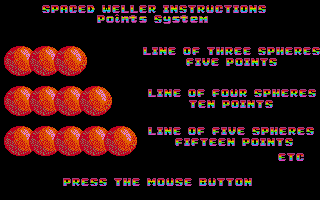
The first few turns of Spaced Weller sound almost too straightforward: lay coloured lines on a 7×6 sphere grid and score rows of at least three. Then you notice that diagonals count as well as horizontal and vertical rows, and the board starts demanding real attention. A promising move can set up multiple directions at once; a careless one can hand the next player an obvious line.
The turn structure gives every placement a little sting. You keep making lines until none remain, then control passes to the other player, so a good turn is not merely about collecting the points in front of you. You want to leave the grid in an awkward shape, with its useful connections exhausted and its easy scoring routes blocked. The ticking round timer keeps that calculation from becoming leisurely board-game analysis.
Special spheres are the reason the basic matching rules do not go stale. Purple spheres act as obstacles, forcing detours through the grid. Blitters can destroy opposing and purple spheres, turning a blocked section back into an opportunity or wrecking a rival’s arrangement. Bonus spheres add extra points when folded into a line, making them valuable targets without changing the central objective. The result is a sharper, more combative puzzle than its simple grid suggests.

Graphics
Spaced Weller is built around a clear board of coloured spheres on a magical grid. The fixed 7×6 layout makes horizontal, vertical, and diagonal possibilities easy to inspect, while the distinct purple, Blitter, and bonus spheres give important board states a visible difference.

Story
There is no grand journey pulling you from round to round here; the drama comes from the board itself. A line that seemed harmless can become the centre of a scoring run, and a purple obstacle can turn into the piece both sides are fighting around.
That makes each round feel like a tiny competitive story: establish a route, interfere with the other side’s options, and grab the profitable bonus sphere before it becomes their scoring tool. The changes happen through placement and removal rather than through characters or set pieces.
It is a fitting frame for a puzzle game this compact. You are not waiting for plot developments; you are waiting to see whether your opponent notices the diagonal you have left open.
Overall Experience
Spaced Weller has the satisfying shape of a game you can learn in minutes and continue second-guessing after a loss. Its scoring rules are approachable, but the diagonal lines, alternating turns, obstacles, destruction, and bonus scoring create enough overlap that the obvious move is not always the strongest one.
Frustration is likely to arrive when a carefully arranged area is broken apart by a Blitter or when a blocked board ends your turn before you can convert a setup. That irritation is part of the competition rather than wasted busywork: the game asks you to account for disruption instead of treating every colourful cluster as safely yours.
Give it a chance if you like direct head-to-head puzzle strategy and prefer a timer to keep decisions moving. The payoff is not in elaborate progression; it is in spotting a scoring path, squeezing extra value from it, and leaving the next player staring at a grid that no longer behaves the way they hoped.


Reviews
There are no reviews yet.