 Retro Replay Retro Gaming History, Reviews & Emulation
Retro Replay Review
Gameplay
Tonic Tile understands the immediate pleasure of a brick breaker. You move the bat, meet the ball cleanly, and watch the upper wall start to disappear. There is no long setup period or complicated learning curve: within the first minute, you know exactly what a good return feels like and exactly how irritating it is when the ball slips below your bat.
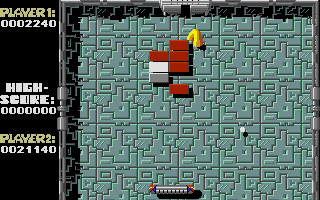
The falling power-ups are what keep the familiar formula from becoming completely mechanical. Lasers let you attack the bricks more directly, the sticky-ball option gives you a chance to aim your next launch, and a wider bat offers the kind of breathing room you will be grateful for when the ball starts coming back at awkward angles. These bonuses make a run feel swingy in the right way. You are always deciding whether to leave the bat safely positioned or drift after a useful icon.
Floating shapes add another complication by deflecting the ball without directly harming you. That sounds minor, but it can turn a reliable trajectory into a scramble and makes the lower half of the board matter. The frustration is classic paddle-game frustration: losing a life can feel abrupt, especially after a long exchange, and the game asks you to accept that recovery is part of the challenge.
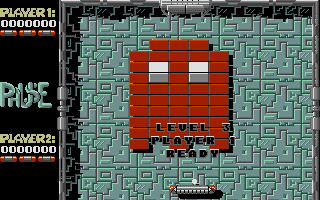
Thirty-three levels give the format a respectable amount of runway, while the option to select any of the first 16 is especially welcome. It lets you revisit a favorite stretch or skip early boards when you only have a few minutes. Two-player play alternates turns after a lost life, so it works best as a friendly contest over who can survive longer rather than a simultaneous team game.
Graphics
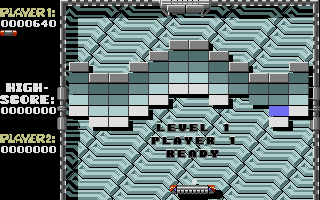
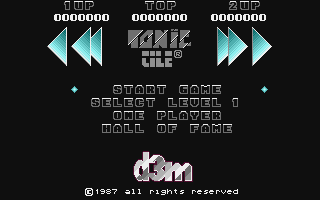
The action is presented as a clean side-view playfield: bat at the bottom, brick formation above, and floating shapes crossing the space between. That layout keeps the ball, falling icons, and obstacles in one glance, which matters far more here than ornate detail. Power-ups have to be spotted while you are tracking a moving ball, and the simple arcade arrangement serves that pressure well.
Story
Tonic Tile is not interested in building a narrative around its brick-breaking. Its entire drama comes from the ball’s path, the shrinking brick layout, and the number of lives you have left.
That lack of story fits the format. You are not waiting for a plot beat to justify the next level; clearing the board is the reward and the invitation to continue.
The closest thing to an arc is personal: an early level teaches your hands the timing, a bad bounce tests your patience, and a hard-won clear makes you queue up the next board. If you need characters or a world to pull you through, this will feel spare. If you like arcade games that let your performance create the tension, it stays honest about what it is.
Overall Experience
Tonic Tile is a modest but worthwhile take on the Arkanoid template. It does not need to reinvent the bat-and-ball routine to be enjoyable; the pleasure comes from handling a fast-moving ball under pressure, grabbing the right bonus, and watching a stubborn layout finally vanish.
Its limitations are also the genre’s limitations. Success depends heavily on consistent positioning, and the punishment for one miss is immediate. The floating deflectors can turn careful play into a frantic response, which will either make the game feel lively or make you wish for a more predictable ball path.
Give it a chance if you want a compact Atari ST arcade game that rewards repetition and quick reflexes, especially with another person nearby to trade turns. The selectable early levels make it easier to enjoy in small bursts, while the full set of 33 boards offers enough challenge for anyone who gets hooked on mastering the bounce.



Reviews
There are no reviews yet.