 Retro Replay Retro Gaming History, Reviews & Emulation
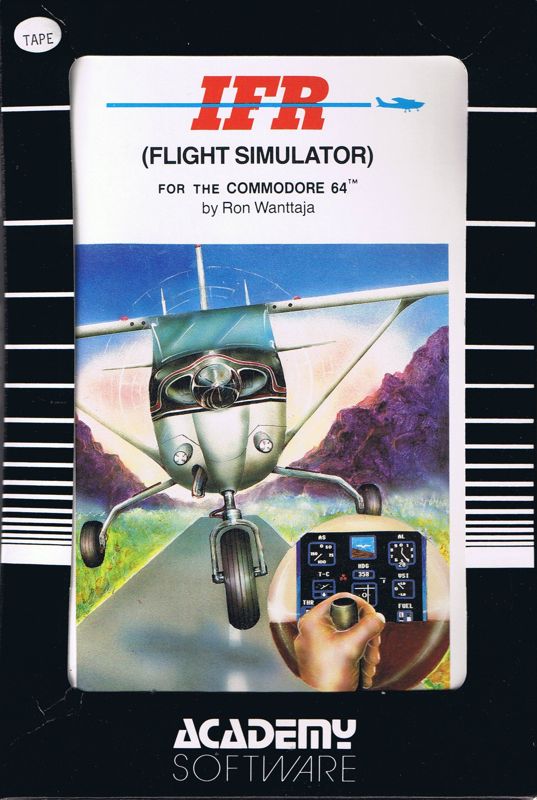
Retro Replay Review
Gameplay
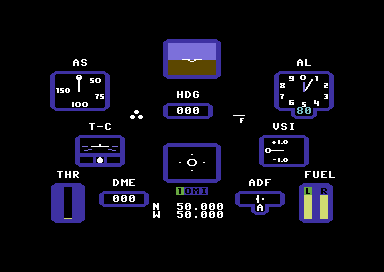
IFR begins with a useful shock: you are looking at instruments, not a landscape. With no external cockpit view, every decision comes from the panel. You watch the artificial horizon to keep the aircraft level, manage airspeed and rate of climb, and use the turn indicator rather than a distant horizon to judge what the aircraft is doing. It can feel forbidding if you want immediate arcade-flight thrills, but its commitment to the premise is admirable.
Once the basics click, the route planning has a sharp little tension to it. Four airfields sit on the map, terrain stands in the way, and the fuel supply lasts about 30 minutes. You cannot casually wander around waiting to get oriented. A good flight means choosing a sensible direction, holding it, checking your instruments, and making corrections before a small error becomes a problem.
The navigation equipment gives the simulation its real hook. LORAN-C, ILS, and ADF support the work of finding the available beacons and airfields, so the game asks you to interpret navigation information rather than simply point at a visible runway. That is satisfying when your readings line up and frustrating when they do not; IFR rewards patience and careful attention far more than reflexes.
Aircraft handling is not merely decorative. Flaps and retractable landing gear matter, while stalls, wind, and turbulence ensure that a flight can become unstable if you treat the panel casually. Adjustable difficulty is especially welcome here. Start lower if the workload feels overwhelming, then raise it when reading the gauges becomes less like decoding and more like flying.
Graphics
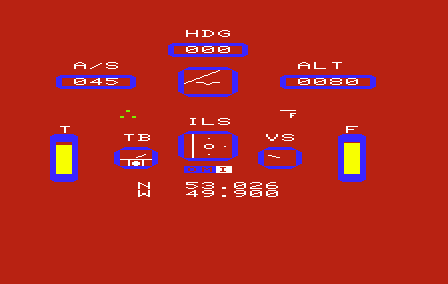
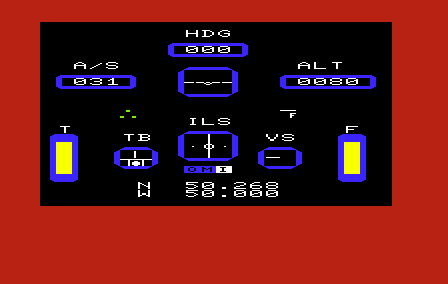
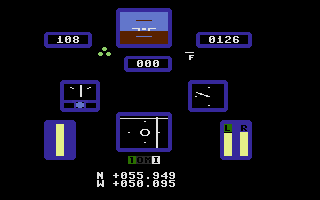
The view is an instrument panel filled with the altimeter, tachometer, artificial horizon, airspeed, turn, and climb indicators. It is necessarily functional rather than scenic, but that fixed first-person view suits a game built around reading gauges under pressure.
Story
IFR has no character drama or authored plot to carry you through its flights. Its story is the one you create in the cockpit: a route to finish, limited fuel, terrain to avoid, and an aircraft that needs competent handling.
That stripped-down structure works because every successful leg has a beginning, middle, and end of its own. You set out with a plan, deal with imperfect conditions, and try to arrive at an airfield without turning a manageable trip into an emergency.
The lack of narrative makes the game a poor fit if you need a campaign or a strong sense of place. For simulation-minded players, though, the purpose is clear enough: learn the instruments, make sound decisions, and get the Cutlass safely where it needs to go.
Overall Experience
IFR is a narrow game in the best and worst sense. It does one thing—instrument flying in a light aircraft—and refuses to dilute that challenge with an external view or easy visual cues. The first hour can be rough because the panel asks you to learn its language before it offers much satisfaction.
Stick with it, and its limitations become part of the appeal. The small map, four destinations, and short fuel window make flights compact and purposeful. You are not settling in for a sprawling aviation sandbox; you are solving concentrated piloting problems where a stable heading and a correctly read instrument genuinely matter.
Give it a chance if you enjoy old-school simulations that expect study, concentration, and a little self-discipline. Skip it if your ideal flight game is about sightseeing, dogfights, or a quick pick-up-and-play rush. For the right kind of patient gamer, IFR turns a bare panel of gauges into a surprisingly tense cockpit.


Reviews
There are no reviews yet.