 Retro Replay Retro Replay gaming reviews, news, emulation, geek stuff and more!

Retro Replay Review
Gameplay
The first hour is about learning to stop treating the island like open ground. Operation Iceberg puts the whole Okinawa battlefield in front of you, but the important work happens before the results are calculated: checking the terrain, noticing minefields, judging where your units can press, and deciding which risks are worth taking. It is a strategy game that asks you to think ahead rather than react quickly.
Turns have a satisfyingly tense rhythm. You give orders to the Allied forces, the Japanese side responds under computer control, and then the game resolves the consequences. That structure can be frustrating when a plan does not work out, since you cannot simply rush in and correct it moment by moment. Yet that is also where the game finds its bite. A bad order is not just a missed button press; it is a decision you have to absorb and revise around.
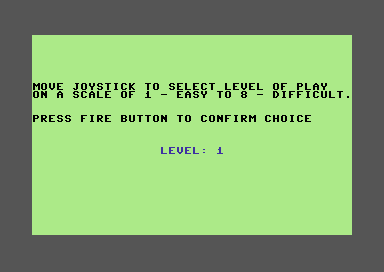
The eight difficulty levels are more than a token option because this kind of turn-based war game needs room for you to learn the map and its demands. Start low if the format is new to you, then raise the pressure once reading terrain and hazards begins to click. The objective—defeat the Japanese forces and control the island—is direct, but getting there depends on disciplined planning rather than brute force.
Graphics
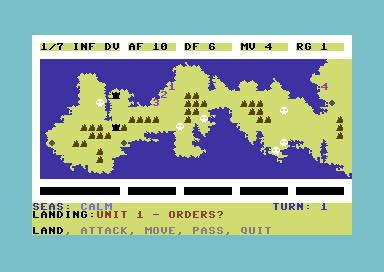
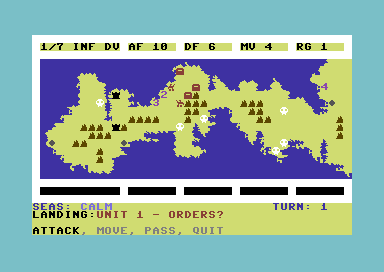
The game is viewed from above on a full-island map, using icons to mark terrain, minefields, enemy forces, and Allied units. It is a functional battlefield display rather than a character-focused war drama, and the top-down view makes the important information easy to keep in front of you while planning a turn.
Story
Operation Iceberg draws its purpose from the Battle of Okinawa, framing the island invasion as part of the Allied push toward Japan’s defeat in World War II. You command the Allied side, while the computer takes the Japanese forces, so the historical conflict is immediately translated into a clear strategic role.
Don’t come looking for a personal campaign narrative. The story is carried by the military objective: seize Okinawa, overcome resistance, and take control of the island and its air bases. That narrow focus works for a wargame because every advance can be read against the same larger operation.
The historical subject gives the map more weight than a generic contest for territory. Terrain and minefields are not decorative obstacles; they sit between your forces and an island you are trying to secure. The game stays concentrated on that operational struggle, which will suit anyone who prefers history expressed through decisions rather than dialogue.
Overall Experience
Operation Iceberg is a compact, demanding turn-based wargame built around the pleasure of making a plan, watching it meet resistance, and trying again with better judgment. Its strongest quality is its clarity of purpose: study Okinawa, order your forces forward, and earn control of the island one calculated turn at a time.
The cost of that focus is a slow, unforgiving tempo. You spend more time considering the map than receiving immediate excitement, and the computer’s results can turn a confident move into a hard lesson. That frustration is worth it if you enjoy games where careful decisions matter; it will not convert anyone who wants a fast-moving action game.
Give it a chance if historical strategy and deliberate command are already your comfort zone. The payoff is not spectacle but the quiet satisfaction of understanding a difficult battlefield well enough to make a better next turn. For patient Commodore 64 strategists, it remains a worthwhile invasion to attempt.


Reviews
There are no reviews yet.