 Retro Replay Retro Gaming History, Reviews & Emulation

Retro Replay Review
Gameplay
Star Trek begins with the sort of direct mission that leaves no room for dithering: locate the Klingons scattered through the quadrant and eliminate them all. You sit in the Enterprise, checking the nearby area for stars and hostile ships, then deciding whether this is a firing problem, a defense problem, or a navigation problem. That narrow focus is its strength. Every command feeds the same hunt.
Combat asks you to enter an angle for each proton torpedo, and the shot travels in a straight line. That makes a kill feel more satisfying than simply pointing a cursor at an enemy; you have to judge the line correctly. It also means misses are on you. When Klingon torpedoes are incoming, raising shields becomes the other half of the exchange, creating a simple but recognizable back-and-forth between committing to an attack and surviving long enough to line one up.
Travel is deliberately abstract. To leave a screen, you enter an angle and a distance, then rely on the computer map and long-range scanner to narrow down where something might be waiting. Stars are harmless, so not every destination advances the mission. That can be frustrating if you want immediate action, but it gives the game a methodical search-and-destroy pulse. The more you use the map and scanner with purpose, the less the quadrant feels like a blind guess.
The limits are plain: this is a command-driven game built around a small set of choices, not a broad space adventure. Still, the restrictions create useful pressure. You cannot move from the default local view, so each shift between observing, firing, shielding, and navigating feels like a deliberate decision rather than a constant stream of motion.
Graphics
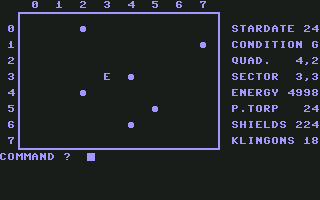
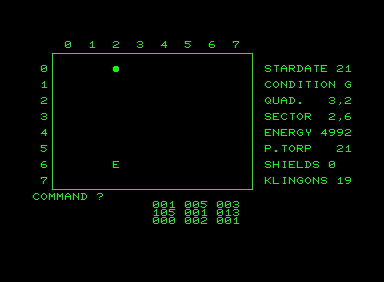
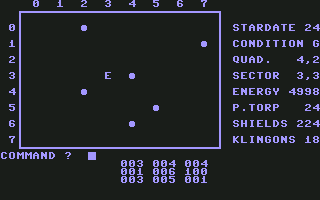
The local view is sparse, showing the Enterprise’s immediate surroundings as stars or Klingons. That simplicity suits the angle-based combat: you are looking for positions and lines of fire, not elaborate space scenery. Separate screens for movement and the computer map reinforce the game’s screen-by-screen, tactical structure.
Story
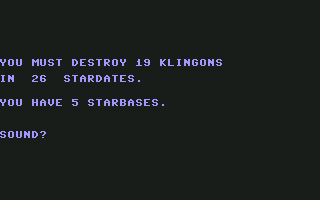
There is barely any narrative baggage between you and the mission. As an unofficial take on Star Trek, it uses the Enterprise and Klingons to frame a straightforward military assignment: clear the quadrant of enemy ships.
That thin premise is enough because the real drama comes from the situation you create. A Klingon on the current screen turns a quiet search into a firing-angle puzzle, while an incoming torpedo gives the shields immediate importance. Do not come here for character moments or a plotted voyage; come for the clean fantasy of commanding a starship under pressure.
The lack of detours also gives the game a sharp ending condition. You know exactly what success means, and every scanned sector or defeated Klingon points back to it. For a game this compact, that clarity works better than a larger story would.
Overall Experience
Star Trek is most enjoyable when you accept its pace. It is not interested in making you feel like a hotshot pilot; it wants you to act like a captain working from limited information, choosing a course, checking the situation, and taking a calculated shot. The first hour’s pull comes from gradually turning those plain inputs into a workable routine.
Its rougher moments come from the same minimalism that makes it distinctive. Searching can feel dry, and a wrong angle or unproductive move carries more weight because there are so few actions to hide behind. Yet that economy also makes successful decisions feel clean and personal. You can trace a good result directly back to the scan you trusted, the route you chose, or the shot you judged correctly.
Give it a chance if you enjoy early computer-game logic, text-entry commands, and tactical problems with little ornamentation. Skip it if you need a rich story or constant visual action. For the right mood, this is a compact, demanding Klingon hunt whose modest tools produce genuine tension.


Reviews
There are no reviews yet.