 Retro Replay Retro Gaming History, Reviews & Emulation
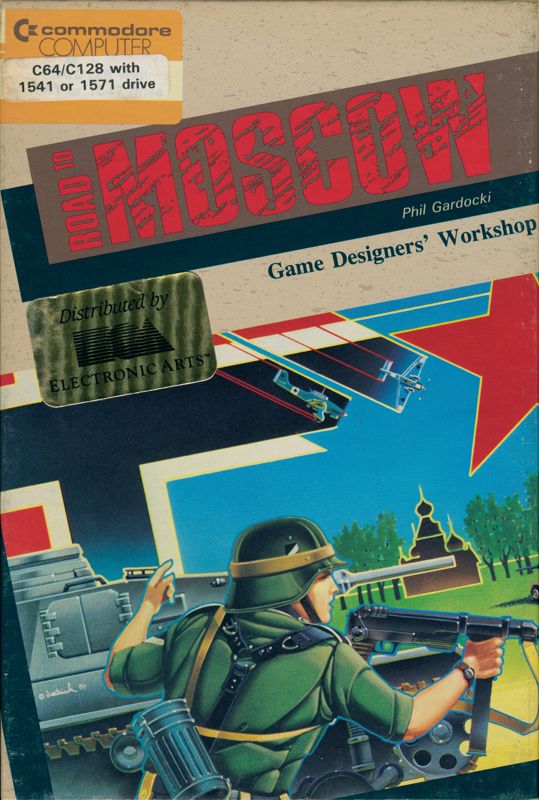
Retro Replay Review
Gameplay
The first hour of Road to Moscow is less about charging toward a famous objective than learning not to wreck your own offensive. You move German units across a broad Eastern Front, commit your choices, and then let the computer resolve movement and any fighting that results. That delay between giving orders and seeing their consequences gives the game its tension. A route that looked sensible can become a costly mistake once weather, terrain, enemy resistance, and distance from supply are factored in.
Supply is the pressure point. Push too far ahead and your units become useless, which makes the map feel less like a field to paint with your color and more like a problem you have to solve carefully. You are trying to gain ground before winter arrives and Soviet strength becomes overwhelming, but reckless momentum is exactly what the game is waiting to punish. With only two movement phases per month, each decision carries weight; there is little room to casually tidy up a bad position afterward.
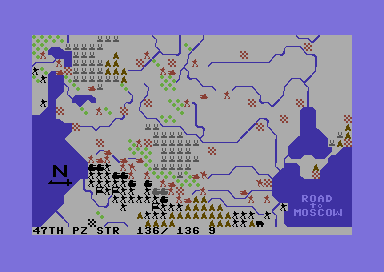
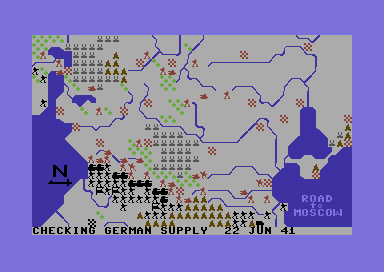
The unusual orientation deserves a warning: east sits at the top of the screen. It is a small rule, yet it can make early turns feel upside down if you come in expecting a conventional north-up map. Give it time. Once that mental adjustment clicks, the wide front—from Finland down to Crimea—becomes easier to read as a set of connected strategic commitments rather than a collection of isolated fights.
Ten skill levels give the game some welcome range, while the campaign options make it easier to meet it on your own terms. You can begin the full 1941 campaign or tackle individual year-long scenarios covering the invasion, the second offensive, the Russian offensive, and the battle for Poland. Start with a single year if you want to learn how supply and seasonal pressure interact; the full campaign is where the long-term strain of the war has the most room to build.
Graphics
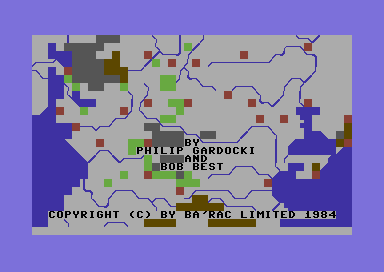
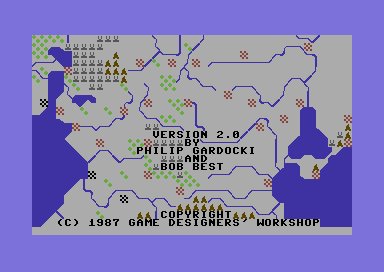
The game uses a top-down view of a small portion of the larger map, with armies represented by icons. That simple view suits a game concerned with where units can go and how far they can remain supplied, though the reversed east-up orientation makes the map take some getting used to.
Story
This is history as a campaign problem, not a character-driven war story. You command the German Army against the computer-controlled Russians across the Eastern Front in World War II, beginning with the 1941 invasion or entering at later stages of the conflict. The drama comes from what your map tells you: a front that is too wide, a timetable closing in, and an opponent becoming harder to contain.
The victory conditions give the full campaign a stark shape. To force a Soviet surrender, you need Moscow, Stalingrad, Leningrad, and everything west of them. That is an enormous demand, and it makes the game’s historical arc feel appropriately unforgiving without needing cutscenes or scripted turns to explain the stakes.
The individual campaigns also create a useful sense of progression through the war. 1941 asks you to make the invasion count; later scenarios put you into offensives and the 1944 battle for Poland, when the strategic situation has changed. For background on the game itself, the Road to Moscow history and release information is a worthwhile companion.
Overall Experience
Road to Moscow is compelling because it refuses to flatter you. It does not let a large army solve everything, and it turns the basics of logistics and timing into the real enemy. The payoff comes when you stop treating a turn as an opportunity to move everything forward and start treating it as a calculation about what your supply lines, terrain, and calendar can actually support.
Frustration is part of the deal. Combat is calculated after you finalize movement rather than played out as a separate tactical contest, so you must accept outcomes that follow from plans already committed. Gamers who need immediate control over every battle may find that detached resolution limiting. Gamers who enjoy accepting uncertainty and living with the consequences of operational decisions will find it suitably tense.
For a Commodore 64 war game, it has an impressively broad scope and a clear strategic focus. The interface asks for patience, the map orientation asks for adjustment, and the subject matter is inherently grim. But if you want a compact historical strategy game where winter, supply, and overreach can undo an ambitious offensive, Road to Moscow remains worth the effort.


Reviews
There are no reviews yet.