 Retro Replay Retro Gaming History, Reviews & Emulation
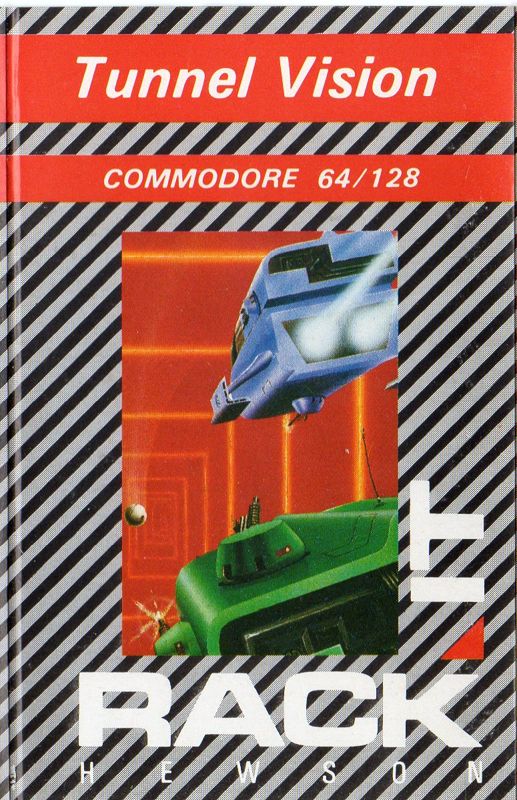
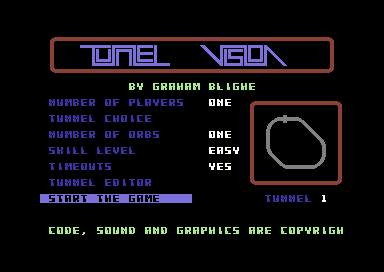
Retro Replay Review
Gameplay
Tunnel Vision gets to its point quickly: you drive through futuristic tunnels, hunt down an orb, and race it back to the finish while another pilot tries to do the same. That capture-and-return objective gives the racing a sharper purpose than merely reaching a line first. You are not just chasing speed; you are deciding when to pursue the prize, when to pressure the other craft, and when to survive the traffic around you.
The controls are pleasingly direct on paper. The joystick steers left and right and changes your speed, while the fire button handles the laser. Fuel and shields put limits on reckless driving, and the additional small craft firing at you ensure the tunnel is not simply a course to memorize. This is an arcade game with several pressures stacked into one tight run: keep moving, keep your defenses intact, and do not lose sight of the orb.
Two-player mode is where the idea has its best chance to catch fire. Seeing one player on the top half of the screen and the other below turns each orb chase into an immediate contest, especially once lasers enter the equation. The track editor is the other big reason to return. A game this centered on routes and races benefits enormously from letting you build fresh tunnels rather than exhausting a fixed set of challenges.
Graphics
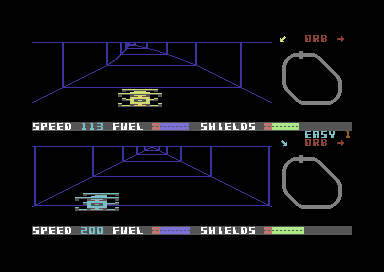
The action is viewed from behind your craft as it moves through 3D tunnels, a perspective that makes the enclosed courses the main visual attraction. In two-player games, the screen splits horizontally, with player one above and player two below.
A tunnel map remains on screen alongside player positions, speed, fuel, and shield information. For a game asking you to race, fight, and carry an objective, having those basics visible is useful rather than ornamental.
Story
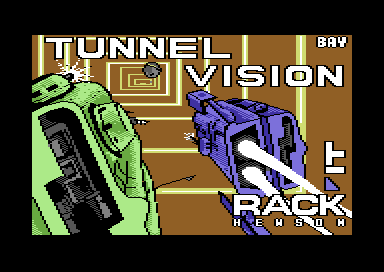
Tunnel Vision uses a distant-future setting as a clean frame for its competition. You pilot a craft through tunnels, armed with lasers and surrounded by other hostile craft, in pursuit of a single orb that must be returned to the finish line.
That is a thin setup, but it fits the game’s arcade priorities. The orb is not an abstract score item: it is the thing that changes a race into a contest over possession, escape, and interception.
Do not come here expecting the fiction to carry the experience. The future setting earns its keep by giving the tunnel races, weapon fire, and rival pilots a coherent sci-fi wrapper, then leaves the real drama to what happens between the two crafts.
Overall Experience
Tunnel Vision sounds most compelling when you have a second person nearby. Its split-screen rivalry, laser fire, and shared objective invite the kind of quick rematch where a narrow loss naturally becomes “one more go.” The race is not merely about raw driving, and that extra layer helps it stand apart from a straight head-to-head time trial.
Solo play still has a clear structure thanks to the orb, hostile craft, and resource displays, but the central idea is built to make another human pilot matter. If you enjoy old-school games that place the whole contest in a few understandable rules, this is an easy format to appreciate: get the orb, get back, and stop the other side from doing the same.
The track editor meaningfully sweetens the package. It gives you a reason to experiment with routes and then test whether a new tunnel produces a tense race or a messy laser-filled grudge match. Tunnel Vision is a focused 1987 Commodore 64 arcade racer-shooter, not a sprawling future epic, but its competitive core and editable tracks make that focus count.


Reviews
There are no reviews yet.