Retro Replay Retro Gaming History, Reviews & Emulation
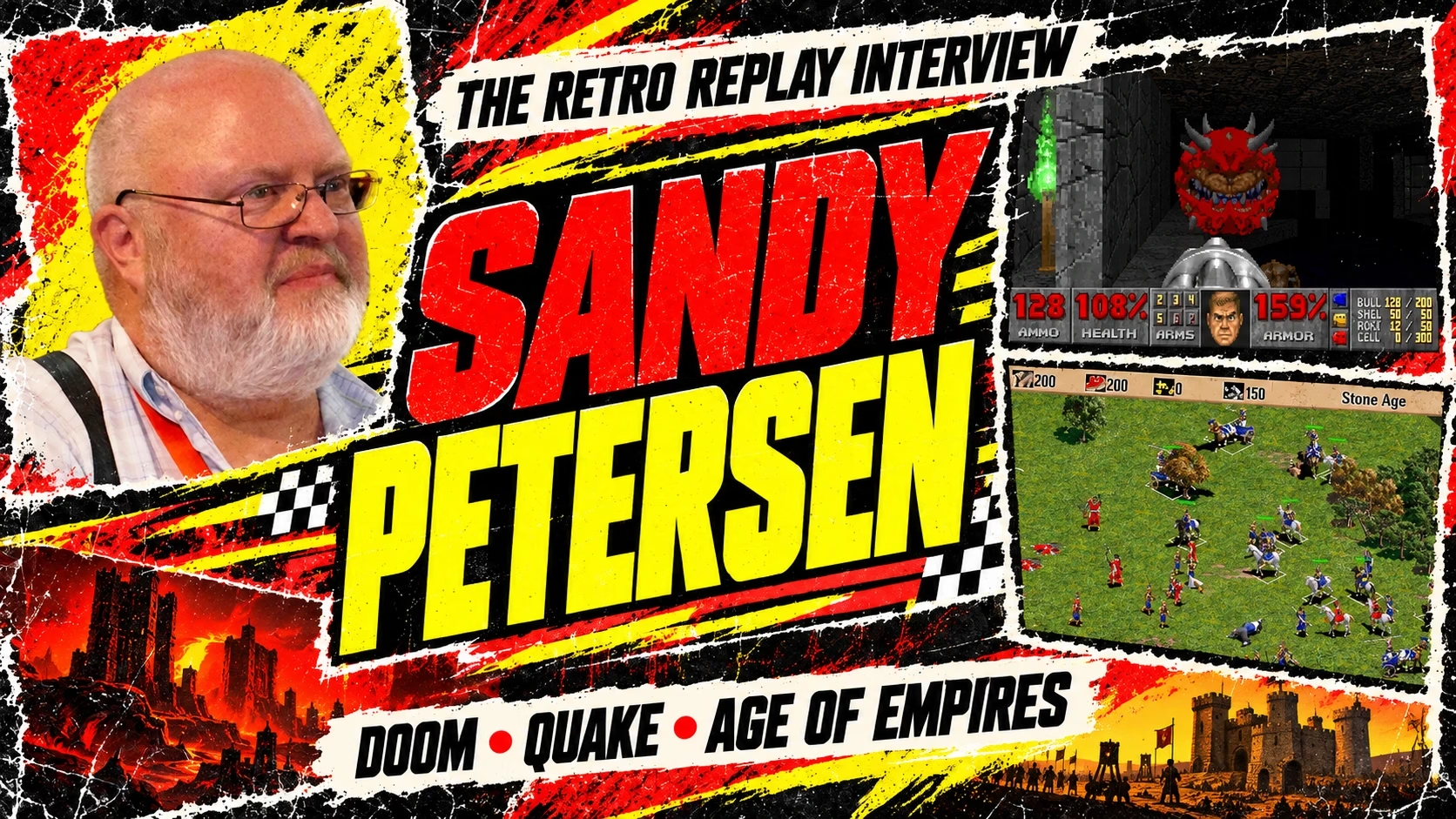
A room full of explosive barrels is a wonderful place to discover that your shotgun has become a liability. Sandy Petersen picks Barrels o’ Fun from Doom II as a map he is particularly proud of, and it is an excellent introduction to his work: a memorable situation, a nasty surprise, and a player suddenly having to reconsider the plan. Ask him about another famous level, Doom’s E2M2, and he starts pulling his own design apart. He wishes he had expanded the creepy warehouse at the beginning instead of spending so much of the map in the installation beyond it.
Sandy has earned a place among gaming’s great designers several times over. Call of Cthulhu alone would give him a remarkable legacy in tabletop role-playing. Then came the computer games: MicroProse, Doom, Quake, and the Age of Empires series. His career runs from players imagining the horror around a table to players meeting it on a monitor, then out onto battlefields where gathering resources and keeping an army alive become the evening’s entire concern. Few designers have worked across that much territory with so many enduring games to show for it.
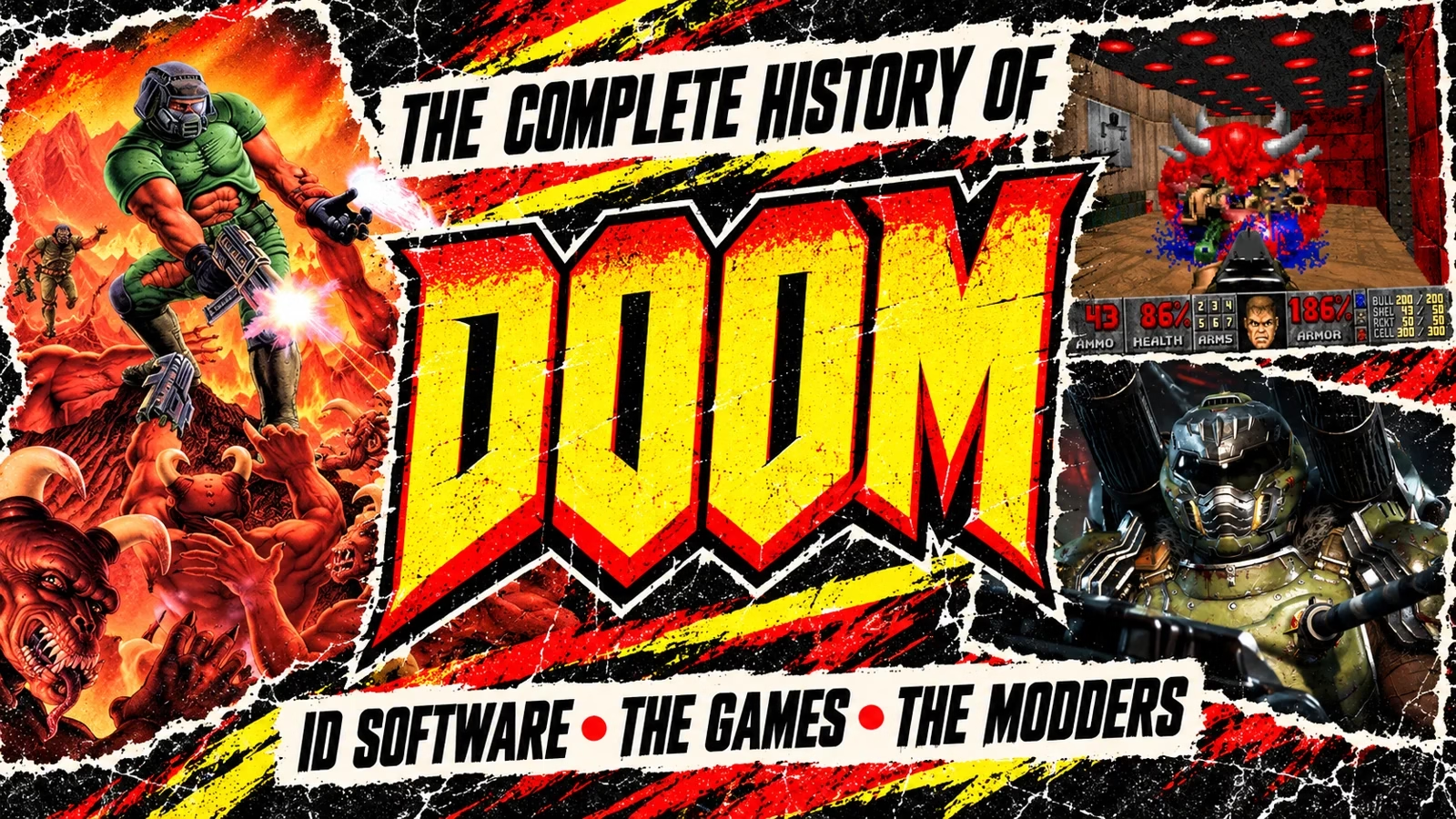
At id Software, he brought years of dungeon adventures and horror movies to the business of building places people would explore at gunpoint. The working routine he describes is wonderfully direct. He would keep two or three Doom levels going at once, leave one alone when he felt burned out, and return with fresh ideas. Artists supplied new textures. John Carmack introduced another feature. If Sandy needed a new trigger or ability, John Romero could have it working that same day. Beyond the familiar names and release dates, there is the pleasure of hearing how these games actually got made. For more on the team and the game taking shape around those levels, our history of Doom follows id’s early years, the shareware release, and the player-made maps that gave Doom a life far beyond its original episodes.
Quake made that job harder. A player who could jump could reach places a Doom designer had never needed to consider, and building those genuinely three-dimensional environments took more time and more people. Sandy also remembers a difficult workplace, and he speaks candidly about it here. His move to Ensemble Studios brought a striking change of atmosphere. The history buff and tabletop player found room to work on strategy games with a team he remembers as friends, playing board games together and showing off what they had made. Of all his video-game designs, Age of Empires III: The WarChiefs is the one he says makes him proudest.
We are honored to have Sandy join us at Retro Replay. There are few opportunities quite like asking someone about games that helped shape whole stretches of your hobby and receiving answers this direct. He answered every one of our 30 questions, discussing the Doom maps he would revisit, the community levels that forced him to improve, the different ways tabletop and video games create fear, and why Hyperspeed is the older project he would most like another chance to make.
His clearest statement of what matters to him is also one of the best lines in the interview: “The player shouldn’t have to earn the right to have fun.” With that, we will hand things over to Sandy.
Interview by David Becker for Retro Replay. Sandy’s recollections and opinions are presented in his own words.

Explore the interview (click to expand)
From GenCon to id Software
Retro Replay: Before joining id Software, how did you first make the transition from tabletop game design into computer and video games?
Sandy Petersen: at GenCon 1988, I walked my resume around the convention hall (with Chaosium’s knowledge). Lawrence Schick from MicroProse had actually come to the convention in part specifically to recruit me. So, obviously, he succeeded.
Retro Replay: What initially attracted you to id Software, and what do you remember about your first days working with the Doom team?
Sandy Petersen: I had already played Wolfenstein 3-D and a friend Josh Billings put me in contact with id, who were looking for a designer. I remember it being chaotic and disorganized but full of ambition, talent, and energy.
Retro Replay: Doom was already taking shape when you joined. How quickly were you able to understand what John Carmack, John Romero, and the rest of the team were trying to accomplish?
Sandy Petersen: pretty quickly actually. I’d played Wolfenstein, and the first game I ever pitched to MicroProse was actually a zombie shooter (before we even know what an FPS was).
Building Doom, one map at a time
Retro Replay: What was the level design process for Doom actually like in those days?
Sandy Petersen: well, for me it was simply sitting down laying out a level then fleshing it out over a period of 6 weeks or so. Usually I’d be working on 2-3 levels at a time. When I felt “burned out” on one level, I’d switch to another. Periodically the artists would make new textures or John Carmack would ask us to use some new functionality. When I needed a cool trigger or ability I’d ask John Romero to install it. Usually he did it the same day.
Retro Replay: Did designers have much freedom to experiment, or were there fairly strict rules about what a Doom level should feel like?
Sandy Petersen: we all played each others levels but I can’t remember anyone ever coming down and saying, “Doom levels are thus-and-so.” We were all supposed to just “get it”. And we did. I mean it was just me and John Romero, plus some leftovers from Tom Hall that I had to rework.
Retro Replay: You designed a substantial number of Doom and Doom II levels. Is there one map from those games that you are particularly proud of?
Sandy Petersen: I am particularly proud of Barrels o’ Fun (Doom 2 M23)
Retro Replay: Is there a Doom level you designed that you would approach very differently if you were making it today?
Sandy Petersen: when I reworked E2M2 from Tom Hall’s stuff, I realized that the very best part was the warehouse at the start – claustrophic, creepy, and full of surprises. The rest of the level just a big boring installation, like so many E1 episodes. I should have split off the installation part (maybe added it to another level that needed more oomph), and expanded more on the warehouse.
Retro Replay: Doom has a very distinctive mixture of science fiction, demonic horror, speed, and action. How much did your background with horror and Call of Cthulhu influence the levels you created?
Sandy Petersen: I spent years building dungeon crawls adventures and watching horror movies. So Doom was a natural fit.

Inside id Software
Retro Replay: What was the working environment at id Software really like during the height of Doom’s development?
Sandy Petersen: Have you seen a nature documentary with a bunch of hyenas eating a dead zebra? They bark and snarl at each other constantly. The zebra gets eaten fast, so it’s an efficient process, but not very nice to watch.
Retro Replay: Were the personalities at id as intense and competitive internally as they have sometimes been portrayed in books and documentaries?
Sandy Petersen: intense, yes. Competitive, no. The “competitive” element didn’t make its appearance until Quake when we added a new designer who viewed his co-workers as rivals rather than allies. That ruined id Software, and is why it fell apart after Quake.
Retro Replay: Doom became a cultural phenomenon very quickly. Do you remember the moment when you realized it had become much bigger than just another successful PC game?
Sandy Petersen: when the early version was crashing college networks in December 1993 all over America. We did expect it to be big. Not as big as it was of course.
The players making their own Doom
Retro Replay: What was it like watching players create their own Doom levels and modifications once the tools and file formats became widely understood?
Sandy Petersen: it was terrific. We never tried to gatekeep.
Retro Replay: Did the explosion of user-created Doom content influence the way you thought about game design afterward?
Sandy Petersen: it forced me to adhere to a higher level of quality. Had to beat the freebies.
Quake and the problem of jumping
Retro Replay: Moving from Doom to Quake meant moving into a genuinely three-dimensional world. How dramatically did that change the way you had to think about level design?
Sandy Petersen: it was significantly harder and slower to create levels. Which is why we needed four level designers instead of two.
Retro Replay: What were the hardest lessons the team had to learn when designing environments for the Quake engine?
Sandy Petersen: frankly, it was the ability to jump and the many new accesses this gave players.
Retro Replay: Quake’s development has often been described as difficult and uncertain compared with Doom. How do you remember that period?
Sandy Petersen: we were all in one big room so could never escape anyone else for a break. This was John Carmack’s idea I think he’d read about it somewhere. Maybe good in theory, but not practice. Also as I said we added the new guy who saw us as rivals and backstabbed constantly. When Quake ended, we lost Mike Abrash, American McGee, John Romero, Shawn Green, myself, and Dave Taylor. The company was gutted.
Retro Replay: Quake has a much darker and stranger atmosphere than many shooters that followed it. How much of that came from deliberate horror influences?
Sandy Petersen: all of it. I worked closely with Adrian Carmack with monster and plot ideas. It’s all Lovecraft stuff.
Retro Replay: Is there anything from Doom or Quake development history that you think has been repeated incorrectly so many times that people now accept it as fact?
Sandy Petersen: yes. But if I repeat these again I assume John Romero will misremember it and claim I’m wrong so f*** that.
A different kind of studio at Ensemble
Retro Replay: After id, you worked on Age of Empires. That seems like an enormous change from designing first-person shooters. How did that opportunity come about?
Sandy Petersen: after leaving id Software, I found out that there was another company in Dallas doing games (Ensemble Studios). My old co-worker from MicroProse helped me get my toe in the door. RTS games looked like wargames, or miniature games, and I knew all about those. I was a history buff. So I switched smoothly from horror to war and all was well. There was always a hope that I would be able to create a FPS for Ensemble Studios, and I was certainly willing to, but we never got around to it.
Retro Replay: What did your experience designing Doom and Quake contribute to your work on a strategy game like Age of Empires?
Sandy Petersen: it taught me how to work with artists and programmers and producers in a way that served me well in the far friendlier environment of Ensemble.
Retro Replay: What do you remember about the early development culture at Ensemble Studios?
Sandy Petersen: if id Software was a bunch of hyenas eating a carcass, Ensemble Studios was a bunch of roommates who all got along. We were all friends. We socialized together outside work. We respected each other, and loved showing off our stuff.
Retro Replay: Age of Empires became another hugely influential franchise. Did the team expect it to become as successful as it did?
Sandy Petersen: frankly, yes. We knew that combining real history with a Warcraft-like game would be an instant hit. And we had a team that had proven itself again and again.

The player should not have to earn the fun
Retro Replay: Between Doom, Quake, Age of Empires, and your tabletop work, you have been involved with several games that influenced entire genres. Do you see common design principles connecting all of them?
Sandy Petersen: First, I am always making a game that I would like to play, not a game to appeal to some mythical “market”. I figure if I like it, someone else will too. Second, I do not consider sequels or franchises when designing. This game must stand on its own two legs. Third, the game has to be fun clear from the start. The player shouldn’t have to earn the right to have fun.
Retro Replay: You are also one of the most important figures in tabletop horror gaming through Call of Cthulhu. Do you approach fear differently in a tabletop game than in a video game?
Sandy Petersen: yes, of course. In a video game I have sounds and lighting effects and creepy images. I don’t have any of that in a tabletop game. BUT in a tabletop game what I DO have is emotions and players interacting and ghost stories.
Retro Replay: Are there lessons from tabletop role-playing that you think modern video game designers still tend to overlook?
Sandy Petersen: I literally got my job at MicroProse because I was a skilled tabletop creator. Then one of the early tests I had at Ensemble was to play board games with the team. I think if you only play video games you are blinkering yourself from a huge range of other game ideas and types. It’s why super hero comics used to suck so bad – superhero writers once only read other superhero comics, so they were in a rut. Now there is some pushback.
The WarChiefs, Hyperspeed, and what comes next
Retro Replay: Of all the video games you have worked on, is there one project that you think deserves more recognition than it receives?
Sandy Petersen: Age of Empires 3 The Warchiefs is, of all my video designs, the one I’m very most proud of.

Retro Replay: If you could return to one project from your video game career and work on it again with today’s technology, which one would you choose?
Sandy Petersen: Hyperspeed, 1991

Retro Replay: What are you working on these days with Petersen Games or elsewhere that you are most excited about?
Sandy Petersen: I am kind of cruising now. I have several completely finished games just waiting for the financing to publish them. I have a co-op Lovecraft game which is fundamentally different each time you play (down to the victory conditions). I have a multiplayer strategy game where you design your own faction. And I have a science fiction roleplaying game in the works.
Retro Replay: Are there any upcoming games, tabletop projects, books, videos, or other work you would particularly like Retro Replay readers to know about?
Sandy Petersen: We just published my best strategy game ever, Hyperspace. It’s available right now on petersengames.com.
Retro Replay: Finally, are there any websites, YouTube channels, social media accounts, current projects, or other places you would like me to link to when the interview is published?
Sandy Petersen: Sure. I’m prominent on Twitter as SandyofCthulhu, and even have a subscriber base to publish especially insightful or weird things. I am also on Patreon as SandyofCthulhu and publish games, game ideas, printable 3-d models, and essays on horror, roleplaying, and science fiction. I’m on YouTube as SandyofCthulhu as well and have several hundred videos and shorts. Finally, Petersengames.com is the place to get my games.
Follow Sandy Petersen
Explore Sandy’s games at Petersen Games, including Hyperspace. You can also follow SandyofCthulhu on X, Patreon, and YouTube.
For the story around those early maps, read The Complete History of Doom, from id’s shareware beginnings and Doom II to console adventures, new generations of the Slayer, and the modders still building their own rooms.
Thank you, Sandy
Our thanks to Sandy for answering every question and sharing such candid memories of the games, teams, and ideas behind his career. Thanks also to Arthur Petersen for helping arrange the interview.
Image credits: Portrait by Alessio Sbarbaro, linked and licensed above. The featured collage uses a cropped adaptation of that portrait under CC BY-SA 3.0, with Doom II and Age of Empires imagery. Gameplay images are from the Retro Replay game entries linked in their captions.