 Retro Replay Retro Replay gaming reviews, news, emulation, geek stuff and more!


Retro Replay Review
Gameplay
Discworld is a classical point-and-click adventure that places you firmly in the comedic and frantic boots of Rincewind, the most reluctant hero in Terry Pratchett’s universe. The core interface revolves around a simple icon-based cursor that lets you look, take, use, talk, and push. Despite its apparent simplicity, the game layers on inventive puzzle design that rewards keen observation and lateral thinking. Many solutions hinge on clever timing or creative use of Rincewind’s limited inventory, ensuring that every puzzle feels unique.
(HEY YOU!! We hope you enjoy! We try not to run ads. So basically, this is a very expensive hobby running this site. Please consider joining us for updates, forums, and more. Network w/ us to make some cash or friends while retro gaming, and you can win some free retro games for posting. Okay, carry on 👍)
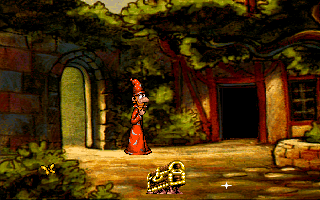
One of the game’s standout mechanics is Rincewind’s famously small inventory, limited to just two items at any given time. The rest of his belongings are stored in the Luggage, an animated, multi-legged chest that follows him everywhere. This mechanic not only injects humor into every inventory check but also forces you to prioritize and plan ahead, often juggling objects between Rincewind and the Luggage to solve intricate puzzles.
Later in the game, you unlock a time-travel device which sends Rincewind hurtling between past and present versions of Ankh-Morpork. These segments radically expand the gameplay by introducing temporal puzzles: actions you perform in the past directly affect the state of the city in the future. This twist keeps the pacing brisk and delivers a fresh challenge beyond standard fetch-quests.
Dialogue and NPC interactions are equally entertaining. The speech trees often hide multiple layers of humor and hint at solutions without feeling too on-the-nose. Whether you’re chatting up trolls in the sewers or bartering with beggars in the city square, each conversation feels alive and true to Pratchett’s hilarious world.
Graphics
For a game released in 1995, Discworld’s hand-drawn, 2D visuals remain a delight. Backgrounds are richly detailed, capturing the grime and grandeur of Ankh-Morpork with vibrant color palettes and clever little easter eggs. From the crooked rooftops to the bustling street markets, every scene feels like a page torn from one of Pratchett’s novels.
Character animations are equally charming. Rincewind’s perpetual panic stance, the Luggage’s staccato stride, and the exaggerated expressions of townsfolk all contribute to a lively, cartoon-like aesthetic. Even without high-definition textures, the smooth sprite work holds up, conveying movement and comedy with surprising fluidity.
The user interface is clean and unobtrusive: an icon bar sits neatly at the bottom of the screen, and descriptive tooltips appear when you hover over interactive elements. This minimalist approach keeps the focus on the art and story rather than on clunky menus or cluttered screens.
Sound effects and voice acting complete the audiovisual tapestry. Rincewind’s quavering voiceover, along with a cast of talented actors, brings each character to life. Background music is sparing but effective, using whimsical tracks to underscore moments of triumph and tension.
Story
The narrative of Discworld is loosely adapted from Terry Pratchett’s novel “Guards! Guards!”. In both media, a shadowy cabal summons a dragon to terrorize Ankh-Morpork. Here, however, the task of dragon-slaying falls to Rincewind, the world’s worst wizard, rather than the city’s beleaguered night watch. This change injects the plot with a sense of absurdity right from the start.
You follow Rincewind on a frantic journey across Discworld’s iconic landmarks: the Unseen University, the Patrician’s Palace, the Docks, and even the mythical Circle Sea. Along the way, you meet an eclectic cast of characters—from irritable dwarfs to inept city guards—each delivering witty banter that faithfully echoes Pratchett’s trademark satire.
While the main quest revolves around stopping the dragon, the side moments often prove more memorable. Scenarios like negotiating with a philosophical troll or outsmarting a bureaucratic golem showcase the game’s sharp writing. The sense of humor is consistently clever, whether you’re deciphering a riddle or accidentally triggering an anarchic pie-throwing contest.
Though fans of the novel may notice deviations from the source material, the game’s storyline stands on its own merits. Its pacing is tight, with just the right balance of exploration, puzzles, and story beats to keep you engaged for the entire playthrough.
Overall Experience
Discworld excels at blending classic adventure mechanics with Terry Pratchett’s wit, resulting in a gaming experience that feels both familiar and refreshingly original. Whether you’re a veteran point-and-click enthusiast or new to the genre, the game’s intuitive controls and robust hint system ensure you rarely feel stuck for long.
The humor is the true star here. From Rincewind’s endless exasperation to the Luggage’s unexpected cameo appearances, every moment feels imbued with comic gold. If you’ve ever chuckled at Pratchett’s novels, you’ll find yourself laughing out loud at many of the game’s absurd scenarios and clever dialogue snippets.
Despite its age, Discworld remains surprisingly accessible. The pixel art still charms, the voice acting delights, and the puzzles are engaging without ever becoming frustrating. It’s a testament to the strong source material and the developers’ respect for the world Pratchett created.
For anyone looking to dive into a humorous, well-crafted adventure that never takes itself too seriously, Discworld is an easy recommendation. Its blend of unforgettable characters, imaginative puzzles, and hearty laughter make it a standout title in the pantheon of classic adventure games.


Reviews
There are no reviews yet.