 Retro Replay Retro Gaming History, Reviews & Emulation
Retro Replay Review
Gameplay
The first few turns of Filler are wonderfully easy to understand: choose a color adjacent to your territory and watch your side spread across the board. Then the consequences begin to pile up. Every selection changes not only what you can reach next, but what your opponent is temporarily forbidden from taking. You are never simply choosing the biggest immediate patch; you are also deciding which opportunity to deny.
That makes the game far more tactical than its simple board suggests. A modest-looking color can be the right call if it opens a useful border, while a large annexation can be a blunder if it hands the other side an even stronger reply. The race to control more than half the terrain keeps both sides pointed at the same clear objective, and the turn-by-turn color lock gives each decision a satisfying bit of spite.
Filler is at its strongest against another person, where you can feel each turn becoming a direct answer to the last. Computer opposition is useful for learning the rhythm and testing board settings, but the human match is where denying a color and stealing a route carries real weight. Larger boards reward longer planning; a time limit can make that same planning much more uncomfortable.
Frustration can set in if you expect constant action or broad strategic freedom. This is a compact board game built around one repeated choice, and a poor sequence can leave you watching the other territory surge ahead. Yet that sting is part of the point: losses are easy to trace back to a color you took too greedily or a denial you failed to anticipate.
Graphics
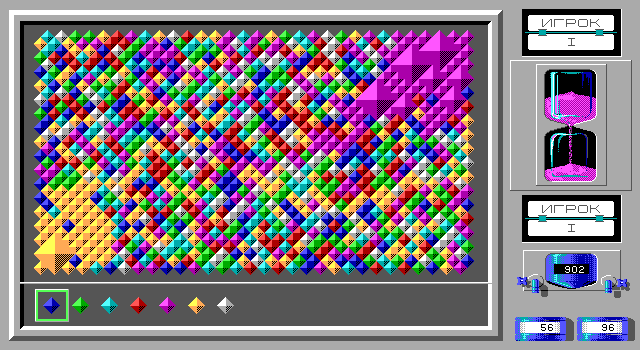
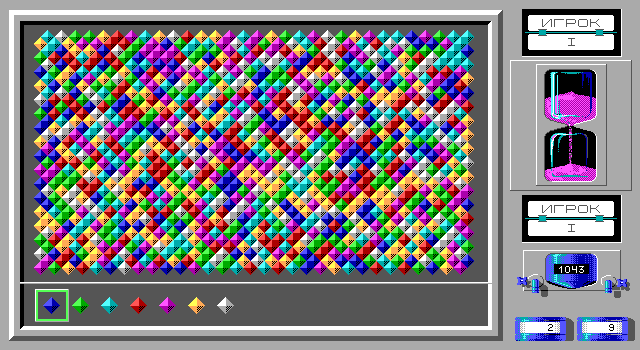
The top-down board is made from rectangular diamond tiles in seven colors, with each player advancing from an opposite end. It is a clean fit for the game: you can quickly see where your territory ends, which colors touch it, and where a single choice might spread next.
Story
Filler frames its conflict as an abstract contest for territory rather than a character-driven tale. You begin at one end of the board, your rival begins at the other, and the only question that matters is who crosses the halfway mark first.
That stripped-down setup works because the board itself creates the drama. A blocked color becomes a small act of sabotage, a newly opened chain feels like a breakthrough, and the shrinking neutral space raises the pressure without needing extra narrative dressing.
There is no need for a larger plot when each match produces its own little story of overreach, recovery, and last-turn denial. If you enjoy making meaning out of competitive play rather than being led through a scripted scenario, the spare framing leaves room for the rivalry to do its job.
Overall Experience
Filler is a sharp, old-school strategy puzzle whose strongest idea is also its simplest: every color you claim is briefly unavailable to your opponent. That rule gives the game a real competitive personality and keeps the board from becoming a straightforward race for the largest cluster.
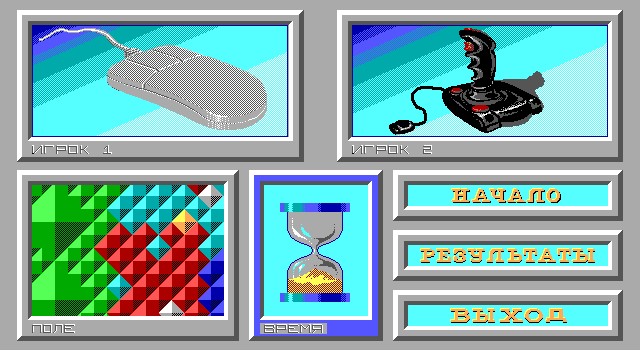
Give it a chance if you like abstract two-player games that reveal more depth after a handful of turns. You do not need a long rules explanation, but you do need patience for looking one move beyond the obvious expansion. The adjustable board and clock settings help tailor that thinking time to the kind of match you want.
It will not win over anyone who needs story, variety of actions, or a constantly changing set of rules. For a quick tactical duel, though, Filler earns its name by making every bit of newly claimed ground feel consequential. Its payoff is the moment you recognize that the best move is not the color that helps you most now, but the one that leaves your opponent with nowhere good to go.


Reviews
There are no reviews yet.