 Retro Replay Retro Gaming History, Reviews & Emulation

Retro Replay Review
Gameplay
The first hour asks you to settle into a familiar point-and-click rhythm: visit locations, inspect what is around you, pick up useful objects, combine inventory items, and work through puzzles to move Paul Lerche’s assignment forward. The immediate hook is that the central problem is not merely a stolen-object mystery. You are trying to make a farming project work in a village where failed harvests and distrust have made every conversation consequential.
Its adventure structure is traditional, which is both comforting and limiting. If you enjoy slowly testing objects and revisiting locations as new information arrives, there is a proper puzzle-solving backbone here. The seed theft gives the game a concrete investigative thread, while Paul’s effort to persuade the villagers gives your actions a larger purpose than simply opening the next screen.
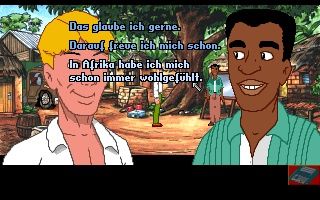
Dialogue is where the educational mission takes over. Many exchanges use multiple-choice responses, but the game often moves through the other answers after you choose incorrectly, ensuring that you receive the lesson and the story continues. That is useful for teaching, but it weakens the satisfaction of making a sharp conversational choice. Come to it ready to read and reflect rather than expecting every response to carry dramatic weight.
Graphics
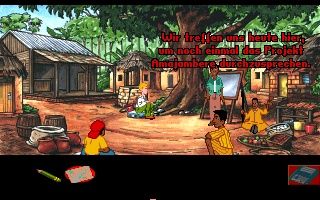
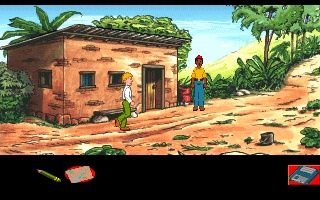
This is a 1995 DOS graphic adventure seen from a third-person perspective, with Paul Lerche serving as your on-screen presence as you move between the village locations of Mihanatoke and the surrounding investigation.

Story
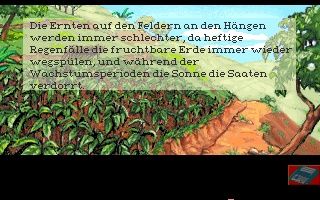
Hilfe für Amajambere has more on its mind than the average adventure-game premise. Heavy rain has washed away fertile earth, harsh sun has damaged crops, and worsening harvests threaten to push villagers toward leaving for Majikitoyo. Paul arrives after his predecessor is badly injured, representing a joint German and Ubuntakan project meant to introduce multi-level plant cultivation.
The strongest part of the setup is that the villagers’ resistance is treated as part of the problem to understand, not a hurdle to dismiss. The game uses conversations and Paul’s journal to explain why the cultivation method matters, why people might reject it, and what daily agricultural pressure can look like in the region. That is a thoughtful foundation for an educational game aimed at younger players.
The seed thefts give the instruction a needed sense of momentum. Rather than asking you only to absorb information about farming, the story gives Paul an immediate crisis: without seeds, nobody can plant at all. It is a straightforward mystery, but it keeps the broader lesson tied to the village’s survival.
Overall Experience
This is not a light, freewheeling adventure. It is dialogue-heavy educational software that uses classic point-and-click puzzles to carry lessons about agriculture, development, and social resistance. If you meet it on those terms, its seriousness feels purposeful rather than accidental.
The biggest frustration is also the clearest statement of intent: the game prioritizes delivering its information over letting you fail or meaningfully steer every discussion. Being walked through unchosen answers can make conversations drag, particularly for an experienced adventure-game fan who wants deduction and consequence. Younger players or classroom-minded groups may find that same structure helpful.
Give it a chance if you are curious about how 1990s adventure games tackled real-world education and can tolerate a didactic pace. The payoff is not a dazzling mystery finale; it is a game that makes its farming problem, its villagers’ concerns, and the difficult work of persuasion feel connected. That is a modest but genuine achievement.


Reviews
There are no reviews yet.