 Retro Replay Retro Gaming History, Reviews & Emulation

Retro Replay Review
Gameplay
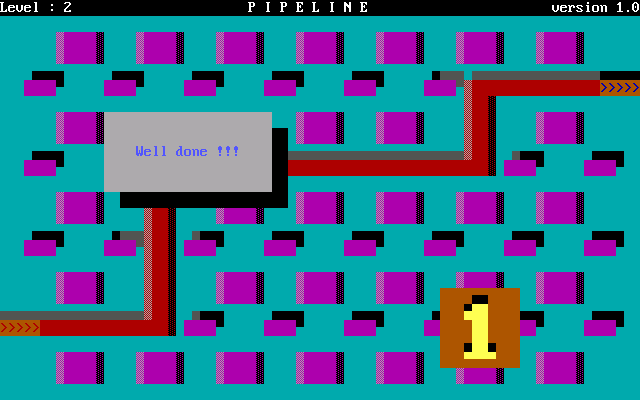
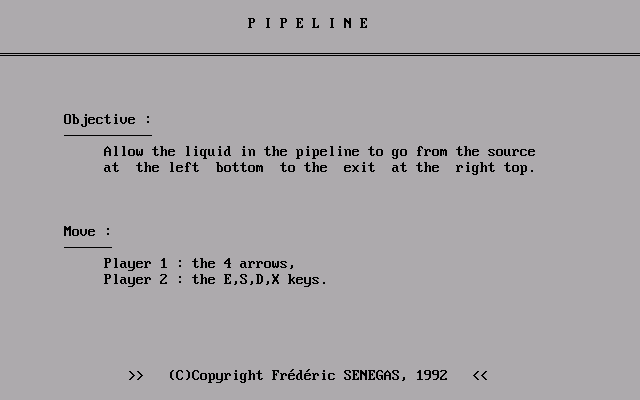
Pipeline gets tense fast because it does not wait for you to admire the board. Red liquid starts moving from the opening moment, and you need to build a continuous route before it finds an empty space or enters a pipe that points the wrong way. The basic task is immediately understandable; surviving it is another matter. You move a single player tile around the grid, swapping with adjacent blank or pipe tiles, so every useful adjustment also depends on whether you can physically reach the piece you need.
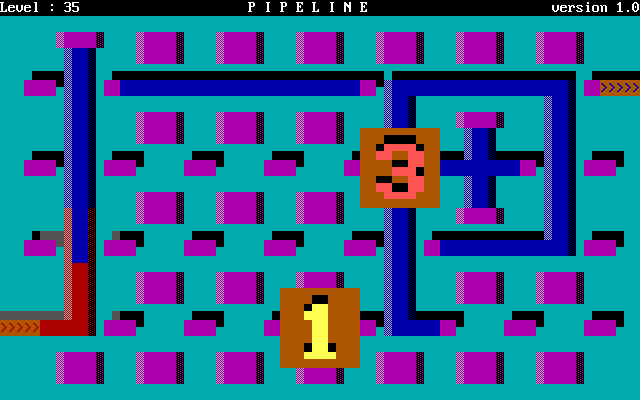
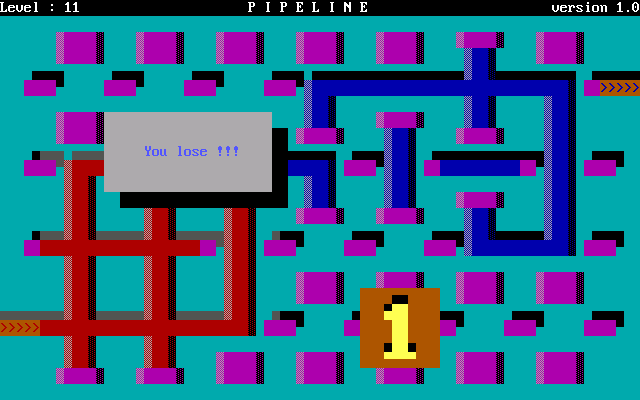
That sliding-puzzle restriction is what gives the game its bite. A straight segment can be perfect for the route but stranded on the wrong side of the board. Corner pieces demand more foresight, while cross pieces offer welcome flexibility because they can carry flow horizontally and vertically. Once liquid reaches a piece, it is locked in place, turning every successful connection into both relief and a commitment. You are not just assembling pipes; you are making decisions that the advancing liquid can permanently endorse or punish.
The first few levels should teach you to look ahead rather than merely patch the next danger point. Later puzzles earn their rising difficulty by asking for cleaner movement and faster route planning, not by changing the goal. Being able to choose among all fifty levels is a smart fit for a puzzle game this demanding: if one board keeps crushing you, you can leave it and come back with fresher eyes. Two people on one keyboard can also make the scramble more social, though the pressure to coordinate in real time is hardly relaxing.
The computer-controlled third mover in some stages is the real troublemaker. It wanders randomly, blocks your path, and can wreck a layout you were carefully preparing. That unpredictability will irritate anyone who wants every failure to feel fully solvable through planning. For everyone else, it gives those levels a nasty, memorable edge: you have to react when the board stops respecting your plan.
Graphics
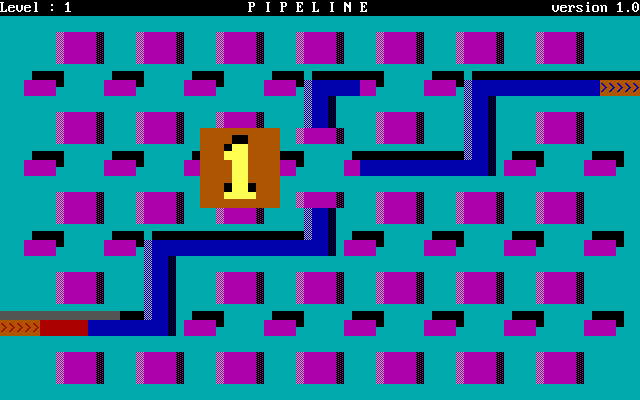
Pipeline is built around a fixed top-down grid of blank tiles and pipe sections, with the red liquid serving as the crucial visual cue. Horizontal, vertical, corner, and cross pieces are easy to distinguish, which matters when you are scanning for a route under pressure. The board is functional rather than decorative, but the moving liquid makes a nearly finished connection easy to read at a glance.
Story
There is no narrative detour between you and the puzzle. Each level begins with a broken arrangement of pipes, a source, a destination, and a liquid already on its way. That bare setup works because the immediate situation creates its own tiny drama: can you turn this mess into a route before one wrong opening ends the round?
The escalating levels supply the sense of progression. Early boards let you understand the rules; harder arrangements force you to anticipate where the flow will go and where your movable tile needs to be next. A pipe filling with red liquid becomes a small point of no return, and that is enough to make a simple grid feel urgent.
The occasional random third mover changes the tone from clean problem-solving to interference. It is not a character-driven conflict, but it creates a clear antagonist in practice: the board itself has become less cooperative. If you like puzzle games that create tension from rules rather than dialogue, Pipeline stays focused.
Overall Experience
Pipeline is a sharp little pressure puzzle whose central idea holds up because the pieces do not wait politely for you to solve them. The combination of route-building and sliding tiles means you are constantly balancing the ideal pipeline against the route your own mover can actually take. When a last-second swap carries the red flow safely onward, it delivers the satisfying snap that great arcade-minded puzzles live on.
Its frustrations are part of the bargain. A failure can arrive suddenly when liquid reaches a gap or an incompatible pipe, and the random computer-controlled mover can make certain losses feel especially unfair. Still, the rule set is clean enough that most mistakes teach you something useful about timing, positioning, or committing a pipe too early.
Give it a chance if you enjoy games that turn a familiar puzzle idea into a race against the clock. The fifty selectable levels make it easy to sample its range, and the two-player option adds a spirited way to share the panic. Pipeline does not need a complicated hook: it takes one smart constraint—moving pieces through a sliding grid while the liquid is already coming—and squeezes a lot of tension out of it.



Reviews
There are no reviews yet.