 Retro Replay Retro Gaming History, Reviews & Emulation
Retro Replay Review
Gameplay
PowBall starts with an immediately recognizable challenge: launch the ball, steer the paddle left and right, and make sure the return does not slip past you. That simplicity is a strength. You can understand the whole deal in seconds, then spend the next several minutes discovering how much trouble a particular brick arrangement can cause when the ball comes back at an awkward angle.
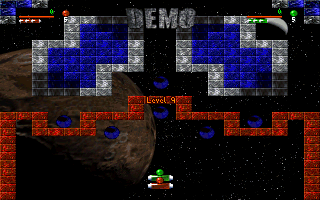
The brick variety keeps the basic routine from becoming completely automatic. Some blocks disappear on contact, while others demand repeated hits and force you to keep a rally alive longer. Clearing bricks raises your score, and broken blocks can scatter blue crystals or paddle power-ups into your path. Catching those drops adds a second priority: you are not only preserving the ball, but judging whether you can safely move for a bonus without losing the rebound.
Frustration arrives in the classic paddle-game way. A missed return costs one of three lives, so a strong run can end abruptly because you misread a bounce or committed too far to one side. That sting is part of the formula, but PowBall at least gives you tangible goals beyond simply staying alive: clear the layout, gather crystals, and push the score higher. The shareware version’s ten levels make it a focused arcade session; the full game’s hundred-plus levels are for anyone who wants a much longer climb through new brick formations.
Two-player mode is a welcome fit for this kind of game. Each side has its own differently colored paddle and ball, making it clear whose return you need to track. The core loop remains unchanged, but sharing the screen turns a solitary reflex test into a more animated score chase.
Graphics
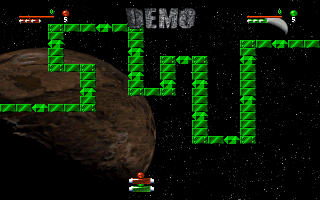
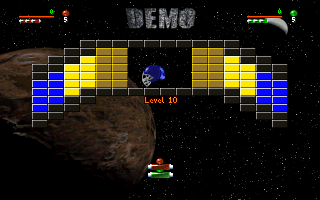
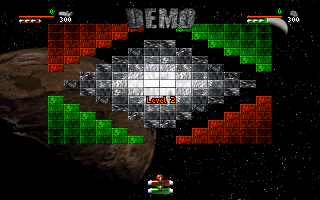
The playfield is built around brick layouts that change from level to level, with blue crystals dropping from destroyed blocks and power-ups falling toward the paddle. Different colors for each player’s paddle and ball help keep the two-player action easy to follow when both sides are active.
Story
PowBall wraps its arcade action in a grim 25th-century setup: Earth is overcrowded, resources are scarce, and wars have erupted over what remains. The discovery of Alchemite, a crystal that can be refined into any known substance, provides the reason for heading out to mine nearby systems.
You play a would-be rockhopper searching for that material, which makes the falling crystals feel thematically appropriate rather than completely arbitrary. Still, this is framing for the score attack, not a narrative that develops as you play. The important drama happens in the rebounds: whether you catch the ball, break the last stubborn bricks, and keep a run going.
That light touch suits the game. The bleak premise gives PowBall a little more character than an entirely abstract brick-breaker, without getting in the way of the immediate arcade objective. Do not come for a deep science-fiction tale; come for a simple premise that gives the crystal hunt a bit of edge.
Overall Experience
PowBall succeeds when you want a direct, old-school arcade game that asks for timing rather than a long learning period. The first hour is likely to be spent chasing cleaner angles, trying to avoid wasted lives, and realizing that bricks requiring multiple strikes can turn a comfortable rally into a tense one. It is familiar design, but familiar design can still be satisfying when the ball is in motion and one more block stands between you and a cleared board.
The limited shareware set is a sensible way to see whether that rhythm grabs you. If the repeated cycle of launching, returning, collecting, and clearing starts to click, the full game’s larger level count has real value. If you need constant new systems or a story that carries you forward, the straightforward structure will wear thin much sooner.
My recommendation is simple: give PowBall a chance if you have affection for Breakout-style games and enjoy score-chasing under pressure. Its ideas are not radical, but durable bricks, collectible crystals, power-up drops, and two-player support provide enough variation to make the basic paddle-and-ball contest feel purposeful. It is a modest arcade game with a sharp, dependable loop.


Reviews
There are no reviews yet.