 Retro Replay Retro Gaming History, Reviews & Emulation



Retro Replay Review
Gameplay
The first stretch puts you in the right investigative frame of mind. A troubling request arrives, Katsuya has an unusual way to pursue it, and the game asks you to start working through people and places rather than charging toward easy answers. There is a satisfying fit between the detective premise and an adventure built around questioning characters: every conversation has the potential to be the lead that moves the case forward.
Interaction is intentionally old-school. You view locations from a first-person perspective, then use a command menu for environmental interaction and travel. That makes Memories feel methodical, and you should go in willing to slow down, consider where to go next, and return to dialogue when progress stalls. The interface style is unlikely to win over anyone who wants direct, freeform exploration, but it does give the investigation a measured rhythm.
Conversations carry most of the load, which is both the strength and the potential friction point. When the writing has you curious about a person’s past or fate, asking questions feels purposeful. When you are merely trying to identify the next required exchange, the pace can drag. This is a game for a patient adventure fan who enjoys following a case step by step, not for someone looking for dense action or constant puzzle variety.

Graphics
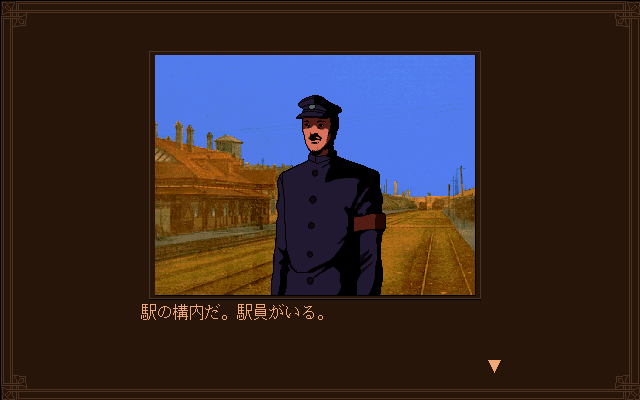
Locations are seen through Katsuya’s eyes in first-person screens, while the command menu handles movement and interaction. It is a functional viewpoint for a detective story: you are placed at the scene and encouraged to inspect it before deciding where the investigation should go.

Story
The central hook is stronger than a routine missing-person setup. Katsuya cannot shake memories of Rieka, the woman who continues to appear in his dreams, and the girl’s request to erase her father’s memory immediately turns memory itself into the case. That gives the story a personal, uneasy starting point rather than treating Katsuya’s psychic power as a mere excuse for detective work.
Katsuya’s ability to travel into the past and relive memories gives the investigation a fittingly introspective direction. The premise invites you to think about memory as something painful, malleable, and consequential, while the detective work keeps that idea tied to individual lives. It is the sort of supernatural mystery where listening carefully matters as much as solving anything.
As the second entry, it continues a series built around this psychic-detective angle. If the premise catches you, the related Psychic Detective is worth considering as another stop in the series. Even on its own, though, Memories has a clear dramatic question: what would it mean to remove a memory that someone desperately wants gone?
Overall Experience
Psychic Detective Series Vol.2: Memories earns its time through mood, mystery, and a premise that is more emotionally pointed than its menu-driven structure first suggests. The case begins with enough intrigue to pull you along, and the combination of detective questioning with psychic trips into the past gives it a distinct angle.
Its limitations are equally clear. The command-based first-person format is deliberate and conversation-heavy, so momentum depends heavily on your interest in following dialogue and revisiting leads. If you are impatient with older adventure pacing, you may find yourself wishing the investigation moved with more urgency.
For the right gamer, the payoff is in settling into its slower cadence and seeing where its questions about memory lead. Give it a chance if you enjoy supernatural mysteries that ask you to listen, connect clues, and let the atmosphere build. Skip it if you want an adventure driven primarily by action or brisk puzzle-solving.



Reviews
There are no reviews yet.