 Retro Replay Retro Gaming History, Reviews & Emulation
Retro Replay Review
Gameplay
The first hour of Sleuth is less about flashy deduction than settling into the rhythm of an old-school investigation. You wander through a house, examine rooms and objects, and interrogate a fixed group of seven guests. The objective is admirably clean: identify the murderer, the room where the murder happened, and the weapon used. That clarity helps, because each action feeds the same final accusation rather than sending you down unrelated puzzle-game detours.
Its strongest idea is the deadline. You need to find the weapon, bring everyone to the actual murder scene, and confront the culprit before your gumshoe routine irritates the murderer enough for them to eliminate you. That puts pressure on every round of questioning and keeps aimless room-by-room searching from becoming too comfortable. You have to investigate with purpose, not simply exhaust every possibility.
The text parser is where your tolerance will be tested. Sleuth comes from an era when interacting means working through typed input, and the game asks you to turn observations and suspicions into the right investigative actions. For some, that makes solving the case feel hands-on: you are actively probing the house rather than selecting a highlighted dialogue option. For others, the same process can become a barrier between a good hunch and progress.
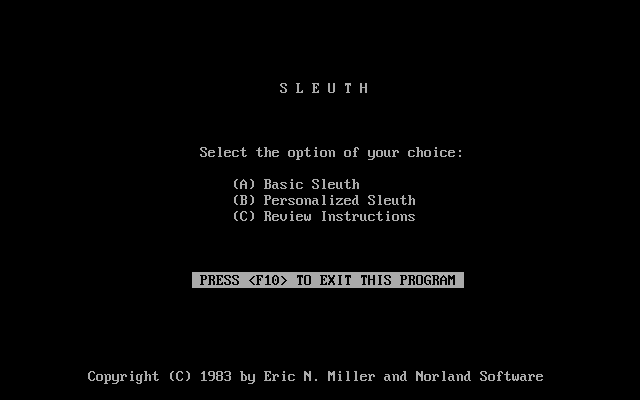
Basic Sleuth randomizes character names, while Personalized Sleuth lets you assign first and last names yourself. The personalized option is a small but welcome way to make the cast easier to remember or more amusing to accuse. More importantly, the repeated structure invites another attempt: the game understands that a whodunit earns its tension from asking you to put clues together under pressure, not merely from reaching an ending once.
Graphics
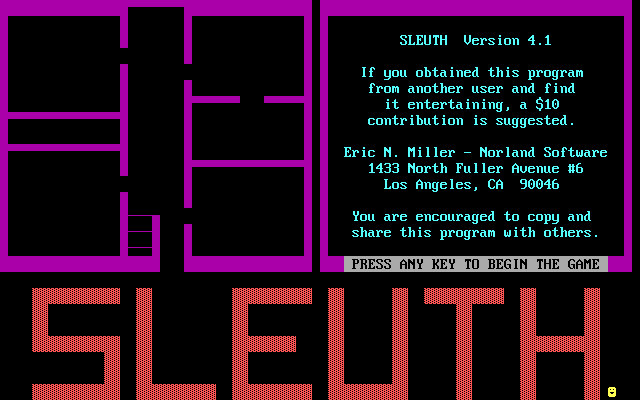
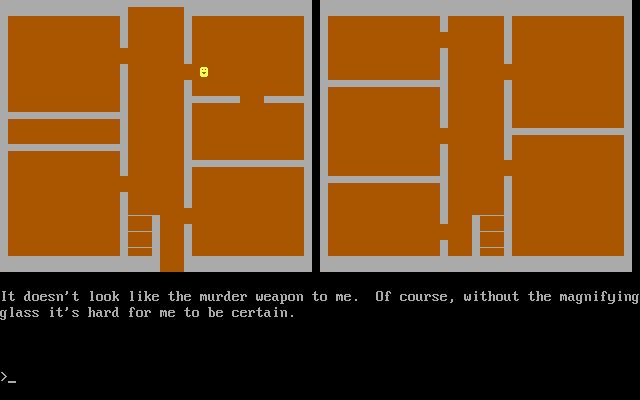
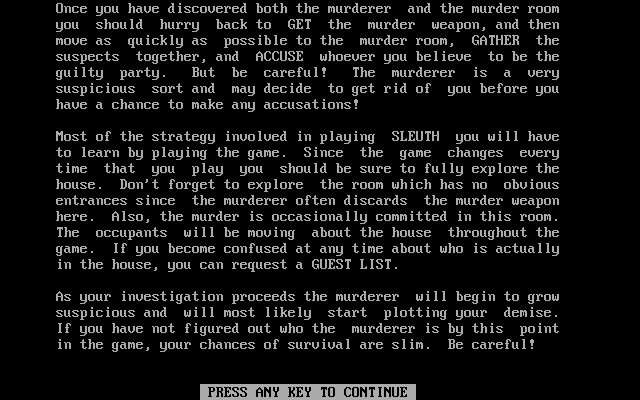
Sleuth is text-based but includes graphics, fitting its DOS-era mystery format rather than trying to overwhelm the investigation with imagery. The important information still comes through your exploration, examinations, and questioning, so the visual side serves as accompaniment to a parser-driven case.
Story
This is a stripped-down drawing-room murder mystery, and that is a compliment. A murder has occurred in a house full of guests, one of them did it, and you must reconstruct the basic facts before it is too late. Sleuth does not need a sprawling plot to create a reason to keep digging; the unanswered question of who did it is enough.
The seven guests give the case a manageable suspect pool. You are not dealing with an endless cast or a giant map, which makes the mystery feel like something you can genuinely get your arms around. Each interrogation matters because the culprit is somewhere in the same house, inside the same small circle you are trying to untangle.
The threat of being killed if you take too long changes the tone from a cozy puzzle into a race. It is a blunt form of suspense, but an effective one: delay is not merely inefficient, it is dangerous. That urgency makes the eventual confrontation feel like the point of a case you have earned rather than a formality after gathering clues.
Overall Experience
Sleuth is a narrow, focused mystery game with a satisfying core loop: search, question, connect facts, and make an accusation. It asks you to meet it halfway with careful attention and a willingness to type your way through the investigation. When that rhythm clicks, the game creates the specific pleasure of turning a scattered set of observations into a confident answer.
Its age is most apparent in the parser-led interaction, which can make the route from idea to action feel slower than the mystery itself. That friction is not trivial, especially when the clock is running. Still, the time limit also gives the old format an edge that many leisurely detective games lack; hesitation has consequences.
Give Sleuth a chance if you enjoy classic computer mysteries, compact logic problems, and the ritual of keeping your own mental—or literal—case notes. It is not the kind of detective game that carries you forward with spectacle. It is the kind that asks whether you have actually listened, searched carefully, and put the room, weapon, and suspect together before the murderer decides your investigation has gone on long enough.


Reviews
There are no reviews yet.