 Retro Replay Retro Gaming History, Reviews & Emulation
Retro Replay Review
Gameplay
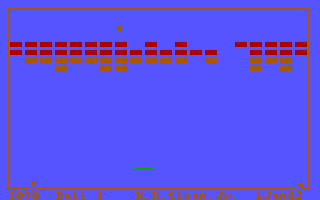
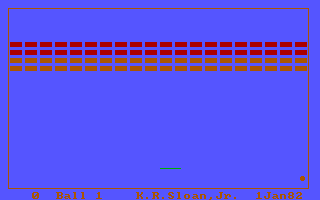
Spinout reduces the paddle-and-ball formula to its essential contest: keep the bouncing ball in play and send it upward to remove every brick. Four rows wait at the top of the screen, while your paddle provides the only defense at the bottom. The objective is immediately understandable, which makes the game easy to approach even if its demands become less forgiving as a ball drops toward the lower edge.
Controlling the paddle is about anticipation rather than elaborate systems. You need to read the ball’s path, get underneath it, and make sure a return is possible before it slips past. That straightforward interaction gives each successful deflection a practical importance: it preserves one of the five balls available at the start and creates another chance to chip away at the brick layout.
The fixed-screen structure gives the game a focused, arcade-like rhythm. There are no distractions from the central loop of returning the ball and reducing the remaining bricks. It is best suited to players who enjoy repeating a clear skill test, improving their positioning through play, and working toward the clean finish of an empty field.
Graphics
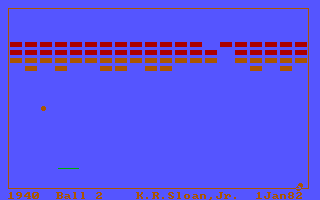
The visual presentation is defined by function. Bricks occupy the upper portion of the screen, the ball moves between them and the paddle, and the paddle anchors the action along the bottom. This arrangement makes the game state legible at a glance: you can see the remaining target, follow the immediate threat, and judge where your defense must be.
As a side-view, fixed-screen arcade game, Spinout does not need visual complexity to communicate its play. The important elements remain on one screen, so attention stays on the ball’s route and the gaps opening in the brick rows. That clarity is the presentation’s main strength.
Readers expecting elaborate scenery or character-driven visual spectacle should look elsewhere. The appeal here is the compact game board itself, where every visible object contributes directly to the challenge. Its sparse presentation matches a design built around quick recognition and immediate response.
Story
Spinout is not a narrative game. Its premise is conveyed through its goal: use the paddle to keep the ball active and destroy the bricks above. There are no documented characters, plot developments, or dramatic framing competing for attention.
That absence is appropriate for the format. The game creates momentum through the changing board state rather than through story beats, with progress measured by how many bricks remain and tension measured by the risk of losing a ball.
If you want an arcade game with a developed setting or narrative payoff, this is unlikely to satisfy that particular interest. If you prefer a game whose “story” is the struggle to complete a screen before the last ball is gone, its directness is part of the point.
Overall Experience
Spinout offers a compact brick-breaking challenge with an uncomplicated win condition: eliminate all of the bricks before losing all five balls. Its rules are simple enough to understand immediately, and its pressure comes from executing those rules consistently when the ball must be recovered.
The pacing is naturally shaped by the ball’s movement. Quiet stretches of controlled returns can give way quickly to a dangerous descent toward the paddle, while every destroyed brick makes the board visibly closer to completion. That produces a concise loop centered on concentration rather than variety.
This is a solid fit for players who value classic paddle games, fixed-screen action, and a pure score-and-survival mindset. Those seeking changing stages, narrative context, or a broader range of mechanics may find it too bare-bones, but its focused design remains effective for a short, disciplined arcade session.

Reviews
There are no reviews yet.