 Retro Replay Retro Gaming History, Reviews & Emulation
Retro Replay Review
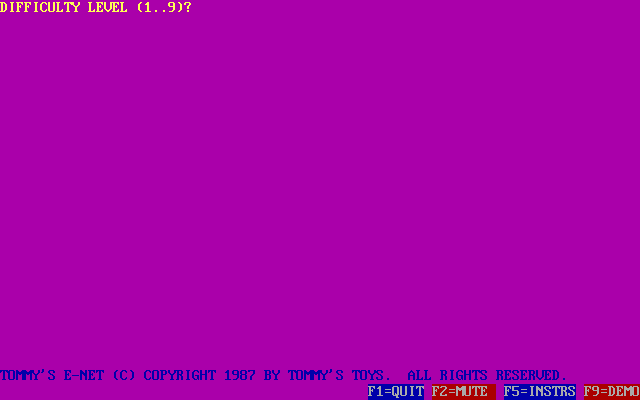
Gameplay
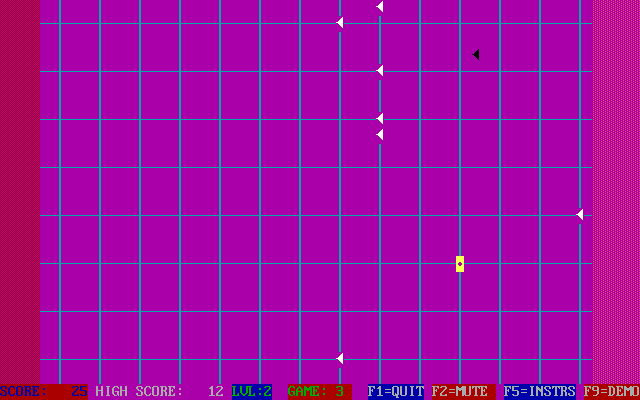
The first few minutes of Tommy’s Enet are likely to feel a little peculiar. You are not freely roaming around the board or firing at enemies; you are riding the grid’s vertical lines, going up and down until reaching the top shifts you into the next lane. Meanwhile, enemies travel right to left, and you can only destroy them at the instant they cross one of those vertical paths. It is a compact rule set, but it asks you to think ahead rather than simply react.
Once that rhythm clicks, the game becomes an exercise in positioning. You watch an enemy’s approach, pick the line it will cross, and use your current route to arrive at the right moment. A late move means a missed interception; an early one can leave you committed to the wrong lane. That constraint gives this otherwise bare-bones concept its bite. You are constantly judging whether to hold course, adjust lanes at the top, or alter speed to meet the next threat.
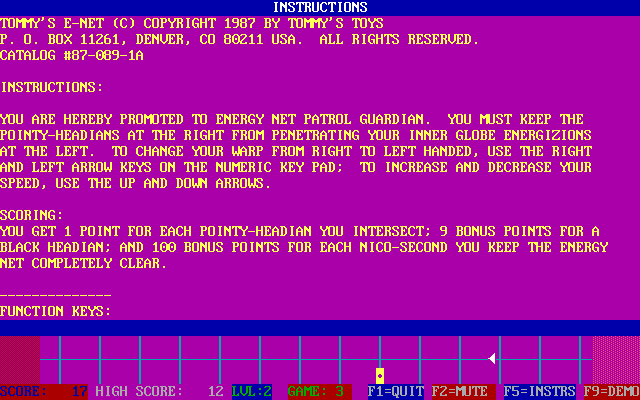
The numeric keypad layout is unmistakably from its DOS era. Keys 4 and 6 move you left and right, while 8 and 2 increase and decrease speed. It is not a control scheme that disappears into your hands instantly, because speed is part of the decision-making rather than a background setting. Give it a little time. Once you stop fighting the layout, changing pace becomes another useful way to make an interception instead of just hoping your route works out.
Scoring keeps the focus sharp. Ordinary enemies are worth one point, while the black super bad enemies offer bonus points and naturally become higher-priority targets. The nine difficulty levels and separate top-ten tables make this a better fit for repeat sessions than for a one-and-done curiosity. If you enjoy chasing cleaner runs and gradually proving you can handle faster, tighter arcade pressure, Tommy’s Enet has more staying power than its modest setup suggests.
Graphics
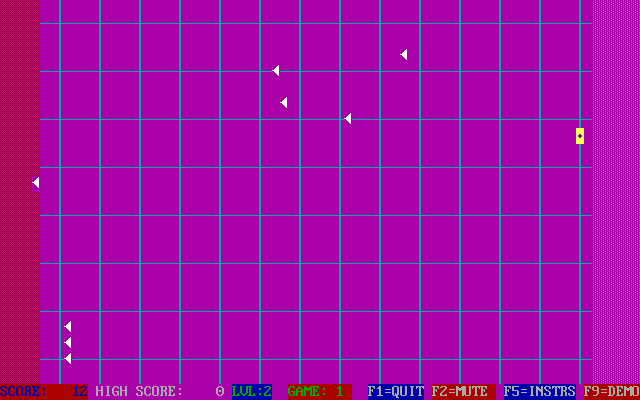
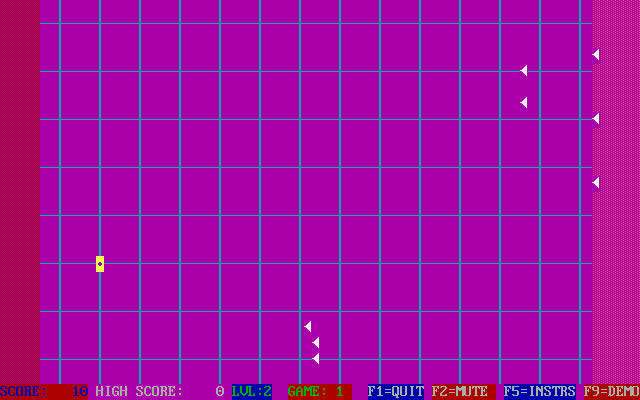
The action is built around a clean 15-node-wide, eight-node-high grid, with the guardian traveling vertically along its lines and enemies crossing from right to left. That rigid board makes the important information easy to parse: you can see the lanes, track approaching enemies, and understand why a near miss happened. The black bonus enemies also stand out as an immediate scoring opportunity.
Story
There is only the lightest framing here: you are an energy guardian defending inner globe energizions from an enemy breach. It supplies a clear reason to stop the incoming threat, then gets out of the way. That is the right call for a score-driven arcade game built around repeated attempts.
Do not come in expecting characters, twists, or a growing campaign narrative. The story functions as a label for the task at hand: protect the inner globe, eliminate enemies, and keep the score climbing. Its simplicity lets the timing challenge carry the game.
That minimal premise does have one advantage: it makes failure and recovery easy to read emotionally. An enemy slipping through is not a complicated plot beat; it is a direct sign that your route or timing was off. The next attempt is immediately about doing better.
Overall Experience
Tommy’s Enet is a small, focused arcade game that gets value from a single restrictive idea: you can only remove enemies at grid crossings. That limitation turns routine-looking movement into a series of tiny predictions and corrections. The payoff is not variety so much as the satisfaction of learning the board’s cadence and making a run feel more deliberate.
Frustration can set in if you want constant new objectives or a broader action toolkit. Everything rests on lane selection, speed control, and timing, so the game either becomes pleasantly obsessive or feels too narrow. The keypad-driven movement also asks for a little patience before its logic feels natural.
For a gamer who likes compact DOS score chasers, the nine difficulty settings and per-difficulty high-score records give Tommy’s Enet a worthwhile competitive loop. It is a lean game, but not an empty one. Give it a chance if the idea of mastering a constrained grid under pressure sounds satisfying; skip it if you need arcade action with more moving parts.


Reviews
There are no reviews yet.