 Retro Replay Retro Replay gaming reviews, news, emulation, geek stuff and more!

Retro Replay Review
Gameplay
The first hour asks you to meet 380000 Kilo no Kokū on its own terms. You return from extended space travel to a society rebuilt around colonization ambitions, then spend most of your time reading conversations, descriptions, and the protagonist’s thoughts. This is not an adventure game that keeps handing you puzzles or busywork. Its interaction is the act of following a complicated situation closely enough that a later decision feels like a decision instead of a blind button press.
Choices occasionally let you select an action or response and alter the story’s course. That gives the otherwise linear rhythm a welcome jolt: you are not simply turning pages, even if turning pages is clearly the central activity. The strongest reason to stick with it is the sense that your attention matters. When the writing starts connecting its people, organizations, and history, choosing a reply carries more weight than it would in a lighter branching story.
The extensive scientific and political database is either the game’s secret weapon or its biggest obstacle, depending on your mood. If you enjoy stopping to understand how a fictional society works, it deepens the colony setting and rewards patience. If dense terminology makes your eyes glaze over, the game can feel more like assigned reading than momentum-driven drama. Go in ready to read deliberately, not to rush toward the next interactive scene.

Graphics
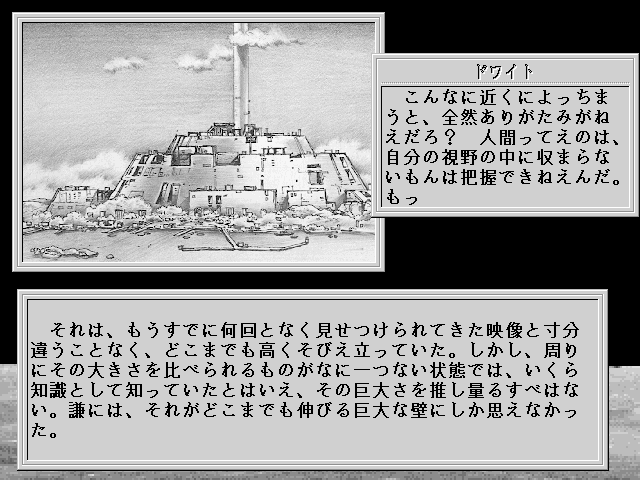
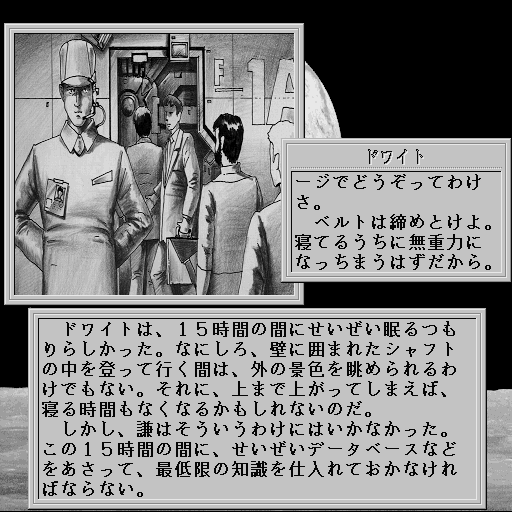
Images, usually portraits of people, appear in small windows alongside the text and can be switched off entirely. That choice says a lot about the experience: the pictures are accents for a text-first story, not the main reason to be here. The compact character imagery helps put a face to a conversation, while the option to remove it suits anyone who would rather treat the game like a pure novel.
Story
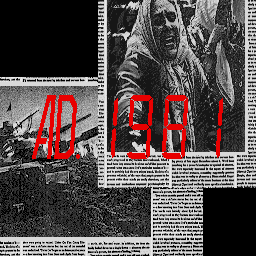
The setting has an immediately compelling scale. A devastating USA-Soviet atomic war leaves Earth in ruin, recovery does not truly begin until the mid-21st century, and major nations turn their energy toward colonizing space. It is a heavy backdrop, but it gives the opening situation a strong sense of consequence rather than using apocalypse as empty wallpaper.
At the center is a protagonist returning to the SC, a huge space-colony tower compared with the Tower of Babel. That is a smart place to start a political science-fiction story: home is already an ambitious, precarious project, and the returning viewpoint naturally lets you learn what has changed. The ensuing struggle among countries and political organizations promises complications beyond a simple survival tale.
What makes the premise work is its interest in systems as much as individuals. The story wants you to consider institutions, national interests, and the intellectual groundwork behind a colonized future. That will be catnip if you like cerebral science fiction with a political edge. Anyone hoping for a breezy, character-comedy visual novel may find its seriousness and density less inviting.
Overall Experience
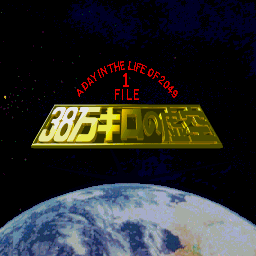
380000 Kilo no Kokū is a niche experience, but it is a confidently niche one. System Sacom’s fifth Novel Ware entry treats visual-novel form as a vehicle for a substantial post-apocalyptic science-fiction scenario, not a thin wrapper around a few choices. You spend your time inside its ideas, and that can be absorbing when the subject matter catches you.
Its biggest weakness is inseparable from its strength: there is a lot to absorb, and the game is unapologetically text-heavy. The database, narration, dialogue, and political setup demand concentration. A gamer looking for regular mechanical stimulation will likely feel stranded, while someone who likes the slower rhythm of an interactive novel may appreciate how much room the setting gets to breathe.
Give it a chance if the image of a battered humanity pinning its future on an immense space colony sounds more exciting than intimidating. The payoff is not fast action; it is the gradual pleasure of inhabiting a dense world and steering through a conflict shaped by competing powers. For the right science-fiction reader, that is more than enough.

Reviews
There are no reviews yet.