 Retro Replay Retro Gaming History, Reviews & Emulation

You are in first place when the rider to your left swings a chain. You lean away, drift toward the yellow line, and see the sedan coming over the hill a second too late. The bike skids down the road without you. Your racer gets up and runs after it while everyone else disappears into the distance. In Road Rash, losing can be funnier than winning, provided you have the nerve to try the next race.
Electronic Arts found that feeling in the early Genesis years, when its developers were still working out what kind of console company they wanted to be. The original trilogy turned traffic, police, fistfights, and bike upgrades into a loop that needed no cutscene to explain itself. Later versions added filmed actors, alternative rock, polygons, four-player chaos, and a prison escape. Some additions made the road bigger; some got between the player and the fight.
This is the story of the people who made the first road work, the multimedia gamble that followed, and the reason a motorcycle combat series has remained easy to describe and strangely hard to replace.

Before Road Rash: Electronic Arts Learns to Build Console Games
Road Rash makes more sense when placed inside Electronic Arts at the end of the 1980s. EA had built its reputation in computer software, publishing games with the language and presentation of albums and books rather than anonymous cartridges. Developers were credited. Packaging could be elaborate. The company talked about software creators as artists. Yet the center of gravity in North American gaming was shifting back toward dedicated consoles after the crash of the early 1980s, and by the time Sega’s Genesis entered the American market, the opportunities were becoming too large for a computer-focused publisher to ignore.
Randy Breen joined EA in the 1980s and moved from technical work into production. Before Road Rash he had worked on projects including John Madden Football and serious racing software, experience that taught him something useful: realism and entertainment were not automatically the same thing. In a lengthy 2022 Sega-16 interview, Breen described the period as a time when EA was becoming a very different company. The console market was no longer merely a side business, and Road Rash became one of the titles through which EA tested the idea of creating major console games in-house rather than simply publishing work made elsewhere.
The project did not begin fully formed. Retrospectives describe EA experimenting with more conventional driving concepts before the team converged on motorcycles. Dan Geisler had worked on Spectrum HoloByte’s Vette!, a technically ambitious driving game that gave him experience with road rendering and the illusion of moving through a 3D environment on modest hardware. Breen, meanwhile, wanted something with more entertainment value than a pure simulation. Motorcycles solved several design problems at once. They were narrow enough to move aggressively through traffic. They exposed the rider’s body, which meant the player could actually see a character rather than a rear bumper. Most importantly, two riders could reach across the gap between bikes and hit each other.
Breen’s shorthand pitch remains one of the best descriptions of the original concept:
“Road Rash on Mulholland Drive.”
— Randy Breen, Sega-16
That phrase captures more than scenery. Mulholland Drive suggested dangerous curves, elevation changes, speed and the mythology of California road culture. Breen has also talked about influences ranging from Akira to motorcycle racing footage in which riders physically jostled for position, while the broader outlaw-biker flavor naturally invited comparisons to Mad Max. He had seen motorcycle groups in Japan while serving in the U.S. Navy and later encountered the Bay Area’s own performance-bike culture. Those pieces came together into something stranger than a simulation and more grounded than a futuristic combat game: ordinary public roads transformed into illegal racetracks.

Dan Geisler and the Road That Made People Sick
Road Rash needed more than a good premise. The fantasy would collapse if the road felt flat. The Genesis could not simply draw the kind of free-roaming 3D landscape that later hardware would take for granted, so Geisler and the programmers had to build the sensation of depth from scaling, perspective tricks, carefully managed sprites and road mathematics. The goal was not merely to put a motorcycle at the bottom of the screen and make roadside objects grow larger. The road had to bend convincingly, climb hills, fall away, carry traffic in both directions and create enough forward momentum that a player could feel when the bike was being pushed too hard.
Later histories describe roughly six months of work before the road effect finally felt right. Geisler’s own recollection has become one of the best legends surrounding the game:
“When I finally got that road effect down, people saw it and got ill.”
— Dan Geisler, quoted in Retro Gaming Geek
The line sounds like a joke, but it gets at what made Road Rash visually special in 1991. The hills did not simply decorate the background. They concealed hazards. A crest could hide traffic until the last moment. A long downhill run made the player feel dangerously fast. Curves were not just visual flourishes; they forced the rider to think about line, speed and the location of opponents. The road system created situations in which fighting was tempting precisely when fighting was least safe. You might be winding up a punch while the roadway disappeared over a rise.
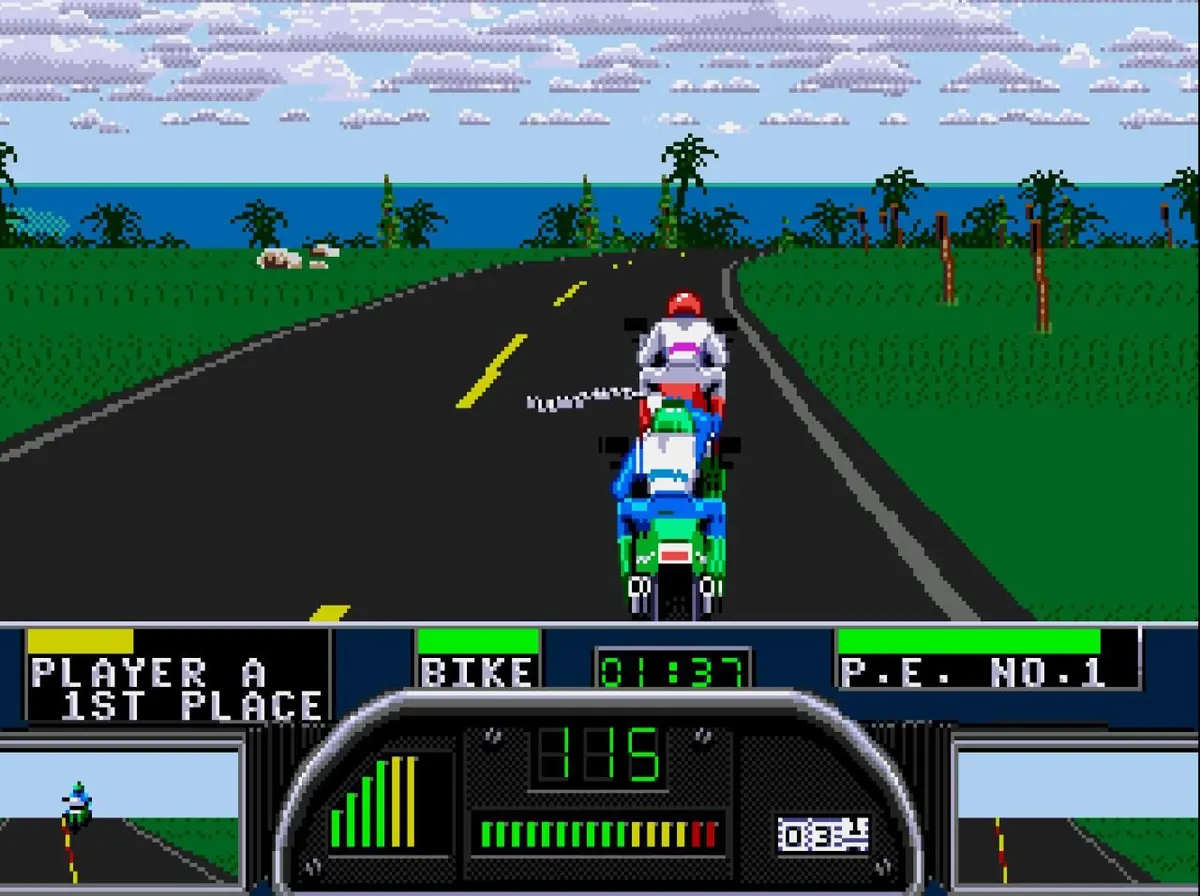
The road alone did not solve the game. Early development was rough enough that Breen later remembered having to fight for the project after EA showed an immature build at CES. The company wanted to display its upcoming Sega software; the Road Rash team believed the game was not ready. Predictably, people judged what they saw rather than what the developers hoped it would become. Breen had to convince management that the technical and presentation problems were solvable. In his Sega-16 account, frame rate and animation were major concerns. The important point is not that the game had a bad trade-show build—many games do—but that Road Rash was close enough to corporate doubt that its eventual identity was not inevitable.
There was another layer of uncertainty: EA’s relationship with Sega. EA had reverse-engineered the Genesis and entered negotiations from an unusually strong position, seeking control over manufacturing and economics rather than accepting every standard term. Breen told Sega-16 that Road Rash was in development while it was still unclear exactly how EA’s Genesis software would be licensed. By release, EA and Sega had reached terms, but the context matters. Road Rash was born while its publisher was simultaneously learning how to be a console developer and challenging the normal rules of console publishing.
1991: Road Rash Finds the Formula

When Road Rash finally shipped on Genesis in 1991, its design was deceptively simple. Players entered illegal point-to-point races through California, finished high enough to progress, earned money and bought faster motorcycles. The structure provided a natural risk curve. Better bikes cost more, went faster and made the same hazards more dangerous. Police were not scenery. Rival riders attacked. Traffic moved in both directions. Crashes cost time and damaged the motorcycle. Get knocked off and the humiliating run back to the bike became part of the race.
That run may be the single most important comic detail in the series. Traditional racing games often treat a crash as an interruption: spin out, reset, continue. Road Rash turned failure into theater. Your body could sail down the road. The motorcycle could slide much farther than the rider. Sometimes the player found himself sprinting toward the bike while opponents blasted past one after another. It gave every wreck a punch line and, because the punishment was measured in real lost seconds rather than a simple animation, it also made crashes mechanically meaningful.
The fighting worked because it competed for the player’s attention. Breen has described the game as a constant act of context switching: watch the road, then the rider beside you, then the traffic, then the curve, then the police. A punch was not free damage. Charging an attack meant devoting mental bandwidth to somebody beside you while something deadly approached from the front. That tension is one reason so many later attempts to copy Road Rash’s surface features never reproduced its rhythm. The game was not simply about adding melee combat to a racing engine. It was about making both systems interfere with each other in funny and dangerous ways.
The original credits, preserved in the Genesis manual and databases such as MobyGames, reveal how compact the team was by modern standards. Breen produced. Geisler, Walter Stein and Carl Mey handled programming, with Mey also serving as technical director. Arthur Koch, Jeff Fennel, Cynthia Hamilton, Connie Braat, Paul Vernon, Sheryl Knowles and Peggy Brennan handled art. Michael Bartlow and Rob Hubbard created music and sound. Michael Lubuguin assisted production. The manual did something that now feels unusually personal: it showed the team, named them and explained what production people, pixel artists, sound designers and programmers did.
Rob Hubbard Gives the Asphalt a Pulse

Road Rash’s sound is an important bridge between two eras of the series. Before the famous licensed soundtrack, there was Rob Hubbard. Hubbard had already become one of the most recognizable composers of the Commodore 64 generation before joining Electronic Arts. The Genesis gave him a different set of constraints: Yamaha FM synthesis, limited memory and a console audience that increasingly expected music to establish an identity immediately.
Hubbard later joked in an Arcade Attack interview that Road Rash was a motorcycle game, so naturally the music was rock. That sounds obvious, but the tone mattered. Road Rash did not want the sterile precision of a motorsport broadcast. It wanted danger, swagger and enough rhythmic pressure to make menus and title screens feel like the start of trouble. Hubbard and Bartlow’s audio helped establish that attitude before the series had access to actual rock bands.
That first game was successful enough that EA did not wait long to decide what came next. According to development histories of Road Rash II, the sequel was greenlit before the 1991 holiday season had fully ended. The first game had taken years of experimentation; the sequel had roughly a year to capitalize on it.
Road Rash II: Bigger, Faster and Built for Two

The deadline for Road Rash II was aggressive, but the team had something it did not possess the first time: an engine and a known identity. That meant less time proving that curved, hilly roads could exist on the Genesis and more time expanding what players could do on them. Randy Breen and Dan Geisler returned as designers. Geisler, Matthew Hubbard and Walt Stein handled programming. Arthur Koch and Peggy Brennan returned in the art group alongside Matthew Sarconi and Keith Bullen. Rob Hubbard, Don Veca and Tony Berkeley are credited for sounds and music. The official Road Rash II manual even preserves another team photograph, making the first two Genesis releases unusually well documented visually.
The obvious headline feature was simultaneous two-player racing. The original could support more than one player, but not with the immediacy of split-screen competition. Road Rash II made the social part of the concept much stronger: now the person sitting beside you could be another source of danger rather than merely somebody waiting for a turn. The sequel broadened the scenery across the United States, increased the bike selection, added nitrous-equipped superbikes, expanded weapons and refined the fighting. The infamous chain became one of the series’ most satisfying tools because taking it from another rider felt like stealing somebody’s advantage and turning it back on them.
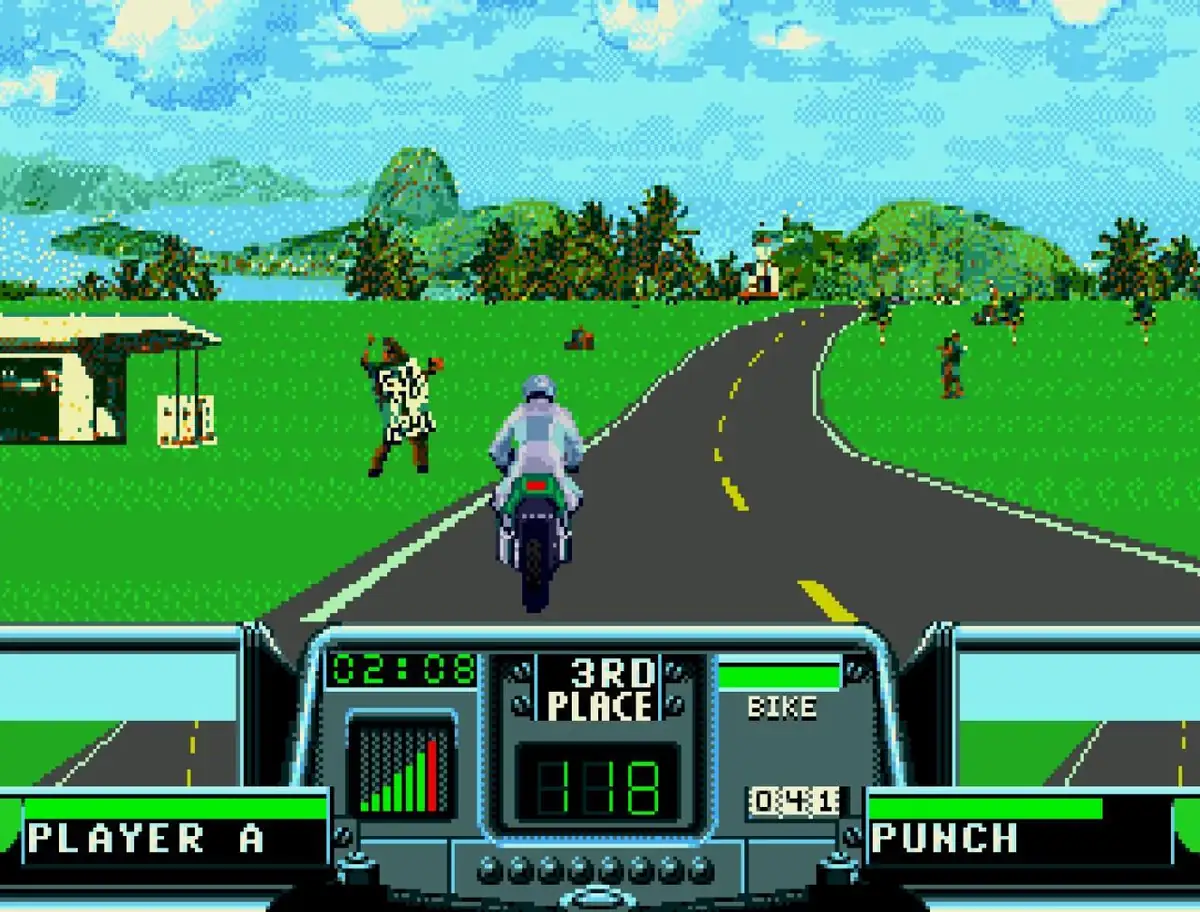
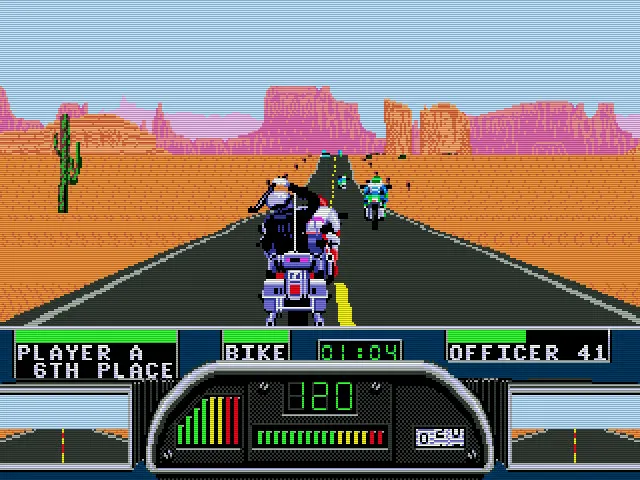
The marketing understood exactly what EA was selling. Period advertisements described the game with phrases such as “Speed and Bleed,” emphasizing wipeouts, chains, faster motorcycles and two-player action. The violence remained cartoonish enough that riders always seemed capable of getting up for another beating, but the attitude was becoming part of the product. Road Rash had discovered that the fastest way to distinguish itself from ordinary racers was not to apologize for being ridiculous.
The sequel also hardened the internal mythology of EA’s early console teams. Developers who had worked on one project reappeared in another. Breen, Geisler, Koch, Brennan, Hubbard, Veca and others were not anonymous names buried behind a giant corporate brand; they formed a recognizable network of creators whose fingerprints can be followed through EA’s 1990s catalog. That becomes even more visible in Road Rash 3.
Road Rash Escapes the Genesis
Although the Genesis was Road Rash’s spiritual home, the original game did not stay there. Versions appeared for Amiga, Sega Master System, Game Gear and eventually Game Boy, with different developers adapting the basic formula to very different hardware. These ports matter because they show how quickly Road Rash became a recognizable property. A game conceived specifically around the Genesis’ strengths became valuable enough that publishers tried to translate its hills, fights, police and traffic onto machines with very different capabilities.
The conversions also reveal what was essential to the identity. Visual fidelity could fall. The road effect could change. Music could change. Screen size could shrink dramatically. Yet as long as the player was racing a motorcycle down public roads while physically attacking rivals, the result still read as Road Rash. That portability would become important when the franchise entered the CD era, where EA effectively rebuilt the concept rather than merely increasing resolution.
Road Rash 3: The Genesis Formula Goes Global
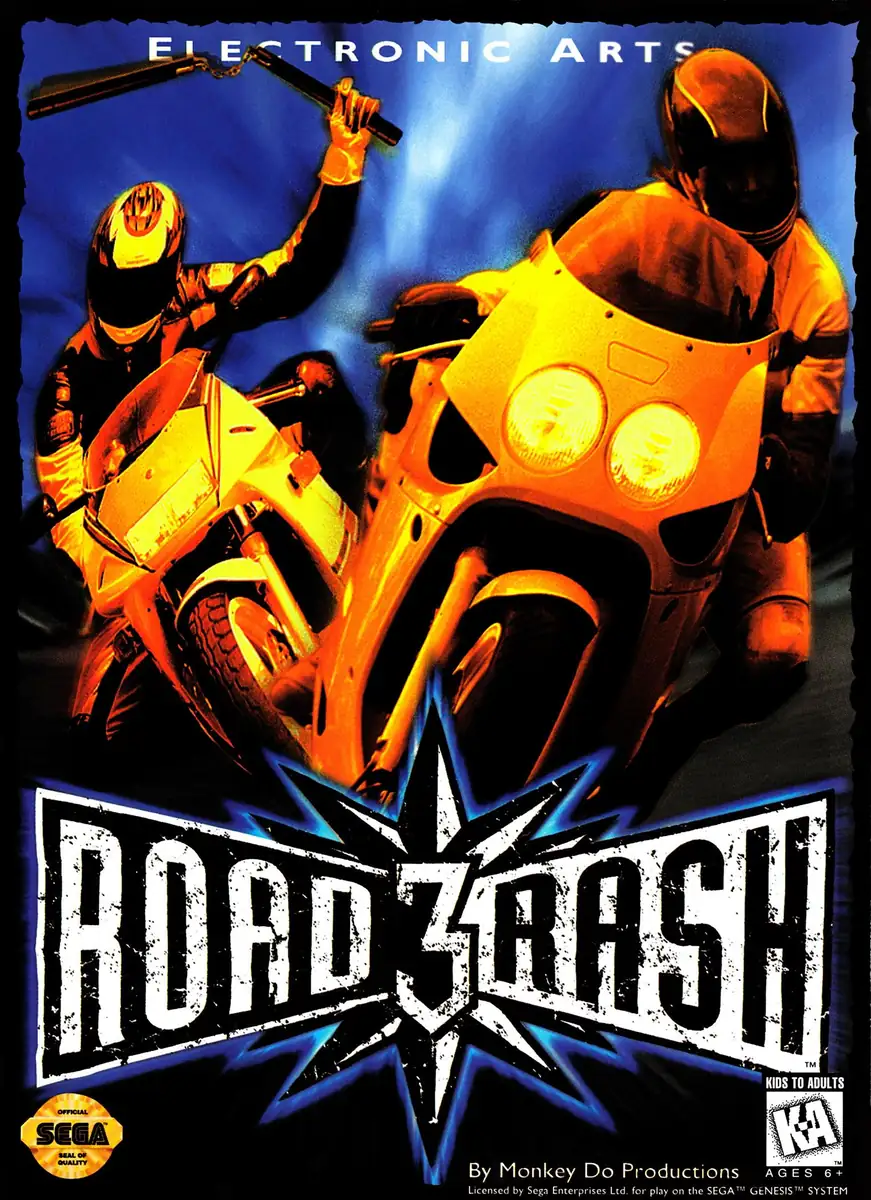
By the time Road Rash II was finished, Dan Geisler was tired. Later accounts say he believed the Genesis technology had been pushed close to its limit and was frustrated with compensation for his work on the first two games. He considered leaving EA and accepted an offer elsewhere before ultimately negotiating to remain. The origin story of Road Rash 3 is therefore less “EA automatically ordered another sequel” and more a case of key people deciding there was still one more worthwhile Genesis game to build.
Development began in 1994 while another Road Rash team was working on the new CD-based version for 3DO. The two projects existed beside each other and shared production resources. Artist Michael Hulme, recruited from Cinemaware, later became associated with one of Road Rash 3’s defining ideas: if the Genesis could not suddenly become a new machine, then the sequel needed a new sense of place. The solution was a world tour. Rather than returning to another variation on American scenery, Road Rash 3 sent riders through international environments and used the visual changes as the major new feature.
The Road Rash 3 manual is especially valuable because it preserves the development team in photographs. Randy Breen appears as producer. Another photo groups David Luoto, Dan Geisler and Warrick Holfeld. Don Veca and Jim Sproul appear together. Separate team photos identify Peggy Brennan, Laura Bowen, Jeff Stokol, Michael Hulme, Michael Shirley, Sung Moon Kwon, Barbara Meyers, Irene Peng, Aaron McClay, Mike Lopez, Thom Phillabaum, David Costa, Steve Murray and testers. For a mid-1990s cartridge game, that is remarkable documentation.

Road Rash 3 added more than scenery. Weapons became more elaborate, the player could steal them from rivals, police pressure increased, and the progression system gained additional complications such as working off debts through “repo man” or “snitch” scenarios. Yet the game still lived inside the familiar Genesis framework. That was both its strength and its limit. By 1995, the industry was moving rapidly toward CD-ROM and polygonal 3D. Road Rash 3 represented the polished endpoint of one technological line while another Road Rash project was trying to define the next one.
1994: Road Rash Becomes a Multimedia Production
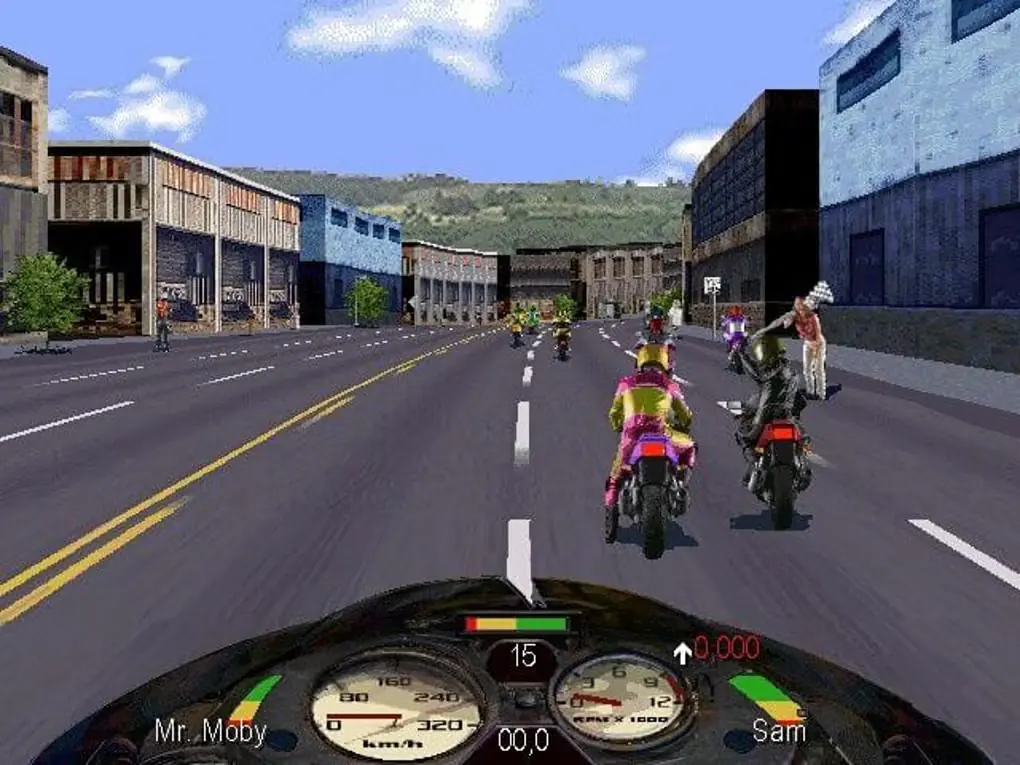
If the Genesis games were built around a clever road engine and compact teams, the 3DO version of Road Rash was something else entirely. The credits for the 1994 release list more than eighty people across programming, graphics, photography, audio, video processing, testing, production and a surprisingly large live-action cast. The project was no longer just a racing game with character portraits. It was being treated like a multimedia production.
That change makes sense only in the context of the early CD-ROM years. A cartridge demanded ruthless storage discipline. A CD offered hundreds of megabytes and invited developers to ask a new question: what can we put on this disc that would have been absurdly expensive or impossible before? For Road Rash, the answer was filmed video, digitized characters, rock music, music videos, photography, more elaborate audio and a presentation designed to make the 16-bit games look like yesterday’s technology.
Retro Replay’s complete history of the Panasonic 3DO covers the larger hardware story: the $699 launch, Trip Hawkins’ open-platform ambition and the strange market into which this new Road Rash arrived. For EA, however, the 3DO was not merely another console. It was a chance to demonstrate why CD storage mattered.
EA Makes a Biker Movie
The live-action production may be the most gloriously 1994 part of Road Rash. The credits preserved by the 3DO manual and MobyGames read less like a normal game staff list and more like a small film production. There was a director, line producer, director of photography, video engineer, key grip, camera car, wardrobe and props, offline editing, online assembly, color correction and special effects. EA staff and local riders appeared on camera. Randy Breen himself is credited among the motorcycle riders and race-conclusion performers, while other developers showed up as business people, bikers, joggers, pedestrians, trophy presenters and various characters.
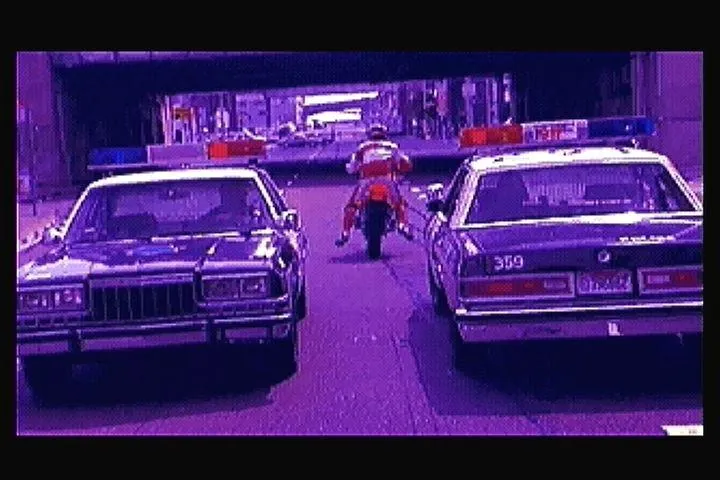
The videos were knowingly ridiculous. Rival riders mugged at the camera. Winners celebrated. Losers complained. Police appeared as recurring antagonists. Rather than trying to make Road Rash serious, the production amplified the personalities that had always existed in the margins of the cartridge games. The result is now a perfect time capsule of mid-1990s interactive entertainment: leather jackets, attitude, fisheye energy, exaggerated acting and the sincere belief that full-motion video was evidence of technological progress.


Later histories describe roughly twenty-five minutes of filmed material. The production used real motorcycles and real roads, not a completely studio-bound fantasy. That decision introduced exactly the kind of chaos you would expect from people filming Road Rash. Accounts of the shoot describe bikes used as production props, including a Ducati that was damaged badly enough during filming that it could not simply be returned and instead became an object EA could display. Whether viewed as marketing excess or inspired commitment, the production embodied the larger philosophy of the game: if you are making a motorcycle-combat spectacle, subtlety is optional.
Lucy Bradshaw and the Expanding Production Machine

The 3DO credits also demonstrate how rapidly game production was changing. Lucy Bradshaw is credited as project manager, long before her later prominence at Maxis. Steve Murray, Lori Washbon, Jeff Smith, Thom Phillabaum, Don Veca and others appear in roles that stretch across design, track creation, art, sound and production. Road Rash had grown from a relatively small Genesis group into a large coordinated effort spanning traditional game development and filmed entertainment.
That expansion did not mean the old creators vanished. Breen remained producer and designer. Don Veca became central to game music and sound effects. The continuity is important: 1994 Road Rash was not a random reboot by strangers. It was an attempt by people who understood the series to reinterpret it for hardware that offered completely different possibilities.
Soundgarden, A&M and the Moment Game Music Changed
The most historically important part of the 1994 project may not be the graphics at all. It may be the soundtrack deal.
Electronic Arts and A&M Records assembled a lineup that included Soundgarden, Paw, Hammerbox, Therapy?, Monster Magnet and Swervedriver. A limited-run audio sampler accompanied some copies, and Billboard treated the partnership as evidence that games were becoming a meaningful new place for recorded music. In January 1994, Billboard’s “Enter*Active File” devoted an article to the Road Rash project, noting that the game would include music and video clips from A&M alternative acts and that the label and EA planned cross-promotion.
“Music is literally becoming part of the game.”
— EA audio director Murray Allen, quoted by Billboard
That sentence sounds ordinary now because modern games routinely use licensed catalogs, artist premieres, radio stations and soundtrack albums. In 1994 it was closer to a mission statement. A&M’s Brad Pollak told Billboard that game players and alternative-music listeners overlapped, but that each audience could still introduce the other to new products. A Road Rash player might discover Paw. A Soundgarden fan might discover a 3DO game. The cross-promotion was not an afterthought; it was part of the business case.

The A&M sampler’s track list, preserved by On A&M Records, reads like a snapshot of the period: Soundgarden’s “Rusty Cage,” “Outshined,” “Kickstand” and “Superunknown”; Paw’s “The Bridge,” “Pansy” and “Jessie”; Hammerbox’s “Trip” and “Simple Passing”; Therapy?’s “Teethgrinder” and “Auto Surgery”; Monster Magnet’s “Dinosaur Vacume”; and Swervedriver’s “Last Train to Satansville” and “Duel.” The timing could hardly have been better for EA. Soundgarden’s Superunknown became one of the defining rock albums of 1994.
A later first-person account from the label side, published by Hypebot, describes A&M initially seeing the proposed game-music deal as unfamiliar and cumbersome until Soundgarden’s enthusiasm changed the conversation. The band already liked Road Rash. That mattered. Instead of musicians treating games as a novelty below their attention, one of the biggest rock bands of the moment wanted in.
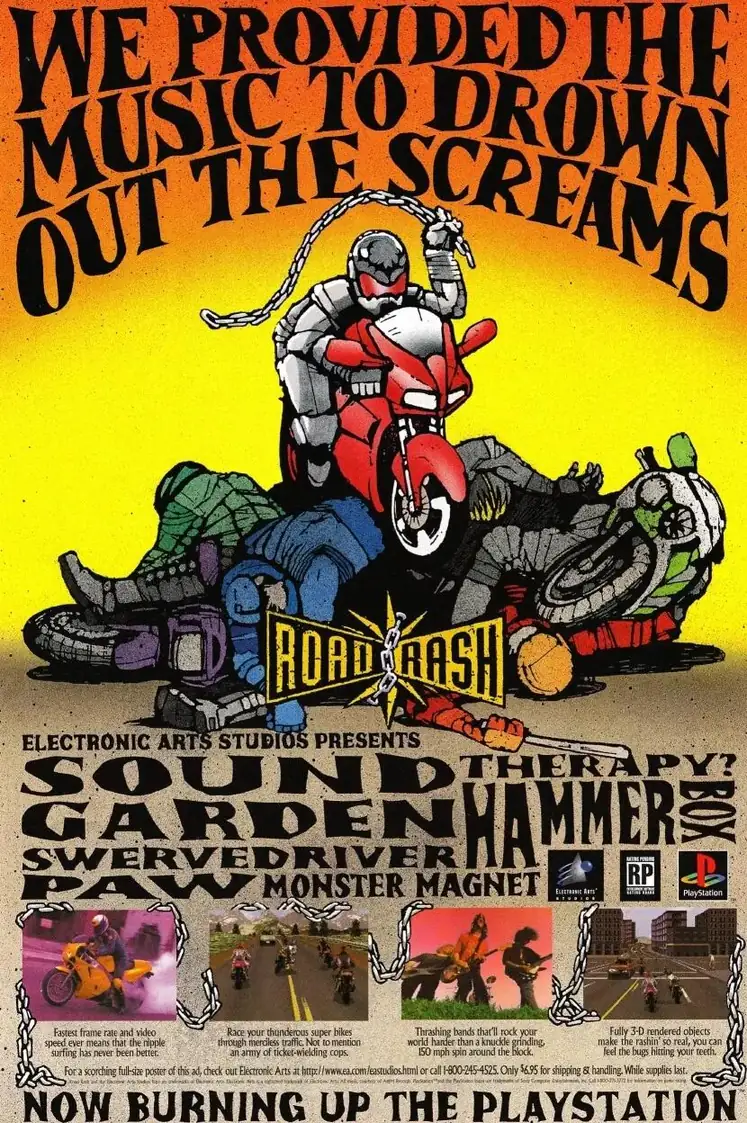
The relationship also helped demonstrate that licensed music could do more than provide background atmosphere. It could sell the game, sell the bands and become press coverage by itself. Billboard returned to the subject later in 1994, reporting that EA considered the response to Road Rash’s music strategy strong enough to inform other projects. By 1998, Billboard was writing about game soundtracks as an expanding label strategy, with Road Rash 3D again in the middle of the discussion.
Sega CD, PlayStation, Saturn and Windows: One Road Rash, Several Machines
The multimedia Road Rash spread outward in complicated ways. The 3DO version arrived first, but the broader production was reused and adapted across Sega CD, PlayStation, Saturn and Windows. These were not always simple one-to-one ports. The Sega CD manual, for example, lists Russ Patterson and Carson Whitsett Jr. as programmers with additional work by Dan Geisler, Warrick Holfeld and Walt Stein, while retaining Breen as producer and drawing heavily from the original 3DO production assets, cast and music.
The Sega CD version is especially interesting because it brought the new multimedia material back onto Sega hardware that was architecturally tied to the Genesis. It looked like the old and new Road Rash worlds colliding: familiar 16-bit roots augmented by disc audio and video. On other platforms, the balance shifted more decisively toward the 32-bit presentation.

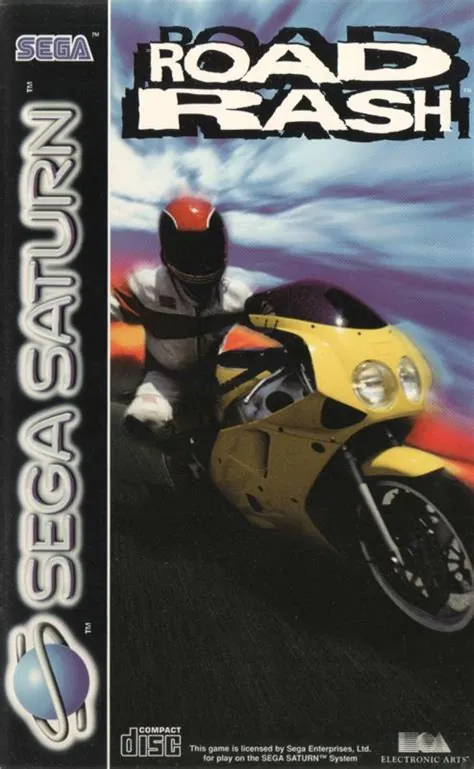
The Windows version pushed the production onto PC and dramatically expanded the credits yet again. MobyGames lists well over a hundred contributors across the Windows production, a reminder of how quickly the size of commercial game teams was increasing. Road Rash had moved from a 25-person Genesis credit list to a multimedia franchise involving film, audio licensing, conversions, platform specialists and international production.
Yet underneath all the spectacle, the core mechanics still resembled the original philosophy. Open public roads. Traffic. Police. Rival riders. Upgrades. Combat. The problem was that the rest of the industry was catching up technologically, and the next major Road Rash would have to do more than place video clips around a 2D-projection racing engine.
Road Rash 3-D: Rebuilding the Road for Polygons

The transition to full 3D was the point where Road Rash stopped being able to rely on the technical identity established by Dan Geisler’s Genesis road. On PlayStation, competitors were increasingly expected to inhabit real polygonal spaces. EA’s answer was Road Rash 3-D, developed through its Advanced Technology Group and released in 1998.
Producer Hunter Smith explained the goal in a GameSpot interview. The older games, he said, created the perception of depth through projection. Road Rash 3-D instead treated bikes, riders and roads as objects inside a true 3D environment with mass, terrain and physical relationships. EA wanted long, interconnected roads rather than lap-based circuits and needed to stream the world while also streaming music.
“True 3D separates this Road Rash from all the others.”
— Hunter Smith, GameSpot
Technically, that was the correct direction. Creatively, it was dangerous. The original Road Rash feel had been built around deliberate exaggeration: readable traffic, big character motions, predictable fighting range and a road model that served the gameplay rather than a simulation. Moving to 3D meant reinventing every one of those relationships. Physics that looked more realistic could feel less immediate. A broader world could make combat less dense. Camera behavior became more complicated. The technology was objectively more capable, but capability did not guarantee the same rhythm.
EA again leaned into music. Billboard’s 1998 coverage of video game soundtrack deals referenced Road Rash 3D as part of a new wave of games using record-industry partnerships. By then the idea that Road Rash should sound culturally current was embedded in the brand. What had begun with Rob Hubbard’s synthesized rock had become a recurring expectation that each new Road Rash needed a contemporary musical identity.
Critical reaction, however, showed the danger of changing the feel. When GameSpot later reviewed Road Rash: Jailbreak, it explicitly framed that game as a return toward the fighting-heavy fun that some longtime players felt Road Rash 3-D had lost. That is the central problem of the 3D era in miniature: EA had solved the technical challenge of building a more modern Road Rash but had not convinced everyone that modernity was what made Road Rash fun.
Road Rash 64: EA Licenses the Fight to THQ

Road Rash 64 is one of the strangest branches in the family because Electronic Arts did not develop or publish it. EA licensed the property, THQ published it and Pacific Coast Power & Light developed it. MobyGames notes that the project was originally expected to be a version of Road Rash 3-D before becoming its own game, with a stronger emphasis on combat.
The developer itself adds another EA connection. Pacific Coast Power & Light had been founded by former EA executive Don Traeger and was later acquired by THQ. The Road Rash 64 credits list Gabriel Jones as producer, Cory Ondrejka as project leader, Richard McGovern as designer and a compact technical and art team. In other words, the first Road Rash on a Nintendo home console was being made outside EA by a studio with roots in EA’s extended family.

The Nintendo 64’s four-controller design made local multiplayer a natural selling point, and Road Rash 64 leaned into the communal violence. The result was rougher and more combat-heavy than the original games, but that very roughness is why it still has defenders. It understood one basic truth: a Road Rash game can survive technical ugliness if hitting another rider off a motorcycle remains funny.
Jailbreak: One More Attempt to Recover the Old Spirit

Road Rash: Jailbreak arrived in 2000, near the end of the original PlayStation’s life, and it is notable for how many old names returned. Randy Breen and Mike Lopez are credited with creative direction, design, tuning and direction. Lori Washbon handled character and vehicle visual direction. Steve Murray worked on world creation and served as associate producer. Hunter Smith produced. Arthur Koch appears again in the art credits. Rather than being an anonymous late sequel, Jailbreak retained connective tissue with the people who had helped define Road Rash across the decade.
The design also acknowledged criticism of Road Rash 3-D. GameSpot’s review said Jailbreak “puts the fun back” into the series by re-emphasizing fighting while maintaining the racing. The game introduced a gang-oriented progression structure, a Five-O mode in which the player acted as police, nitro and weapon upgrades, and a range of multiplayer variations. The most wonderfully strange was sidecar play: one player could focus on steering while another concentrated on attacking, and multitap support allowed four players into the chaos.
GameSpot’s preview of the unfinished game singled out the sidecar battle, cops-and-robbers and expanded attack combinations. Those features show EA trying to answer a difficult question: if the technology of the original was no longer special, what was the essence worth preserving? Jailbreak’s answer was violence, personality and multiplayer.
It was a respectable answer, but the market had moved. By 2000, PlayStation 2 was arriving. Racing games were splitting into increasingly sophisticated simulations, arcade racers, open-world experiments and licensed motorsport experiences. Road Rash no longer defined a category by itself. It was now one recognizable brand competing inside a much larger industry.
The Last Official Echo: Jailbreak on Game Boy Advance
The original run did not end completely in 2000. A Game Boy Advance version of Road Rash: Jailbreak arrived in 2003, developed by Magic Pockets and published by Destination Software under an EA distribution arrangement. It translated the combat-racing idea back onto modest portable hardware, almost like the series had completed a circle from 16-bit sprite racing through multimedia spectacle and 3D experimentation back to a simpler handheld interpretation.
After that, Road Rash effectively disappeared as an active EA franchise.
Why Road Rash Went Quiet
There is no single dramatic moment when Electronic Arts publicly killed Road Rash. The more revealing story is a series of false starts, internal experiments and public comments that never became a finished game. The industry clearly remembered the name. Developers clearly remembered the formula. EA repeatedly showed signs that the property still had value. Yet getting from nostalgia to a modern production proved surprisingly difficult.
Part of the difficulty is visible in Randy Breen’s own analysis. In the Sega-16 interview, he argued that Road Rash is harder to reproduce than it appears because it is not cleanly one thing. It is racing, combat, traffic avoidance, slapstick, progression and character attitude happening simultaneously. A team without a strong shared vision can easily make a motorcycle racer with melee attacks that technically checks the boxes and still does not feel like Road Rash.
Criterion Games, the studio behind Burnout, seemed like the obvious candidate. In 2012, Criterion creative director Craig Sullivan told GameSpot that the property made sense for the studio:
“Road Rash seems like a good fit for Criterion.”
— Craig Sullivan, Criterion Games
Alex Ward went even further conceptually, talking about a ridiculous-sounding Burnout Versus Road Rash idea. Criterion had already added motorcycles to Burnout Paradise, which Ward later described as a useful experiment in camera and handling. But Criterion never actually began a full Road Rash production. Ward later said another EA team had attempted one using code from Burnout Paradise, but the project was cancelled. PlayStation LifeStyle preserved his comments about that abandoned effort.
Dan Geisler Wants Back on the Bike
The most emotionally satisfying revival story came from Dan Geisler. In 2013, fans asked why Road Rash had never properly returned. Geisler’s response was wonderfully candid:
“I just needed 20 years off.”
— Dan Geisler, quoted by Digital Spy
He said he was ready to make another game and floated Kickstarter as a possible route if enough people were interested. The problem, of course, was ownership. Road Rash belonged to EA. Geisler could ask for rights or create a spiritual successor under another name, but nostalgia alone could not unlock the trademark and production budget.
For a time he discussed an independent project called Hard Rider: Back in the Saddle, reportedly involving some people connected to the original games. Funding never materialized. The attempt faded, but it proved that the desire for a return was not coming only from fans. One of the people who built the original road still wanted to take another run at it.
Road Redemption: The Fans Stop Waiting

In 2013, while Geisler was discussing his own interest in returning, another team took the concept to Kickstarter. Road Redemption was not an EA project and did not include the original Road Rash creators. It did not pretend otherwise. The pitch was straightforward: motorcycle combat racing deserved to exist in modern games, and if the official series would not provide it, an independent studio would.
Contemporary coverage from Engadget explicitly framed the project as a Road Rash spiritual successor. The developers expanded the violence with heavier weapons, firearms, explosives, counter systems and modern progression. In a 2013 Nintendo Everything interview, the team described the game as motorcycle combat at extreme speed, emphasizing how moving through traffic transformed ordinary action-game combat into something dynamic.
The finished Road Redemption eventually launched on PC in 2017 and later reached consoles. Its official press kit still describes a cross-country journey built around races, robberies, assassinations and gang progression. It is not Road Rash in name, tone or exact physics, but its existence is proof that the basic fantasy never became obsolete. Players still understand the appeal instantly: put two motorcycles beside each other at 100 mph and give one rider a bat.
Why the Genesis Games Still Feel Different
Technology usually dates old racing games brutally. Frame rates feel low. Draw distances feel short. Sprites look coarse. Road Rash survives better than expected because its most important systems were never trying to simulate reality faithfully. The riders are readable. The attacks are exaggerated. The traffic is spaced to create decisions. The road is theatrical. Crashes are funny enough that losing can still be entertaining.
Most importantly, the game continuously forces the player to choose where to look. The opponent beside you is an immediate threat. The car ahead is a larger threat. The police officer behind you might become the largest threat if you crash. The weapon in your hand is valuable only if you are close enough to use it. The faster motorcycle you bought is useful only if you can keep it on the road. Every system increases the pressure on every other system.
That is why Road Rash cannot be reduced to “racing plus fighting.” Plenty of games have tried vehicular combat. Plenty have had motorcycles. Plenty have included melee attacks. Road Rash worked because the fighting was embedded inside the act of racing so tightly that the two systems constantly sabotaged each other.
The people in the manual
The original manual put the developers’ faces beside the game. Randy Breen, Dan Geisler, Arthur Koch, Peggy Brennan, and their colleagues were visible to the buyer in a way many later game teams were not. The photograph makes the series’ continuity easier to see. Programmers had to coax a rushing road from the Genesis; artists had to make a punch readable at speed; composers and audio staff built attitude first from the console’s sound chip and later from a CD soundtrack.
That later soundtrack was also a business experiment. Billboard’s January 1994 coverage describes EA’s arrangement with A&M Records while game music and record-label promotion were still learning each other’s rules. Soundgarden and other bands gave the CD version a contemporary sound, but the deal did more than decorate races. It tied artists, a publisher, a label, samplers, and press coverage into one campaign. Road Rash did not invent licensed music in games; it showed how a soundtrack could become part of a game’s identity and its sales pitch.
Breen has also described the appeal of original ownership. EA did not need a league or film studio’s permission to make riders punch each other on a public road. As budgets rose, that kind of odd internal bet became harder for a large publisher to justify. The same people who could once pitch a strange idea and build a prototype eventually had to compete with safer franchises for time and money.
The road without a new Road Rash
The question has followed the series for years. The name is familiar, original developers have expressed interest, and Road Redemption showed that players still want motorcycles, traffic, and a good weapon in arm’s reach. Yet a modern revival would have to choose its scale. A huge open world, online gangs, elaborate physics, and hundreds of bikes all sound appealing on a pitch slide. The Genesis game worked because every feature pushed the same dangerous race forward.
Its road gave you enough time to plan a swing and little enough time to regret it. Police made the track feel illegal. Wrecks cost position, money, and dignity, so they remained funny without becoming harmless. A new game could render a continent and still miss that rhythm. The series’ dormancy is frustrating because the core idea remains so clear, not because today’s hardware lacks the power to draw it.
One more hill
The Genesis trilogy is the series at its sharpest: fast roads, readable rivals, comic crashes, and upgrades that make the next race tempting. The 3DO and CD versions capture another era entirely, when filmed actors and licensed rock seemed ready to enlarge every game. Road Rash 3-D, Road Rash 64, and Jailbreak each tried to carry the idea into a new market. None erased the sight of a rider sprinting down the shoulder toward a fallen bike.
Perhaps that is the design test any revival would have to pass. You should be able to tell a story about one bend, one rival, one reckless decision, and the car that appeared at exactly the wrong moment. Thirty years of hardware progress can make the accident prettier. It cannot make the decision for the player.
Research and source notes
Primary and specialist research used throughout this feature: Sega-16’s Randy Breen interview, the original Genesis manual, the Road Rash II manual, the Road Rash 3 manual, 3DO manual, MobyGames, Billboard’s 1994 Road Rash music coverage, GameSpot’s Road Rash 3-D interview, and the Road Redemption press kit.

The crash-and-run-back-to-your-bike routine is still one of Road Rash’s best little touches. It makes a bad swing costly without turning every mistake into a boring reset, which is probably why the Genesis games remain so easy to pick up for a short session.
I loved this game on the 3DO!!