Retro Replay Retro Gaming History, Reviews & Emulation
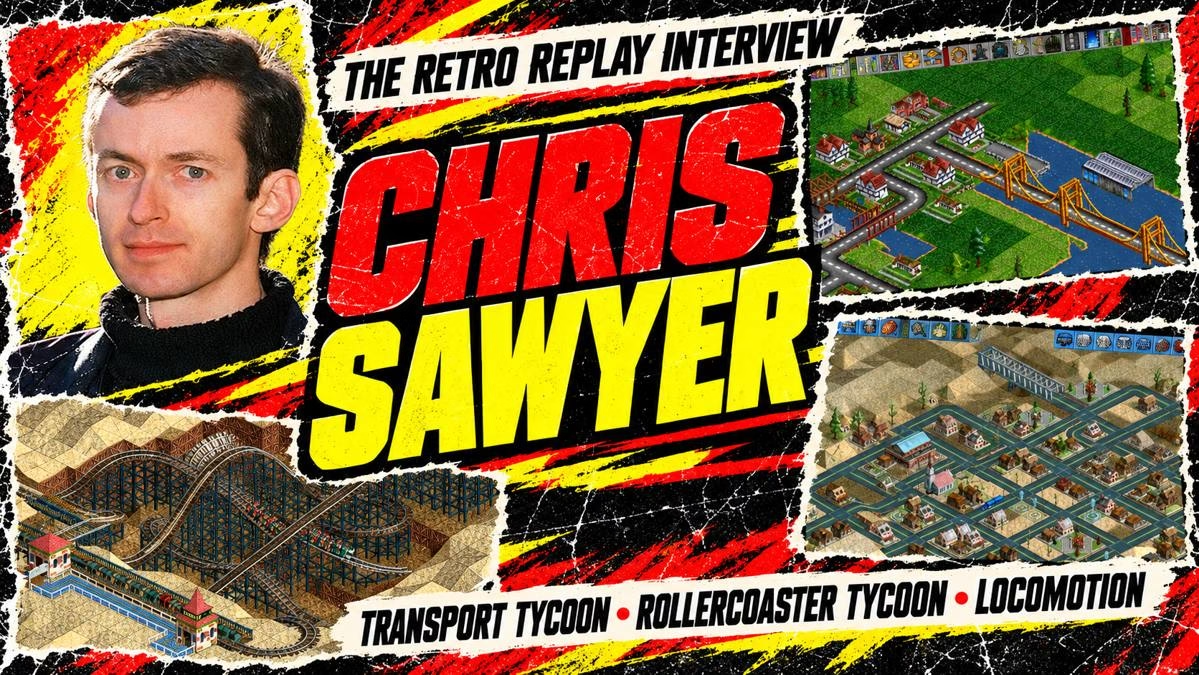
Interview by David, Retro Replay.
A little train following a track was enough to suggest a whole game. For Chris Sawyer, the pleasure of watching a system work came before the business figures surrounding it: the acceleration of a locomotive, the movement of a vehicle through an isometric landscape, or a park guest deciding which ride to try next. Those small interactions grew into worlds that players could build, manage, and happily spend hours watching.
Sawyer is the programmer and creator behind Transport Tycoon, RollerCoaster Tycoon, and Chris Sawyer’s Locomotion. Before those games, his work converting other developers’ titles to the PC gave him years of experience with the constraints of commercial game development. His own simulations brought that technical knowledge together with two lasting interests: railways and roller coasters.
In this written interview with Retro Replay’s David, Chris describes how those games grew through experimentation, why x86 assembly felt like the natural language for his work, and what it took to make busy worlds run smoothly on the hardware of the time. He also reflects on the strengths and compromises of sequels, the lasting appeal of isometric graphics, and the communities still exploring his games.
The conversation offers a detailed view of development from someone who knew the code intimately, but it keeps returning to a straightforward question: was the thing he had just built enjoyable to play?
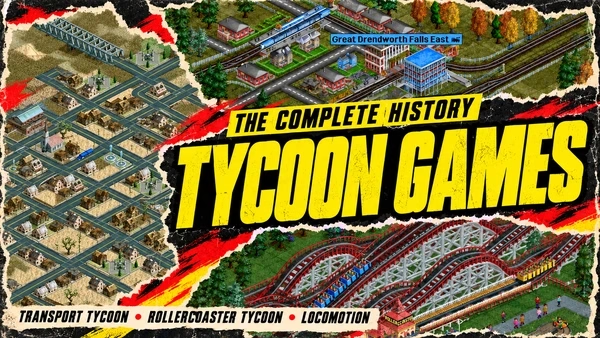
For the wider story of these games and their lasting influence, read The Complete History of Chris Sawyer’s Tycoon Games, then explore their creation in Chris’s own words below.

Learning the Craft Through PC Conversions
Retro Replay: Before Transport Tycoon, you spent years working on conversions of other developers’ games. How important was that period in teaching you how commercial games were structured and optimized?
Chris Sawyer: I learnt a huge amount during those years, both about programming and game design and the games industry. It was a fascinating process converting games to the PC – there were always so many challenges as the PC really couldn’t handle graphics and sound as well as other platforms like the Amiga, and it was also intriguing learning how different styles of games were programmed and optimized.
Retro Replay: What made you finally decide it was time to stop primarily converting other people’s games and create something entirely your own?
Chris Sawyer: Frankly I was getting frustrated that my conversion work was being held up by slow development of the original games I was converting – that’s not a criticism of those writing those games as I had less work to do to convert a game than they did to create the original, but very frustrating when I’d run out of work to do (and also didn’t get paid because I couldn’t finish the next milestone). My final two conversions (Dino Dini’s Goal and Frontier Elite 2) I actually worked on in parallel to try to solve this problem, but it was still frustrating. And I felt it was time to have a bit of fun trying to create a game of my own, and doing it at my own pace rather than someone else’s pace, even though I then had to do it at my own cost too.
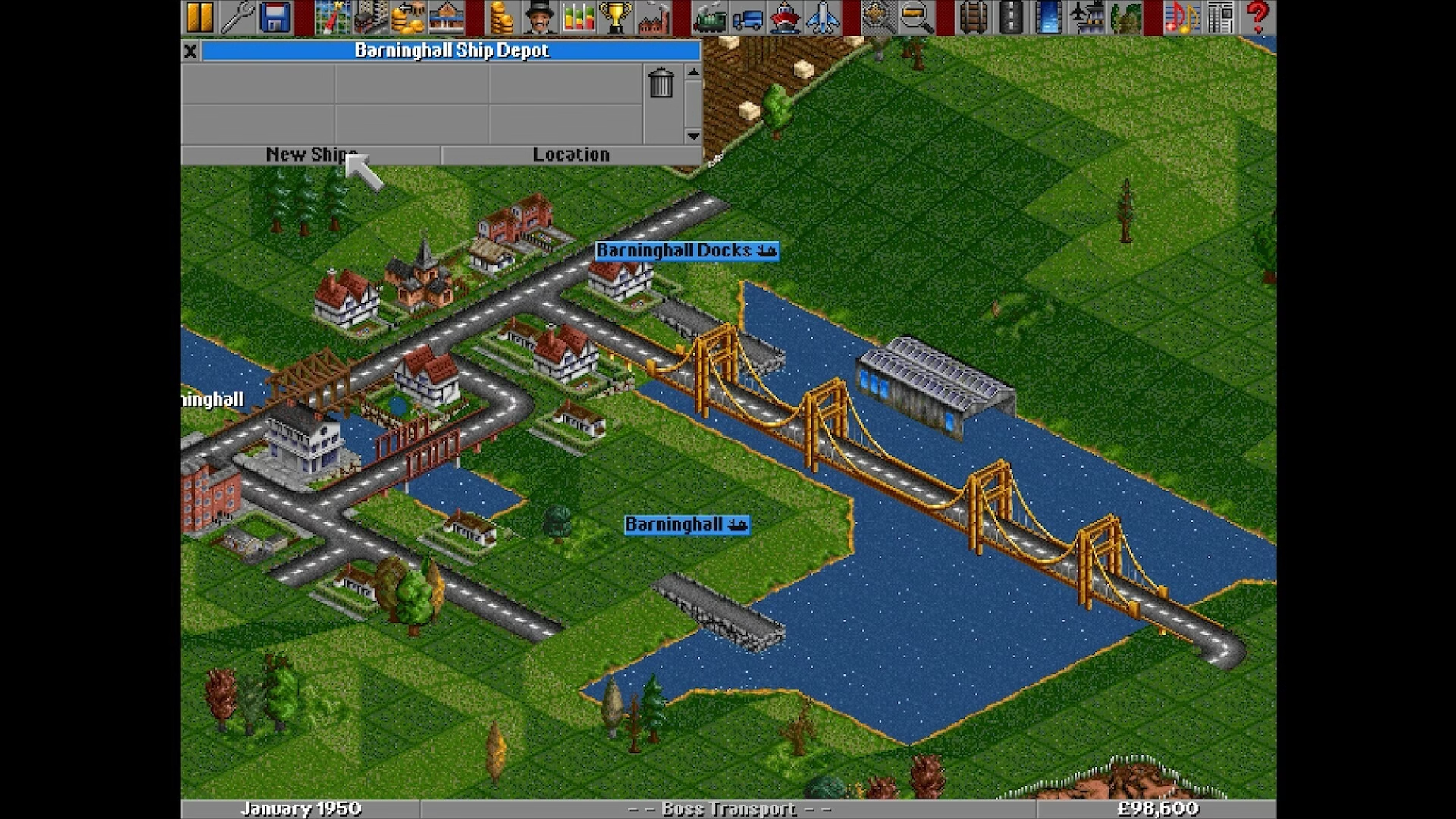
Transport Tycoon: A Train, a Track, and a Living World
Retro Replay: Transport Tycoon combined your interest in transport with a very detailed simulation. Did you begin with the transportation system itself, the business simulation, or simply the idea of creating a living isometric world?
Chris Sawyer: I think what came first was the isometric display system, which is something I’d been playing with on and off for quite a few years. That led to thoughts of trying to get simple railways working in an isometric game world, I guess trying to recreate what I liked from Sid Meier’s Railroad Tycoon but in isometric. Just getting a little train to follow a basic track in isometric was quite satisfying, and the game just sort of grew from there.
Retro Replay: How difficult was it to make a world full of vehicles, industries, towns and changing routes continue to feel understandable to the player rather than becoming overwhelming?
Chris Sawyer: Perhaps the core of what I was doing was that it should be “fun”, so I was creating things and adding features which were fun for me, even if it was just the little details that I enjoyed, like being able to watch a train accelerate along a track or giving it a list of orders for what it should do. Maybe I didn’t always get it right and some parts of the game could be off-putting or confusing for players but I really just wanted to make sure it was fun and easy to play. I did have a preference for construction and operating railways rather than the business side of things, and perhaps that helped make the game less overwhelming for players.
Retro Replay: How much of Transport Tycoon’s design came from games you admired, and how much simply emerged as you experimented with the simulation?
Chris Sawyer: Two games I really admired at that time were Sid Meier’s Railroad Tycoon and Sim City 2000, and I definitely took a huge amount of inspiration from both games. Railroad Tycoon had such a good “game balance” to its business simulation and I learned a huge amount from that, though ultimately I think my own game was much less complex. And I just loved the way Sim City 2000 looked – I guess that was the inspiration behind wanting to create my own detailed isometric game world. Once I’d actually got the basics of Transport Tycoon working though it really just evolved and grew, depending on what I thought might work (and what sometimes didn’t work), until the game was at a point where it could be shown to potential publishers.
Retro Replay: When you were developing it largely by yourself, how did you know when a feature was genuinely fun rather than merely technically impressive?
Chris Sawyer: I guess the short answer is that I didn’t know! I’ve always been primarily a programmer rather than a game designer, and so I do get carried away with technical achievements sometimes and maybe they weren’t always good for the game design. But then I was also creating something that I wanted to play myself, so if a feature made it more enjoyable for me then perhaps it might also make it more enjoyable for others too.
Writing the Simulation in x86 Assembly
Retro Replay: Transport Tycoon was written largely in x86 assembly language. Was assembly simply the natural language for you by then, or did the simulation genuinely require the performance it gave you?
Chris Sawyer: Both really – x86 assembler code was my natural language by then, and I knew I could get more out of the game by writing in assembler code. By then many games were already being written in high level languages like C, and technically I could have gone down that route too, but I knew it would mean compromising on frame rate and possibly features too. I could write x86 code far quicker than C, I could optimize it better, I could be sure of exactly what it was doing (C compilers back then weren’t 100% reliable), and a final benefit was how quickly I could make changes and test the code – No waiting half an hour for dozens of long C code files to compile, just a few seconds to assemble the entire sourcecode and it’s ready to run.
Retro Replay: When people today hear that games of this complexity were written in assembly, they often seem amazed. Did it actually feel unusual to you at the time?
Chris Sawyer: No it felt normal and natural for me – I couldn’t understand at all why some developers were starting to use high level languages like C! Yes I knew that for converting games between platforms C had huge advantages, but everything else I saw as downsides. I was a reasonably proficient C programmer myself, but I could write in x86 code more quickly than I could write in C, and I knew the code would be more efficient and faster, and possibly more reliable too.
Retro Replay: Did programming so close to the hardware allow you to understand exactly where every CPU cycle and byte of memory was going in a way modern development tools sometimes hide?
Chris Sawyer: Writing in x86 assembler code certainly helped a huge amount – that was one of the downsides of C in those days, that you really got very little idea of how its optimisation worked or how to force it to be more efficient. I guess that’s a lot easier these days with modern compilers and development tools which can help with optimisation? Still it’s more fun and satisfying doing it the old way, where you know almost exactly how the CPU cycles work and how to get the best out of both the CPU and memory.
Retro Replay: Was there a particular system in Transport Tycoon — vehicle routing, signals, town growth, economics, graphics or something else — that was especially difficult to get right?
Chris Sawyer: I always struggled with the economics / business side of the simulation – it’s something that didn’t interest me as much as other aspects of the game and something I maybe didn’t understand particularly well. It ended up being rather simplified, and trying to get the game-balance right was just a case of trial and error.
Expanding Transport Tycoon
Retro Replay: Transport Tycoon Deluxe expanded the original considerably. Was Deluxe mostly a chance to add ideas that simply could not fit into the first game?
Chris Sawyer: Yes it was mostly a chance to just expand on the original game with features that didn’t make it into the original or that only came to mind through extensive playtesting of the original. We’d already released an expansion pack for the original game but this mostly added new graphical styles or areas of the world rather than new features, and there was pressure (or expectation) from the publisher to create a new or updated version of the full game next.
Retro Replay: Were there ideas for Transport Tycoon that never made it into either version and that you still wish you could have included?
Chris Sawyer: Maybe a lot of things which didn’t (or couldn’t) be included in the Transport Tycoon games ended up being re-visited when I wrote Locomotion many years later, things like more realistic curved tracks and more detail and multi-level construction.
Retro Replay: One of the remarkable things about Transport Tycoon is how much is happening simultaneously while the player can simply sit back and watch the world operate. Was creating a believable moving world as important to you as creating the business game?
Chris Sawyer: This was probably more important to me than the business side of the game – it was the living / moving world simulation that most interested me, and being able to watch or just tweak the transport systems as they worked. The business side always came second, and probably wasn’t designed particularly well, but I think it was good enough to make the game work as a “game” rather than a simulation or construction set.
From Railways to Roller Coasters
Retro Replay: RollerCoaster Tycoon was obviously a major change in subject matter. What was it about roller coasters themselves that became interesting enough to pull your attention away from transport simulation?
Chris Sawyer: Around that time I was getting quite obsessed with rollercoasters – I guess having been obsessed with transport systems (particularly railways) it was quite a logical progression to become fascinated by the style and engineering and function of rollercoasters, which in some ways are just railways on steroids! The engineering and aesthetics of them fascinated me, and I just became more and more curious as to whether it would be fun to build and operate rollercoasters in an isometric game environment. So it just became a bit of fun to take a break from Transport Tycoon and see what might be possible in terms of adapting the code to handle little rollercoasters.
Retro Replay: When you first experimented with getting roller coasters working inside an isometric world, did you immediately recognize that there was an entire game there?
Chris Sawyer: No not at all – it was all just a bit of fun really, and it took a while to come round to thinking it could actually become a fully-fledged game. I was familiar with Bullfrog’s Theme Park game so I knew that if I could add people and other rides and some sort of economics there was possibly a game there, though probably rather a niche game.
Retro Replay: How much of RollerCoaster Tycoon evolved organically from simply adding one interesting system after another rather than following a rigid design document?
Chris Sawyer: There never really was a design document for RollerCoaster Tycoon, well possibly I had to come up with one towards the end of development when the publisher got involved but even that ended up being quite “fluid”! Most of the game was trial and error, just trying stuff out to see what was possible, what worked, and what was fun. Often things didn’t work, but it never bothered me having to scrap code or days of work – it was all part of the process and when you find that something doesn’t work it often opens up a different direction that does eventually work. Most of RollerCoaster Tycoon’s features were ones that came about from the technical side of things, for example seeing what was possible graphically without slowing the game down, or seeing how much detail could be incorporated into guests’ intelligence without using too much data or processing, or even just seeing how much ambient sound could be processed and in what level of detail without over-stretching the hardware.
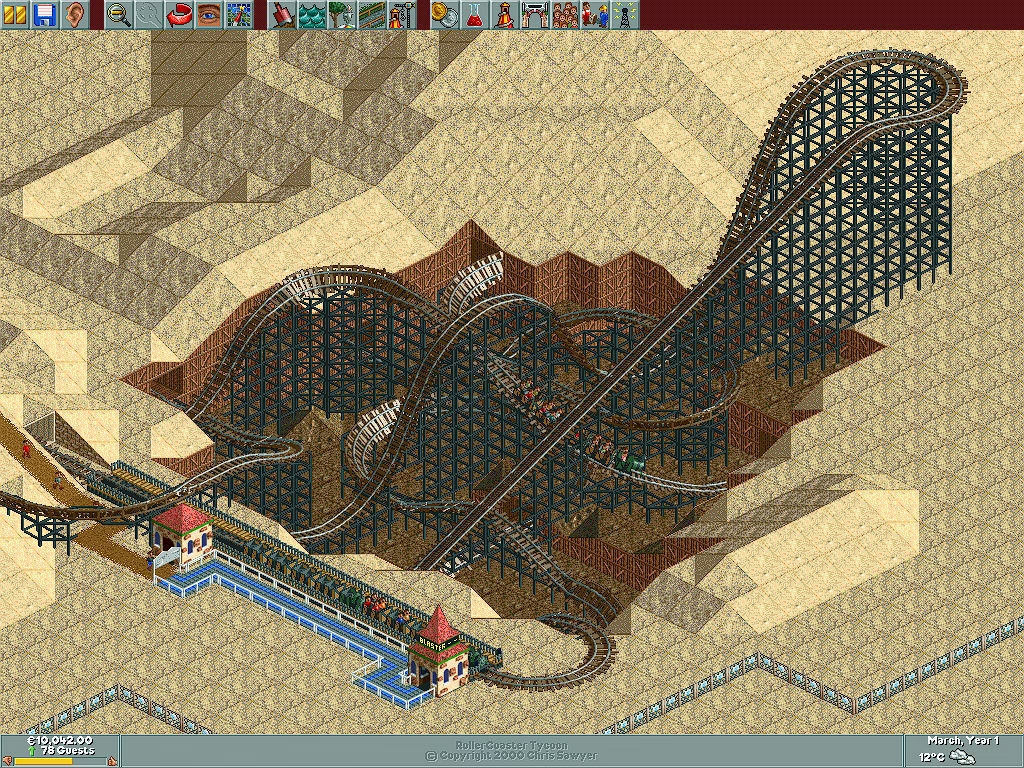
Building Tracks and Bringing Guests to Life
Retro Replay: The coaster construction system still feels extraordinarily flexible considering the technology of the time. What was the hardest part of allowing tracks to twist, climb, cross over one another and interact with terrain?
Chris Sawyer: Maybe I was lucky with the grid-like system I started off with, as it did eventually cope with some remarkably twisted and complex track sections. The data structure for the landscape (including coaster track and anything else except vehicles/people) was really important to get right at the start – it needed to be a whole lot more expandable and flexible than the one in Transport Tycoon, while also remaining compact data-wise, and efficient for displaying in an isometric projection. That data structure maybe didn’t end up being quite as efficient as it could have been because I ended up constantly expanding and adjusting it as new features were added, so maybe I was quite fortunate that it did the job so well.
Retro Replay: How did you approach simulating thousands of individual park guests without making the game unbearably slow?
Chris Sawyer: This proved really difficult – The biggest challenge was how to display and update hundreds of people on the game display without things slowing down too much. Back then there just wasn’t the processing power to update the entire display every frame, so the game uses a system whereby it only updates small areas where it knows something has changed. So only areas where people are moving or animating, or where ride vehicles are moving are being updated, which helped speed considerably. Simulating guests’ logic and movement wasn’t really a problem at all speed-wise, apart from route searching! That ended up being a huge problem throughout the life of the games – I had a really good recursive route-searching algorithm but if the “look ahead” was above a certain level each decision would stall the game for seconds or more. Trying to get the balance of reasonable route-searching without overloading the processor was quite a challenge, and involved a lot of fudging and throttling-back of the algorithm. The route-searching in the game is often criticised, and I’d agree that it’s far from perfect, but then I personally often get completely lost while trying to navigate a real theme park so maybe the lack of perfection from RCT’s guests isn’t too unrealistic!
Retro Replay: Guests have simple needs and behaviors individually, yet together they make a park feel alive. Was that emergent feeling something you deliberately designed for?
Chris Sawyer: It was something I hoped for, and yes the underlying guest simulation is very simple indeed, so it was definitely good to see how such simple guests could make the park feel alive.
Retro Replay: The visual feedback in RollerCoaster Tycoon is extremely readable — a player can often understand what is wrong simply by watching the guests. How deliberately did you design the game around communicating information visually rather than through menus and statistics?
Chris Sawyer: Perhaps that is the core of the game? Ultimately the game is all about keeping your guests happy, and everything else feeds into that, so it becomes really important that you can work out what’s going well and what’s not going well by what you see happening in the game world. Leaving the game world to look at statistics or pages of information or hints takes you away from that direct interaction with the game world. And maybe it helps the illusion of the game world being human by not showing too much in the way of statistics, so you experience it mostly through watching and interacting with it?
The Details Players Keep Discovering
Retro Replay: Modern players have spent years dissecting the internal mechanics of RollerCoaster Tycoon in extraordinary detail. Have you ever been surprised by just how deeply people have analyzed systems you programmed decades ago?
Chris Sawyer: Absolutely – I’ve been amazed to read and watch some incredibly in-depth analyses of parts of my games, and also surprised that (mostly) the inner workings of the game actually stand up quite well even when analysed in great detail like that!
Retro Replay: Are there mechanics players have discovered or obsessed over that you originally considered minor implementation details?
Chris Sawyer: I guess it’s been funny sometimes seeing detailed analysis of particular guest behaviour that actually weren’t programmed and are just random!
Retro Replay: What part of the original RollerCoaster Tycoon are you proudest of from a purely programming standpoint?
Chris Sawyer: From a programming point of view I got the most satisfaction out of getting the graphical side of the game running fast enough on even slow PCs so that the rollercoaster vehicles “flowed” well as they travelled around a ride – That was such an important thing for me, to make sure the look and feel of the rollercoasters was good enough, and that required a huge amount of careful programming and optimisation and carefully-crafted data structures.
Retro Replay: And from a game-design standpoint, is there a different feature you are proudest of?
Chris Sawyer: Maybe just the logic behind the guests’ interaction with rides – making sure the guests looked like they were making individual (and personal) decisions about what to ride, how to get there, and then how they felt after going on that ride.
Success, Sequels, and the Isometric View
Retro Replay: RollerCoaster Tycoon became far more successful than you initially expected. At what point did you realize it had become something much bigger than simply another PC simulation game?
Chris Sawyer: I don’t remember the timeline accurately but I believe it was quite some time after the game was published that sales numbers showed that the game was attracting a much large audience than I expected. I thought the game would only be for rollercoaster or theme park enthusiasts and certainly wouldn’t take off like Transport Tycoon had done, but the sales figures soon showed it was one of the top selling games of the time on the PC.
Retro Replay: When you moved into RollerCoaster Tycoon 2, how difficult was it to decide which parts of the original should remain almost untouched and which areas genuinely needed expansion?
Chris Sawyer: This was really difficult. There were a lot of logical improvements I wanted to make, like improving the scenery flexibility and construction, and adding more ride and rollercoaster types, and more detail generally, but there was also a lot of pressure to change areas of the game in response to feedback from players. Many players wanted greater freedom and less restriction on what to build, and ultimately what they wanted was a “sandbox” mode. So RollerCoaster Tycoon included many more tools to allow rides to be custom-designed and tested, and even scenarios built from scratch, and became a lot more “sandbox” like in nature. I thought this was the right way to go at the time, but it’s interesting looking back now, and reading some contemporary reports on the games saying that RollerCoaster Tycoon 2 wasn’t as much fun as the original game, even though it had more features and more freedom. Maybe RollerCoaster Tycoon 2 sacrificed challenge and gameplay a bit too much in its attempt to cater for those who wanted a sandbox style game?
Retro Replay: Do you think one reason RollerCoaster Tycoon and Transport Tycoon have aged so well is that their underlying simulations were more important than graphical spectacle?
Chris Sawyer: That’s a difficult question – Yes the underlying simulations were good, but I wouldn’t say they were as good as some other games of the last 25 years. I wonder whether the graphical style actually has a lot to do with how well they’ve aged, as it’s now so distinctive amongst a modern era of projected-3D games? When I created RollerCoaster Tycoon the decision to use pre-rendered isometric graphics was a very positive one for me – I love the look and feel of the graphics, but also they helped control and limit the player’s view of the game such that the game didn’t need to simulate unnecessary detail. The crisp slightly exaggerated style came from the need to make everything look a bit more clear than would normally be possible with the limited graphical resolution possible in those days. It all led to quite a unique looking game, with a graphical style that was heavily criticised at the time, but maybe that graphical style is now seen as distinctive and unique, and suits the style of gameplay? I was never interested in creating a fully-3D version of the game myself – the isometric viewpoint just suited the game perfectly.
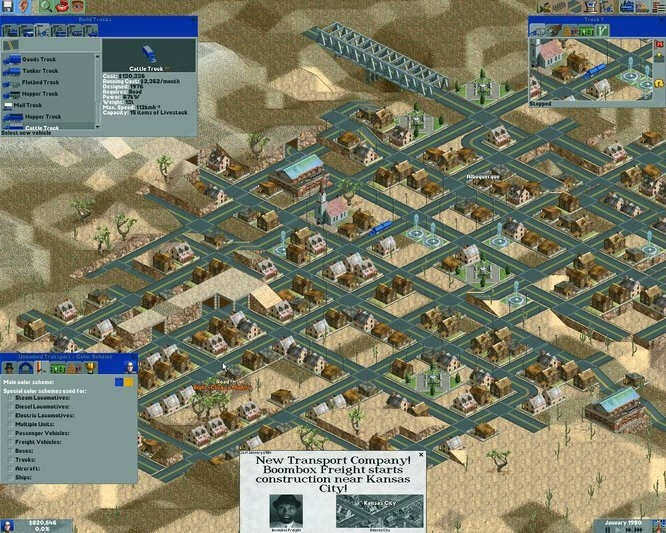
Locomotion and Returning to Older Games
Retro Replay: Chris Sawyer’s Locomotion brought you back to transportation after the RollerCoaster Tycoon games. What were you finally able to do in Locomotion that you had wanted to accomplish in Transport Tycoon years earlier?
Chris Sawyer: The isometric game engine from RollerCoaster Tycoon 2 allowed so many improvements over the original Transport Tycoon, and it was quite exciting re-imagining that game with a much more detailed and flexible landscape, multi-level tracks and roads, complex junctions and smooth curves, and many other things that the original game lacked. Processing power and memory had increased considerably over the years too, allowing a much larger and more detailed world map, more detailed and better animated vehicles, and improvements to competing companies and two-player games linked via the internet. It was also a time to re-write the game much more cleanly, with expansion and customization in mind, using what I’d learned from RollerCoaster Tycoon.
Retro Replay: Looking back now, is there anything about Locomotion you would approach differently?
Chris Sawyer: There’s no doubt that Locomotion never quite captured the hearts of Transport Tycoon players, and there’s been much analysis online about this – maybe it’s the slightly dull graphical style, or the clunky track construction, or did it lose too much of Transport Tycoon’s simplicity? I’m not sure what I would have done differently if I’d known that – I still think Locomotion was some of the best programming I ever did (it’s a much more complex game internally than RollerCoaster Tycoon ever was), but clever programming doesn’t necessarily make a good game.
Retro Replay: You later revisited your older work for modern devices. What was it like seeing interfaces and systems designed around a mouse adapted to touchscreens decades later?
Chris Sawyer: This was a really exciting time – Although I wasn’t programming the re-writes myself (the Origin8 team were doing a great job of this themselves) I was overseeing it all and making sure the recreations were 100% authentic and even mostly compatible with the original games. Designing the interface was particularly challenging, but actually most of it adapted well to touchscreen and we could even add small improvements here and there at the same time. Some of the new features in RCT Classic I actually wrote and tested in x86 assembly code with the PC version of RollerCoaster Tycoon 2 to see how well they might work, and then handed that new code over to the developers to convert into C for RCT Classic.
Retro Replay: OpenTTD and OpenRCT2 have helped keep the style and mechanics of your games alive with modern players. What is it like watching communities continue extending ideas and systems that originated in code you wrote so long ago?
Chris Sawyer: I have mixed feelings but admire the skill and commitment of those involved, and it’s amazing that there’s such a huge community still enjoying the game.
Making Games Your Own Way
Retro Replay: Modern games are generally produced by enormous teams using sophisticated engines and toolchains. Do you think there are advantages to the older model where one person could understand almost every system in the entire game?
Chris Sawyer: It’s the only way I could create a game – there are so many advantages to creating a game almost entirely by yourself! I wouldn’t know where to start in the modern world of large teams and specialists for different parts of the programming and huge libraries of code or toolkits. It’s not surprising that modern games are so buggy, or need so many updates to fix things – I suppose they are more complex too, but the more people who work on a game and the more libraries involved the more chances of bugs creeping in and the more difficult it is to find those bugs – back in my day when bugs were reported I knew they were mine and I could often quickly locate them because I knew all the code so well.
Retro Replay: If you were starting out as a programmer today, do you think you would still be drawn toward building low-level technology yourself, or would modern engines simply be too useful to ignore?
Chris Sawyer: I’d struggle to get excited about modern game engines and libraries and would prefer to build my own from the ground up, but I’d be very open to using a high-level language instead of assembly code – a lot has changed over the years and the advantages of assembly code are virtually gone these days. In my spare time now I’m writing Python code to run various home automation projects on a Raspberry Pi touchscreen – if I’d been told 25 years ago that I’d eventually be writing complex code in not only a high-level language but one that’s interpreted rather than compiled I’d not have believed it, but it does the job, and does it very well.
Retro Replay: Is there a simulation or management-game idea you once wanted to pursue but never found the right way to make work?
Chris Sawyer: Sadly no – My two great obsessions were railways and rollercoasters and I’ve already turned them both into games!
Retro Replay: After all these years, when somebody tells you that Transport Tycoon or RollerCoaster Tycoon consumed hundreds of hours of their childhood, what does it feel like knowing something you largely built yourself became such an enduring part of other people’s lives?
Chris Sawyer: It can be quite heartwarming, at least about those who say it was a positive part of their childhood or growing up – I do worry that some people perhaps played the games a bit too much though!
Beyond the Screen: Chris’s Roller-Coaster Hobby
The fascination behind RollerCoaster Tycoon extends well beyond the game. Chris is a roller-coaster enthusiast who travels to ride coasters around the world. In Atari’s March 2024 community Q&A, he reported having ridden around 770 different roller coasters. He also described joining the Rollercoaster Club of Great Britain and the European Coaster Club, and reading their back issues as part of his research.
Among the favourites he named were Taron at Phantasialand in Germany, Zadra at Energylandia in Poland, Balder at Liseberg in Sweden, and Ravine Flyer II at Waldameer in the United States. It is a fitting counterpart to the interests he describes in this interview: understanding the engineering, enjoying the ride, and wondering how that experience might work in an isometric world.
Thank You, Chris
Our thanks to Chris Sawyer for sharing such a thoughtful and detailed account of his work. Chris’s recollections bring the technical achievements back to the moments that gave them purpose: a train moving along its track, a coaster taking shape, or a crowd of simple guests making a park feel alive. They also capture the satisfaction of building something you want to play yourself, and discovering how many other people want to spend time in that world too.
For more conversations with the people behind classic games, read our interviews with Chris Beatrice, Louis Castle, and Steve Ince, or explore Retro Replay’s interview collection.