Retro Replay Retro Gaming History, Reviews & Emulation
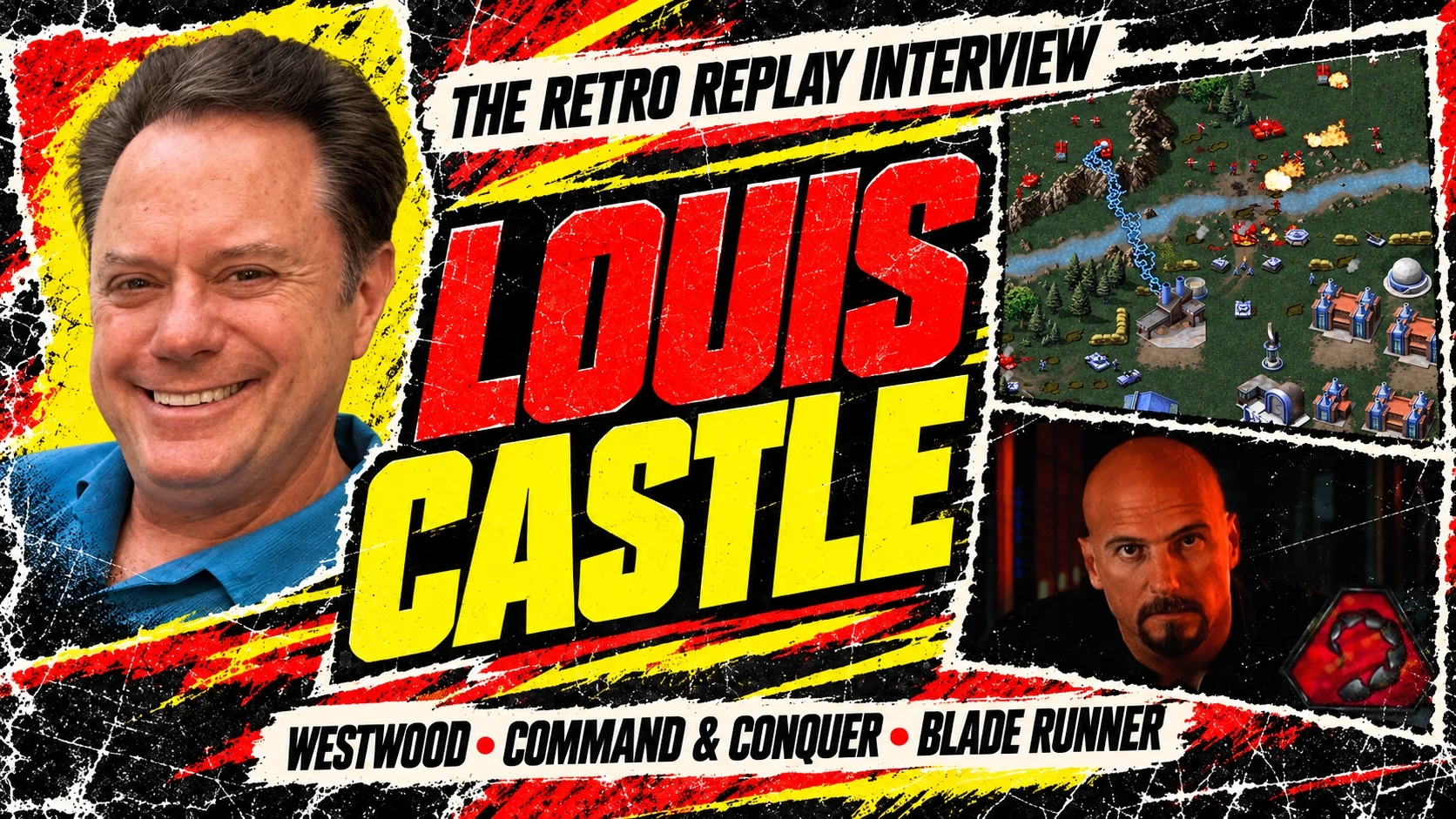
Interview by David, Retro-Replay.
Before there was Tiberium, before Kane stepped in front of a camera, and before players began building bases on Arrakis, there were two friends in Las Vegas finding out what they could make together. Louis Castle was working at a computer store when he met Brett Sperry. An invitation to use a printer led to a conversation about computer art, then to a creative partnership. In 1985, that partnership became Westwood Associates, the company later known as Westwood Studios. The Strong’s Westwood archive records the studio’s founding.
For many Retro Replay readers, Westwood’s name brings back very specific memories: watching a corridor for movement in Eye of the Beholder, protecting a spice harvester in Dune II, hearing the opening notes of a Command & Conquer track, or stepping into the rain-soaked streets of Blade Runner. Castle helped build the studio behind those experiences, bringing an artist’s eye and a programmer’s understanding of what the machines could do. In this interview, he remembers a team willing to stretch both the technology and its own abilities, whether that meant squeezing more artwork onto a disk or turning his favorite film into a world players could investigate for themselves.
His career continued well beyond Westwood. He went on to creative and leadership work at Electronic Arts, Zynga, and Kixeye, and became head of Amazon Game Studios in Seattle in 2017. His work also includes Boom Blox, developed in collaboration with Steven Spielberg. Amazon’s announcement traces that wider career. Today, he is CEO of Monarch Game Studios, where the company is developing games and a connected rewards ecosystem for players. Readers can also follow him on LinkedIn.
For this written interview, Retro Replay’s David asked Castle about the friendship that started Westwood, the decisions behind its best-known games, and the realities of running a studio as it grew. His answers include the story of Joseph Kucan becoming Kane, the ambitions behind Blade Runner, and a candid look at Westwood’s culture and its relationship with EA. Alongside the memories is the same enthusiasm that brought him into games in the first place: he is once again starting a studio, directing a game, and working on the technology himself.

Two Friends and the Beginning of Westwood
Retro Replay: Going back to the very beginning, how did you and Brett Sperry first meet, and what made the two of you decide to start working together?
Louis Castle: I was working at a local computer store, Century 23, and Brett was a customer. We got to be friends, and one day he needed to print out some source code. I had a printer at home so I invited him over and we got to talking. I showed him some of my computer art and we started collaborating on games. I did art and some programming, while Brett handled programming and design.
Several years later, after working on a few games remotely and for some local companies, Brett had a contact at Epyx Games that gave two guys in Vegas a chance to work directly for Epyx as Westwood Associates on a port of John Freeman’s Temple of Apshai Trilogy to the Macintosh.
Retro Replay: Before Westwood became known for games like Command & Conquer, what were those earliest years like? Did you have a clear idea of what kind of studio you wanted to build?
Louis Castle: Brett had a very clear idea of growing the company. We both wanted to build a place where we were excited to go to work each day with people we enjoyed being around. Westwood’s culture and identity organically grew from the amazingly talented people we brought together on our crazy adventure.
The early years were just magical. We worked hard, goofed around a lot, and had the chance to create fun for a growing number of players and fans.
Retro Replay: Westwood worked on a remarkably wide variety of games. Was that variety intentional, or was it simply a result of taking opportunities as they appeared?
Louis Castle: A bit of both. We had specific games and kinds of games we wanted to make and also took most of the opportunities presented to us so we could keep our growing team busy and learning. Most of our hires had never made games before, so having on-ramp game projects was very important and became part of our culture.
Toward the end of the ’80s we had a good deal of success with dozens of games so we were able to pick the kinds of games we worked on. Games like Dune II and Monopoly CD-ROM would likely never be chosen by a AAA studio but we thought we could make them great and we had the freedom to explore.
Eye of the Beholder: Bringing the Dungeon to Life
Retro Replay: Eye of the Beholder became one of the defining computer RPGs of its era. What do you remember most about developing the first game?
Louis Castle: We had already helped SSI land the D&D license with our work on the core 3D engine for use in the Gold Box Games. We loved what FTL had done, expanding the early work of Wizardry with Dungeon Master. EoB was the ambitious effort to take that inspiration, add more real-time elements, a lot more art, and implement the majority of the D&D 2nd edition rules into a computer game. At the time, this was considered very risky, as decision making under time pressure was controversial in computer games. Some argued that the decisions were just too complex to have time pressure. EoB and later Dune II proved that many players loved the challenge. 🙂
Retro Replay: What were some of the biggest technical challenges involved in creating Eye of the Beholder on the hardware available at the time?
Louis Castle: Too many to list! The biggest ones were implementing the D&D rules which were truly not designed to be automated, and fitting all the art into the game. We continued to improve our compression algorithms to squeeze as much as we could onto the limited media storage available. We wanted an extra disk for an ending animation and SSI refused as the cost of goods was getting too high. The result was a text description for the finale, which did upset some customers. We started with the ending for EoB II so we didn’t have the same problem.
Dune II and the Road to Command & Conquer
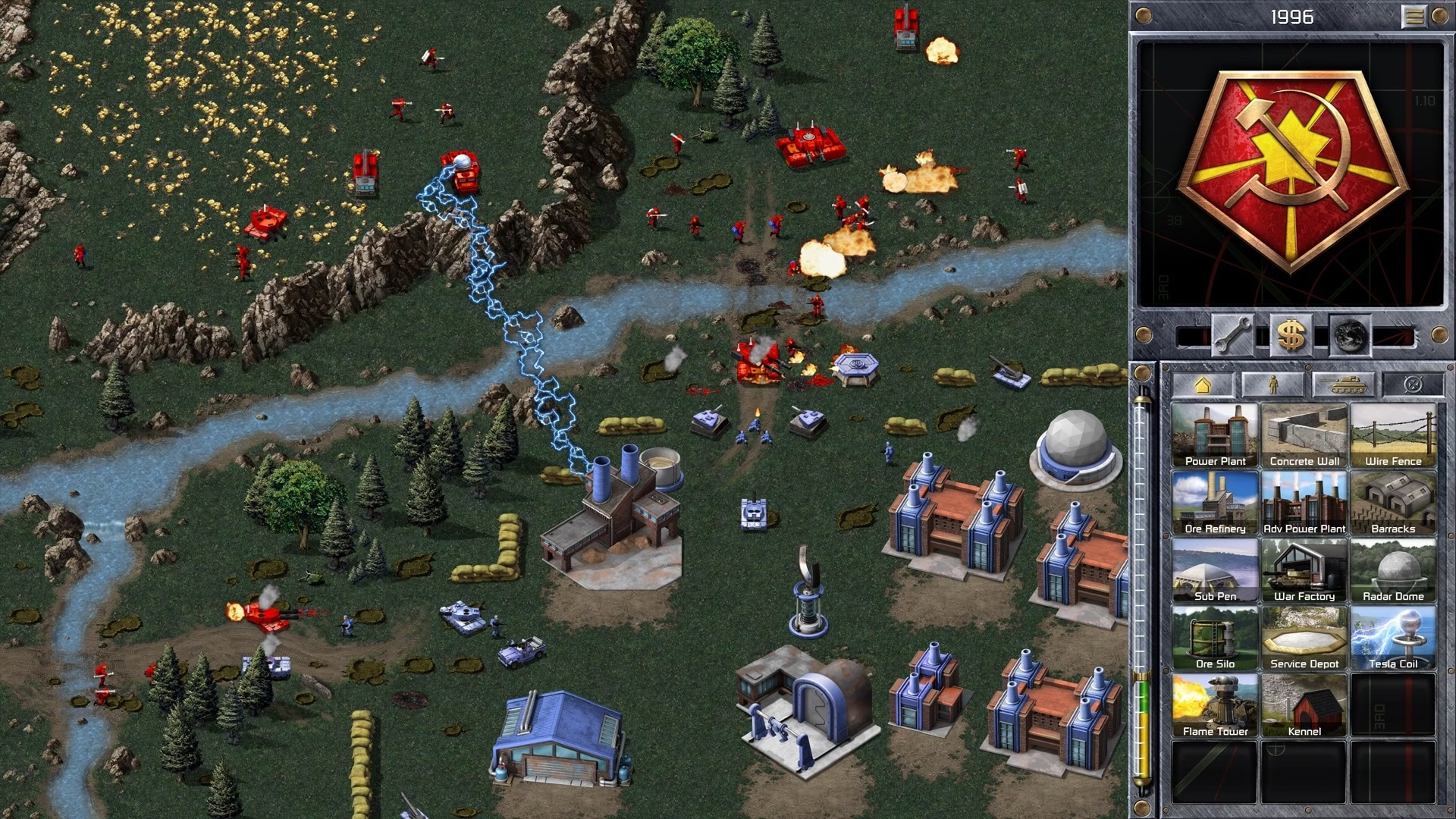
Retro Replay: Dune II is now regularly credited as one of the games that established the modern real-time strategy formula. At the time you were making it, did the team realize it was creating something fundamentally different?
Louis Castle: Sure, we certainly knew we were intentionally making a game that broke conventions. The team loved playing Dune II so we also knew we were on to something great. Could we imagine all the RTS and MOBA games that would sprout from those roots? How could we? We just knew it was a great game.
Retro Replay: Where did the idea of gathering resources, constructing a base, producing units, and fighting in real time come from?
Louis Castle: The core inspirations for Dune II were a turn-based game on the NEC TurboGrafx called Military Madness (one of Joe Bostic’s favorite games) and Rescue Raiders on the Apple II (one of Brett’s favorites for the tower defense mechanics with a real-time agent of the helicopter. Westwood was all about real-time games so the mashup of the two inspirations, with the Dune universe, Brett’s favorite book, resulted in Dune II. The game should have just been called Dune but that’s another story.
Retro Replay: Was there a particular moment during Dune II’s development when you realized the basic gameplay loop really worked?
Louis Castle: Oh yeah, really early on. It was just fun to play. Looking back, it’s a little surprising because the UX was really tedious compared to the eventual RTS innovations. But still, it was new and exciting so the juice was worth the squeeze.
Retro Replay: How much of what Westwood learned from Dune II directly influenced the creation of Command & Conquer?
Louis Castle: Everything! We were intentionally making the gameplay successor to Dune II. It was clear we needed to improve the UX so we borrowed ideas from the smart cursor of Kyrandia. Dune had a central resource that both sides needed to harvest so Tiberium became the replacement for Spice. We wanted different sides, but I think GDI and Nod ended up more similar than originally intended. We also backed off from three sides because we wanted clear ideological and mechanical differences. Then of course there was multiplayer. We really wanted to be able to play against other players.
The original theme was fantasy and would have been Swords and Sorcery but Brett wanted a more contemporary storyline to attract a larger audience so we switched to near future military.
Retro Replay: When work began on Command & Conquer, what did you want to accomplish that Dune II had not been able to do?
Louis Castle: We wanted to tell our own epic story that would take three (or more) games to complete. We wanted to wow players with abilities and scale. We wanted an even tighter connection between the units and the story. C&C was a full-court press to make an epic game.
Retro Replay: Command & Conquer had an unusually strong personality for a strategy game, from its music and FMV sequences to the factions and characters. How deliberate was that emphasis on presentation?
Louis Castle: The universe of C&C was very deliberately crafted. The team was small so everyone could be in on the discussions of how the story interacted with the units, maps and strategies. Everything was intended to work together to create a believable fantasy of commanding armies in a new-future theater of war.
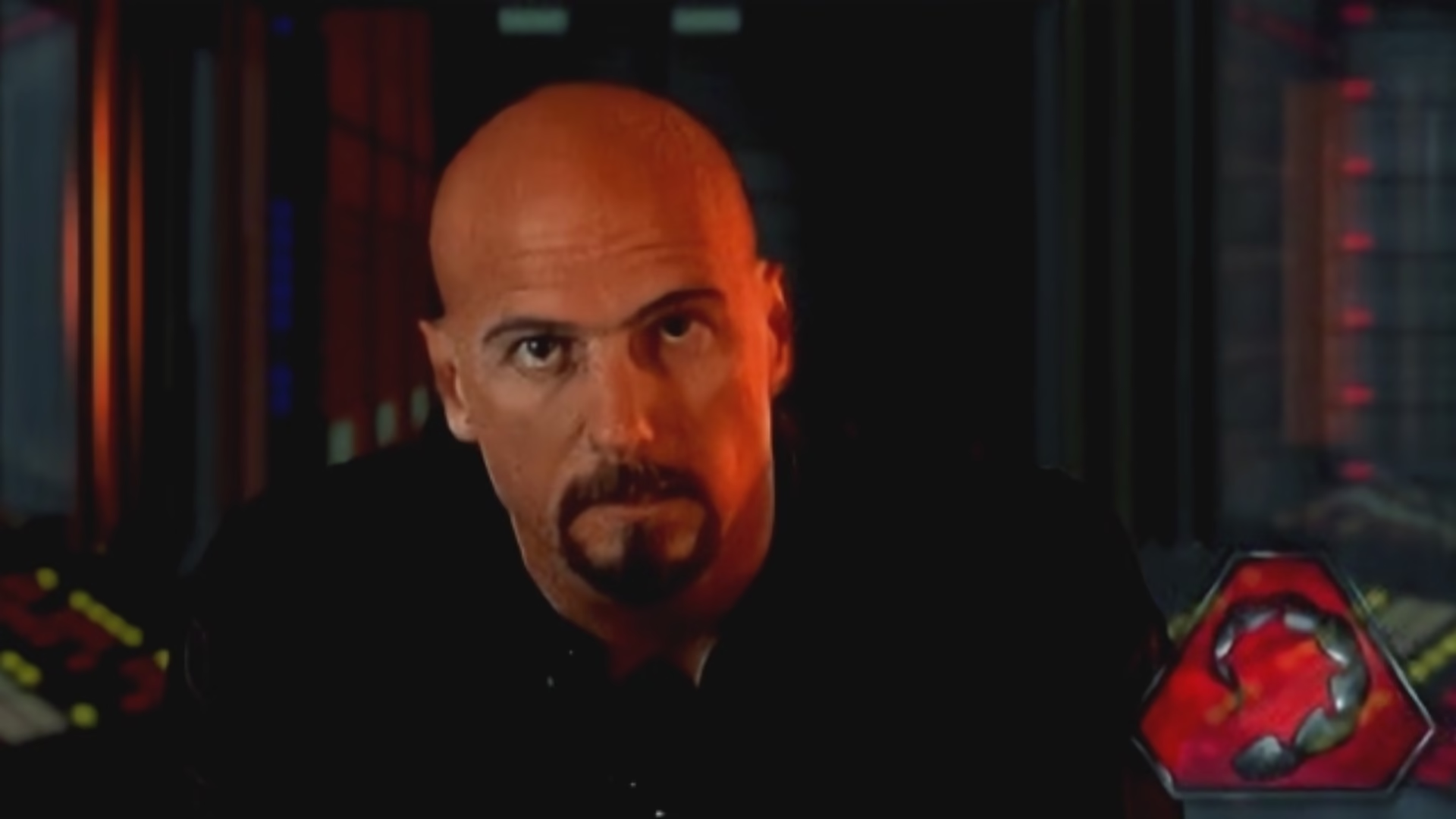
Retro Replay: Kane became one of the most recognizable characters in PC gaming. Did you expect the character to become such a major part of the series when Joseph Kucan first took on the role?
Louis Castle: We knew Kane had to be a strong character to carry Nod. We auditioned many actors and investigated top Hollywood talent. When Brett and I were watching the auditions, Joe Kucan kept directing the talent “…not quite. Do it more like this…”. Brett just flat-out asked if Joe would play the character and I think Joe was surprised but honored that Brett felt Joe could make the best Kane.
Retro Replay: Frank Klepacki’s music became almost inseparable from Command & Conquer. How closely did the design team work with him, and how much freedom did he have to establish the sound of the series?
Louis Castle: Frank was involved in as many creative briefs as possible. Frank’s unusual ability to fit his music to images on the screen allowed the art and story departments to create the most impactful images which Frank would then augment with music. Frank also set very specific themes for each side and specific characters. Frank also composed scores around each factions theme and with the intention of setting the emotion of the level, from stealth missions to all out attacks. He even worked in vocals like Target / Mechanical Man for levels to help sell the narrative.
Retro Replay: The original Command & Conquer also helped popularize networked multiplayer strategy gaming. How important was multiplayer to the project during development?
Louis Castle: We always felt multiplayer was a key factor in making C&C a great game. Dune II players were champing at the bit for multiplayer. In the end I wish we had the resources and time to make a better online network layer. We were so busy trying to ship games for Virgin that we just didn’t have the resources to custom-build something like Battle.net. Network multiplayer was great for the LAN parties so we did have a moment.
Retro Replay: Red Alert took the series in a somewhat different and more exaggerated direction. Was that tone planned from the beginning, or did it evolve during development?
Louis Castle: Yes, the campy “50’s B movie” feel of Red Alert was the original concept. We started with giant ants and fantastic sci-fi and it took on a life if its own. The brief for C&C was to imagine what technology the military had but wasn’t sharing. Red Alert explored what if all the crazy sci-fi weapons actually worked. Tesla and time machines were a natural fit.
Retro Replay: Looking back, why do you think the classic Command & Conquer games remain so playable and popular decades later?
Louis Castle: Like all well-crafted games with strong identity C&C and Red Alert were works of art and passion as much as they were attempts to make best-selling games. I think some of Westwood’s games are still discussed today because we strove to be innovative and took big risks.
Blade Runner: Building a World Worth Investigating
Retro Replay: Westwood’s Blade Runner was radically different from Command & Conquer. What attracted the studio to that project?
Louis Castle: I did. 🙂
Just like Dune was Brett’s favorite book and we both loved D&D, Blade Runner was literally my favorite film. When I saw that we had a chance (a very late chance) to pitch for the license I pulled out all the stops. The big vision of recreating the film with our compression technology and delivering a movie-quality game world, all made in 3D, was a goal the entire art team dove into. Nearly every Westwood artist loved Blade Runner and could hardly wait to recreate the iconic sets. Our pitch was the fully recreated opening sequence of Blade Runner playing on a PC. Aaron Powell did an amazing job and Frank killed it with the score. Bud Yorken asked “If you can rebuild all of that in a couple weeks what parts of the film do you want to use?” I answered none of it. We would recreate everything, including the actors in CG. That and my passionate desire to recreate the emotional themes of the film won us the contract. It still took months of negotiations, and we refined the game design during that time, planning to a level of detail I have never done again. It was a blast.
Retro Replay: Blade Runner attempted to tell an interactive story in a world where characters, clues, and events could change between playthroughs. How difficult was it to build that kind of system in the 1990s?
Louis Castle: It was quite the challenge, but I felt it was critical that our game captured the mood of and detective work of the film. To do that, I didn’t feel we could rely on the branching story structures used in games at that time. It really had to be a simulation where every decision could have an impact. A real-time story simulator was the goal, not just a tag line.
Retro Replay: One of the most interesting things about Blade Runner is that it did not simply recreate the movie. How important was it to tell a new story that existed alongside the film?
Louis Castle: Being a huge fan of Blade Runner the last thing I wanted to do was to change the narrative. Early on I decided our game could fill in the backstory and allow players to decide what happened off screen. That is also the reason I didn’t want the player to play Deckard. The core theme of manufactured human “Replicants” lent itself to similar characters from the film with differing details and personalities and allowed our somewhat primitive CG to feel appropriate. I felt getting to fill in the backstory and off screen gaps from the film was a way for players to be creatively authentic.
Retro Replay: Were there ideas planned for Blade Runner that had to be abandoned because the technology simply was not ready for them?
Louis Castle: Many. Mostly due to time and resource constraints. Every character in the world could have looked as good as McCoy but it took a lot of artists’ time to keyframe the 2,800 motion capture sequences. In the end we had to prioritize the most important ones so the others ironically had more frames of animation but looked blocky because the total amount of voxels were spread across more frames. We also had to scrap quite a few settings. One of the biggest opportunities was that we could have moved the camera a lot more. The animated environments were stunning but when the camera followed McCoy around a corner or into a building it was jaw dropping. We shipped on 4 CD-ROMs, and given more time and budget, we could have expanded the game by at least another two.
Studio Culture, EA, and the Roads Not Taken
Retro Replay: Westwood was eventually acquired by Electronic Arts. From your perspective, how did life at the studio change after the acquisition?
Louis Castle: Not much changed at first. That was a promise that EA kept. Unfortunately it probably was not the best decision. EA was and is a massively successful game company and we shouldn’t have tried to stay the way we were. There were too many friction points. We did start to assimilate after a few years but it was more painful having waited. Gradually embracing EA’s culture from day one would likely have been better.
Retro Replay: Fans sometimes look back at studios like Westwood and describe them as having a unique culture that is difficult to reproduce inside today’s much larger development teams. What made Westwood’s culture special?
Louis Castle: Westwood’s culture was the amalgamation of a bunch of friends off on a grand adventure. Most of the original team were close friends or became close friends. Even when we grew to 150 people I knew everyone and most of them knew each other. Eventually, with Earth and Beyond, we simply became too big to keep it up. Westwood’s culture started to change way before we deliberately moved toward EA culture.
Retro Replay: Was there anything about the old Westwood development process that would probably seem completely crazy to a modern game development team?
Louis Castle: So, so many. Handwritten bug reports, scanning faxes of Disney cel animation since there was no email, lots and lots of spreadsheets; the list goes on and on. We were inventing the processes of making games as much as we were inventing the technology and game design forms.
Retro Replay: Of all the Westwood games you worked on, is there one that you believe never received the recognition it deserved?
Louis Castle: We were really fortunate to have our games get a lot of attention. The team at Virgin were masterful marketers and we had a following. Renegade might be the game that didn’t get its fair shake. The multiplayer game was as great an experience as any game we made, but it was plagued with performance problems and hacking.
Retro Replay: Is there a cancelled Westwood project or unfinished idea that you particularly wish had made it to release?
Louis Castle: Command & Conquer 3 from Las Vegas. Our Las Vegas team pitched the game idea in Q1 of 2004, but we lost the bid to build our destination studio in Las Vegas. EA, understandably, did not want to kick off a major project when we might be consolidating, which we did.
Retro Replay: If Westwood had remained independent for another decade, do you have any idea what kinds of games you think the studio might have pursued?
Louis Castle: I’m quite certain there would have been a C&C MMO, a series of C&C shooters and more real-time adventure games. We probably would have done some licensed games too because we liked the discipline enforced by licensors.
Retro Replay: When you look at modern real-time strategy games, do you still see ideas that can be traced directly back to Dune II and Command & Conquer?
Louis Castle: Yup. Every time. Lol
Retro Replay: Is there anything commonly repeated about the history of Westwood or Command & Conquer that you wish people would stop getting wrong?
Louis Castle: A few things. C&C was not inspired by or even aware of Herzog Zwei. Westwood was far from a utopia. The pranking and horseplay was crueler than I remembered and was at times disrespectful. I only learned of some things years later, and I wish I had paid more attention to my friends. Westwood Las Vegas was not a victim of EA as much as an unwitting participant in the studio closure. We missed the mark on more than a few games.
Retro Replay: When you revisit one of your games from the 1980s or 1990s today, are you able to enjoy it as a player, or do you immediately start noticing things you would have done differently?
Louis Castle: I don’t have much time to go back and play old games. When I have I feel more nostalgic than critical. There are always rough edges but there are also really clever compromises that still hold up.
A New Chapter with Monarch Game Studios
Retro Replay: What are you working on these days, and what parts of your current work are you most excited about?
Louis Castle: I’m back to starting a studio and directing a game. I’m even doing some core tech development. I love the work and I’m super excited but startups are hard!
Retro Replay: Are there any current or upcoming projects that you would particularly like Retro Replay readers to know about?
Louis Castle: I would love to have readers look at our SEC Reg CF fundraising efforts for Monarch Game Studios, a publishing and distribution platform dedicated to rewarding community from day one. We are endeavoring to have community members replace the typical “friends and family” funding that most startups rely on. Our mission is to reward fans for being fans, not just for buying stuff.
Our thanks to Louis Castle for taking the time to share these memories with Retro Replay. Follow Louis on LinkedIn, visit Monarch Game Studios, or read about the company’s community fundraising campaign.