Retro Replay Retro Gaming History, Reviews & Emulation
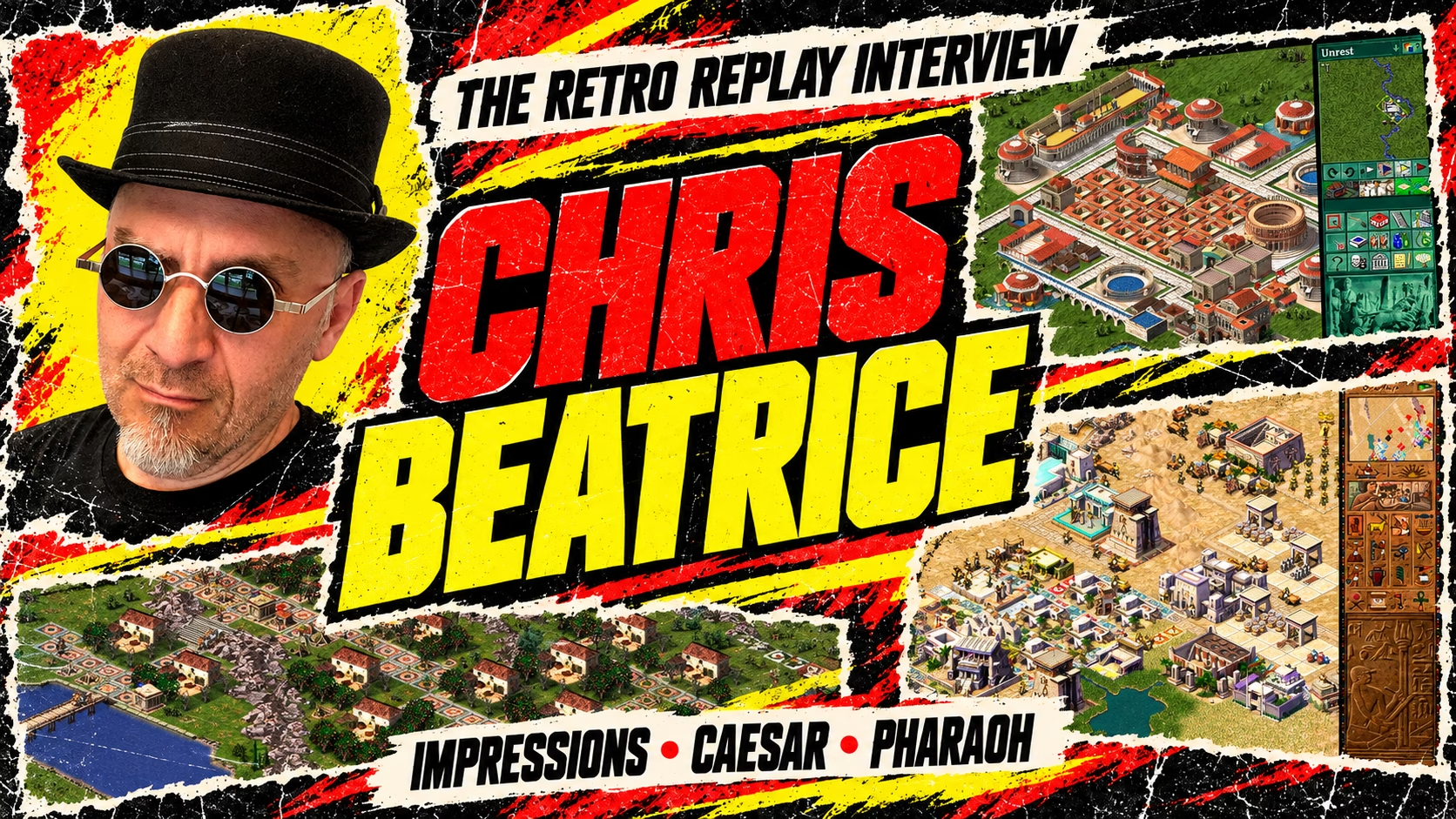
Interview by David, Retro Replay.
A wheat field had to move inside a tiny tile. A Roman city had to feel alive without burying the player in detail. An aqueduct had to look convincing while being assembled from just a handful of graphics. For Chris Beatrice, the art of those early strategy games was inseparable from finding practical solutions that made a world readable, appealing, and enjoyable to inhabit.
Beatrice joined Impressions Games in 1993 after studying art and working in commercial illustration. His career there took him from art director to creative director and studio head, through games including Lords of the Realm, Caesar II, Caesar III, and Pharaoh. He later founded Tilted Mill, continuing his work in city-building with games including Children of the Nile and SimCity Societies.
In this written interview with Retro Replay’s David, Chris describes the artists, engineers, homemade tools, and small technical breakthroughs behind Impressions’ historical worlds. He also remembers the people who shaped the studio, the excitement and compromises of moving into 3D, and why the clarity of those older city builders still matters to him.
His answers bring the workplace into view as vividly as the games: shared dinners, a pool table, a library of illustrated history books, and a company where making a good game also meant trying to give people a lasting place to work.
This interview was conducted in writing. Chris Beatrice’s answers are reproduced as supplied.

From Art School to Impressions Games
Retro Replay: How did you first get into game development, and what brought you to Impressions Games?
Chris Beatrice: In the spring of 1993 I had just finished an extra year of art school, after doing a stint as an art director for a t-shirt printing company. As an artist I had (and have) always waffled between “fine art” and “commercial art” (like, illustration). My art school, Massachusetts College of Art in Massachusetts, had a career placement office that consisted of a binder with a bunch of pages for art jobs. One was a startup in my own town called Kinetic Arts. The position was creating illustrations for adventure games. In that era there were basically people who could use computers, and people who were artists, but not many who were both. I had used a Mac extensively to make art at the t-shirt place, but it was all vector. I thought that’s how all digital imagery worked. But at Kinetic Arts the stuff was all pixel based. There were three different graphics modes for video games at the time: super low res (320 x 200 pixels), 256 colors; or you could go higher resolution, like 640 x 480, but then only 16 or 32 colors. And for Windows games there were only 16 colors. I adapted quickly and really enjoyed this work because it was creating illustrations, even though there were enormous constraints.
Retro Replay: What was Impressions like when you first joined? Was it still small enough that people regularly crossed between art, design, production, and other roles?
Chris Beatrice: If by “crossed” you mean switched from one role to the other, that really didn’t happen at all except for QA personnel (play testers) moving up into design or production, which was common. That’s pretty much where all our second wave of designers came from, actually (except me). And I moved from art director to creative director/designer and finally studio head. It was and is a little unusual to have a person with an art background, not an engineering or design background in charge of a studio.
As for day to day cross-over, in the early days that was kind of free form, which tended to introduce excessive unpredictability in project development timelines, and was disruptive to the design process. So when I started managing the art team and later the whole studio, I formalized this so we could allow everyone to participate, but without creating more problems than help.
What’s always been great about games is that at most game studios, except the very biggest ones, but including Impressions, whatever skills, talents or interests you have, there is a way for them to be used in the project, somehow.
When I joined Impressions in late 1993 I think we had maybe 25 or 30 employees. We had offices in Cambridge, MA and Farmington, Connecticut. Both offices were managed as a single company (for example, I was in charge of the art department as one group spanning two locations). The Cambridge office where I worked was small enough that the whole company went out for appetizers every Friday. David Lester (founder) was great about building community and team dedication in all sorts of ways. I learned A LOT from him (about a lot of things).
In the first year or so I had my hands full figuring out how to make good looking games that also communicated clearly to the player what was happening. I had basically zero experience making games (at Kinetic Arts I just did illustration and did not deal with the nuts and bolts of video game art). In fact when he hired me, David said, “We’re talking to several candidates… you’re the least qualified, but the most interesting.” I was really fortunate to get that position and I worked hard to earn it afterward.
As far as organization, we had the typical departments: Programming (engineering), QA (testing), Art, Sound, Design and Production. But we also had our own Sales and Marketing people (one each). Because in those days we published our own games (physical, box copies) and sold at regular stores at the mall, Staples, etc. The Art department was the biggest with around 12 people. It was the only department that had a manager (me), so I was responsible not only for art direction proper, but department management as well (hiring, firing, performance evaluations, etc.). None of that stuff was in place. Up until that point it had just been David and everyone else. I was told we were going to bring in department heads for the other departments, but it didn’t happen for a very long time. Maybe not even until after David left and I was in charge of the studio. So, as the only department head, I ended up setting a lot of companywide policies about tracking time, vacations, performance reviews, etc. And I put in place some boundaries because, contrary to what I said initially, one of the dangers of having too many freeflowing ideas across departments is it can derail forward progress and undermine the decisions made by designers and producers. With art it’s the worst—someone can walk by an artist’s desk and immediately see what they are doing, and usually they make a comment on it. Sometimes it’s uninformed like, “we changed that yesterday,” so the artist changes what they do, but it turns out the person who made that comment was wrong. And David was used to walking around and directing everyone, so I had to kick him out of the art department, basically. He was very accommodating and respectful, I have to say.I also should mention that as far as organization, we were not team-based. I’m not sure if other studios were or not. In 1994 and 1995 we released eight or ten games a year. And often they were all in production at the same time. So I assigned the artists based on what they were good at (and interested in), and as a result they would hop from project to project, or even be working on multiple projects in the same day.
Making Every Pixel Count
Retro Replay: You worked during a period when PC strategy games were becoming much more visually ambitious. How limiting was the hardware from an artist’s perspective?
Chris Beatrice: I mean… we used to count BITS of data. The biggest problem was needing to fit assets on a floppy disk (often a single). And I I mentioned we were using what’s called indexed color, which means you create a fixed palette of 256 colors and all graphics on screen at the time need to use that. If the scene changes, you could load a new palette, but things like buttons and mouse cursors that were common across scenes needed to retain their color, so part of the palette was reserved for those common things. Palette management was a huge thing, and most of the non-artists never really understood it. Sometimes a graphic would load and its colors would be all mixed up. Because of memory limitations, we also had far fewer frames of animation to work with. I think the pikemen in Lords 2 are like two frames. Making fonts, sometimes we’d have only four pixels of height! Impossible to make a lower case “e,” ha ha. And we didn’t have great tools for creating any of this stuff. All we had was a program called Deluxe Paint.
Retro Replay: Did those limitations ever help creatively by forcing you to communicate more with fewer colors, smaller sprites, or simpler interfaces?
Chris Beatrice: Absolutely. It required a lot of creative solutions usually between artists and engineers, not so much designers because they never really understood most of the technical stuff with graphics. I would try to explain to them why we couldn’t do such and such in a hex-based game and they would just take my word for it. Working with Simon Bradbury (founder of Firefly) was amazing. He was the cheapest cheapskate there ever was when it came to graphics memory, graphics programming, and even design. He (and David) were able to design some amazing games with very simple systems and programming.
Simon and I would work together to figure out things like how to do the castle-based battle maps in Lords 2, or make translucent shadows… even having buildings that extended above their diamond footprint (Caesar II) was a huge deal. Simon made a custom sprite grabber to make sure that not a single unnecessary pixel was loaded into memory. that gave us more space to have better animations, for example.
Lords of the Realm: Fields, Castles, and a Leap into 3D
Retro Replay: What do you remember most about working on Lords of the Realm?
Chris Beatrice: Well, I worked on LotR 1 and 2. Lords 1 was the first big game I worked on at Impressions, and I was on it on day one. My first memory is figuring out how to animate a wheat field within, I think, a 16×16 tile. I didn’t even know what a tileset was—and neither did the artists. And the programmers who did were not artists, so no one really had any idea of how to make one that mated seamlessly. I had to figure that out on my own, and just two years ago I ended up writing a treatise about it for a game company, because tilesets are still a thing. Unchanged in 30+ years.
On Lords 1 David wanted to have large (for the time) animated scenes as rewards for accomplishments. These were very time-consuming to create given our limited tools. But Impressions was somewhat unusual for the time in that our art team was kind of neatly divided into gamers (who didn’t have a deep art background); artists who didn’t have a gaming background, but could make beautiful art; and a few “jacks of all trades.” So I always had a great pool to draw from.Lords 2 was a big leap for us because it was when I first started to fully integrate 3d stuff into the art pipeline for everything. We had used it extensively in Caesar 2 and all games after that, but Lords 2 had a 3d rendered intro, units, etc.One thing I remember about L2 was that I, being the world’s worst gamer, was often called upon to provide feedback about usability.
Caesar: Making a City Readable and Alive
Retro Replay: Caesar II and Caesar III became hugely important city-building games. What do you remember about the visual development of that series?
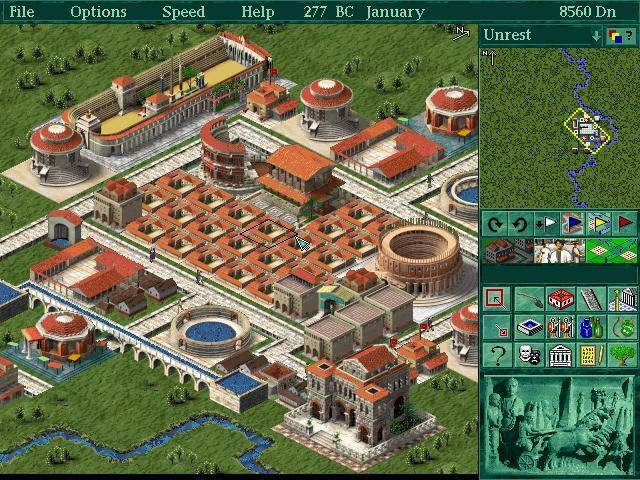
Chris Beatrice: Caesar II was a gorgeous looking game for the time. That’s the mix we had of some super un-technical artists, who could make great art, and people like me and Simon who could come up with ways to transcend the various technical challenges. My fondest memory of C II is getting a cold call from Rick Goodman (founder of Ensemble and designer of Age of Empires). He complimented the art for CII and asked how he might go about building an art team for the studio he was setting up. At the time I thought, “Yeah, sure, you and everyone else…” Of course I still gave him a bunch of advice to help him out. In those days and largely still, small studios don’t feel like competitors with one another. If you spend some time in the trenches of game development you are no longer a “civilian” and you feel like you have a lot more in common with other developers, like you’re all facing the same struggles and challenges. Rick went on to great success and we have been good friends ever since that call. He ended up setting up Stainless Steel Studios right down the road from Impressions. When I started Tilted Mill, Rick loaned me his game engine so I could get our first publishing deal with Microsoft (there were not game engines like Unity or Unreal in those days, and it was a huge up front expense to make your own, which we all generally did).Back to your question… one thing I remember is training the less technical artists to use 3dStudio (which was MS-DOS based at the time). That was a big leap for some of them, but it paid huge dividends in the art of CII, especially the buildings.
Retro Replay: How difficult was it to make a city full of tiny buildings, roads, citizens, services, and resources immediately understandable to the player?
Chris Beatrice: Very hard… it’s still hard! David Lester and Simon Bradbury came up with that system of the random walkers and the columns showing access, which turned out to be GREAT. My part was more about organizing the buildings into sets, using color-coding (which we don’t really do anymore), stuff like that. MORE of the challenge, though, was making it look good. There are a lot of scale issues you need to futz around. You can’t have buildings in scale with one another or things like the circus/hippodrome or coliseum wouldn’t fit, and you can’t have walkers in scale with the buildings or they’d be too small. Yet, some figure animations were part of the building, so there were conflicts. This was waaaaay before the style of mobile games found a happy medium in this area. In the time of CII strategy games had to look realistic/serious AND pretty. Because, honestly, we were all still building off of Civilization to some degree, more than, say, SimCity.
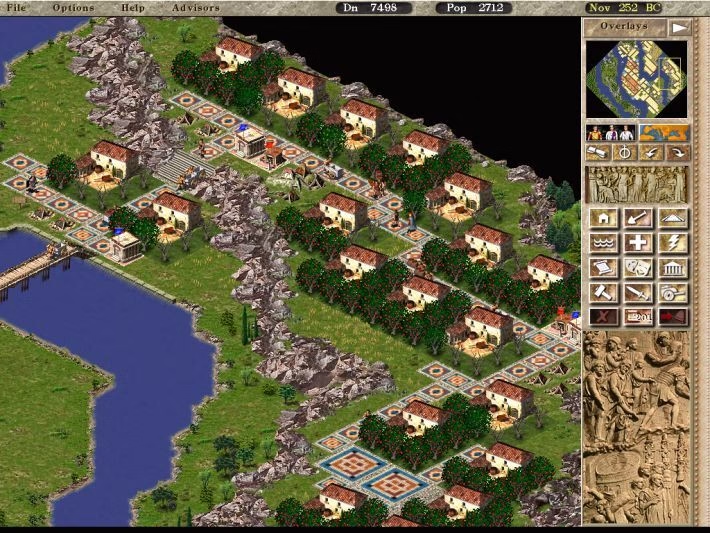
Retro Replay: Caesar III has a very distinctive look even today. Was there a deliberate effort to give the game warmth and personality rather than making it feel like a dry historical simulation?
Chris Beatrice: Well, yeah, we finally found our groove there, not only in terms of the visuals but the humor of the walker speech and things like that. Using humor to also communicate what was going on in the city was a great idea (not mine). As I’ve said, on the visual side there had been, all along, this balance… or I could say tension… between the artist people (like me and about a third of the art team) and the gamer people. Again, there really weren’t game artists at the time. There were absolutely no schools teaching game art (or game anything) and most art schools didn’t deal with digital art at all. Many of the artists were not really interested in playing games, didn’t think much about how the visuals needed to communicate to the player, etc. I know that sounds crazy now, but this kind of stuff was all just arising at that time. By the time of CIII though I had become Creative Director for the whole studio… actually I think I was the Studio Head at that time, so I was not as directly involved on the art side.
Retro Replay: What went into designing buildings so players could understand their function almost instantly just by looking at them?
Chris Beatrice: We did a lot of research using children’s books (again—no internet at the time). Illustrated, non-fiction children’s books would often show recreations of many of the buildings of ancient Rome that were functionally different from what we’re familiar with today. Because we did so many historical games (and because I love history), I built a pretty extensive library which we kept in the art department. But the designers and others would use it as well.
Retro Replay: Did the artists work closely with the designers when deciding how citizens, buildings, disasters, and other information should be communicated visually?
Chris Beatrice: Uh, no… there was not as much cross-department collaboration as there is today, which sounds weird I know. But the art department was almost half of the company. A huge and expensive resource. Everyone always wanted to comment on what the artists were doing, to the point where it risked the development schedule, and usually was not critical feedback. When it came to playtesting, then the art dept would respond to what the playtesters were encountering. But I basically never let designers talk with artists… ha ha.
Retro Replay: One of the things that made Impressions games memorable was watching your city actually function, with people walking around and buildings changing. How technically difficult was it to create that sense of a living place at the time?
Chris Beatrice: Honestly, it’s really a “whole is greater than the sum of its parts” thing. If you can work within the memory limitations, having animated buildings and a bunch of walkers is all it takes to get the sense of a living city. Obviously a lot of buildings were repeated, but that’s what cities look like. Personally I, too, was blown away by it when Caesar III started coming together. As successful as the game was, internally it did not get the credit or attention it deserved on the U.S. marketing and sales side. Warcraft (1) had released in 1994, and all anyone wanted to talk about was RTS (it was a new thing). Some of the higher ups at Sierra urged us to make a real time game… not realizing that the Caesar series had been realtime (and strategy) for a while. So our games occupied this odd space between hardcore strategy and more mass market games. That said, we always had a wide range of players.
Retro Replay: Was there a particular building, unit, screen, or piece of artwork from Caesar II or Caesar III that you were especially proud of?
Chris Beatrice: Maybe the aqueducts? Seriously, I get a lot of joy from coming up with clean, technical solutions that allow you to use just a few simple graphics to get something that looks and feels great to play with.
Did you expect Caesar III to have the longevity it has had? People are still playing and discussing it decades later.
No, and it’s crazy. I have a few go to members of the community that I consult because they are now more familiar with how the game works than I am (because they’ve been playing and modding it for decades). It’s hard for people to understand this now, but at the time it was kind of faux pas to keep building on a single franchise. We’d had CII, so it was like, we’ve already made a great ancient Rome city builder. In those days, every game was expected to be a brand new idea. These were the days when all the seminal, archetypal games we take for granted were just being invented. If you couldn’t keep coming up with brand new ideas, and just kept making sequels, you weren’t worth your salt as a game maker. You’d be like an artist repainting the same image over and over. So Caesar III was initially going to be a sci-fi game, like a moon colony. But we could not get the feedback to work with the elegance and entertainment of the walkers, so… David was convinced to do another Roman game. After that were Pharaoh and Zeus, and, now that I was in charge of the studio, I still kind of had that old mindset. I still felt we needed to innovate, innovate, innovate, and come up with new franchises, when we could have done great focusing on the Lords and Caesar series. When I see CaesarIII and Pharaoh still in the list of top city-building games I can’t believe it.
SimCity, Civilization, and the City-Building Audience
Retro Replay: SimCity had already established the idea of building and managing a living city before Caesar became a major series. How much influence did SimCity have on the thinking at Impressions, either in terms of what to borrow or what you specifically wanted to do differently?
Chris Beatrice: Uh, well, at one point Caesar was described internally as a SimCity + Civilization. That is basically what it was. Designer Will Wright famously branded SimCity as a “toy” not a game. But we had to make city-building into a game. A strategy game. We did ok in terms of the basic gameplay, but it was tough to give it purpose. That’s what the ratings were, and they were pretty good. But in Pharaoh I wanted to go in a different direction and give you tangible goals, things to do with your city, ways to put it to work. I think that worked out brilliantly, though the Egyptian setting is pretty unique for that.
Retro Replay: Did the team ever consciously compare Caesar to SimCity internally, or did you see historical city-building as almost a separate genre despite the obvious similarities?
Chris Beatrice: We didn’t “compare” it, but were definitely inspired by it.
Retro Replay: SimCity was largely about the city as a system, while Caesar gave you individual citizens, historical setting, trade, religion, military concerns, and more visible daily life. Was making the city feel inhabited by actual people one of the big ways Impressions wanted to distinguish its games?
Chris Beatrice: Really we wanted to distinguish it from SimCity, if I were to put it that way, by making it a strategy game that would satisfy hard core players, and also a fun sim that would satisfy anyone. Caesar II was the first game my wife got into, and she was/is not really a gamer. I remember waking up to, “Plebs are needed!” on more than one occasion. She played games like the first Diablo, and now Stardew Valley. That segment of the gaming market, not casual, but not hardcore, was largely untapped in the 1990s, but it was a large part of our audience. We always had a lot more female players than other strategy games. But we weren’t starting with SimCity as a base then differentiating from it. Really we (and other strategy game studios, including Ensemble with Age of Empires) were forever living in the shadow of Civilization. So it was more like we introduced the city sim thing to ancient world strategy gaming.
Retro Replay: Were you personally a SimCity player at the time? If so, what did you think it did especially well, and was there anything you wished it handled differently?
Chris Beatrice: Not at all, but I never have been much of a gamer. I like making games a lot more than playing them. Strategy games especially. I get too hooked on the problem solving and then I think, I’d rather be designing the floodplain system in Pharaoh so I have something to show for my work!
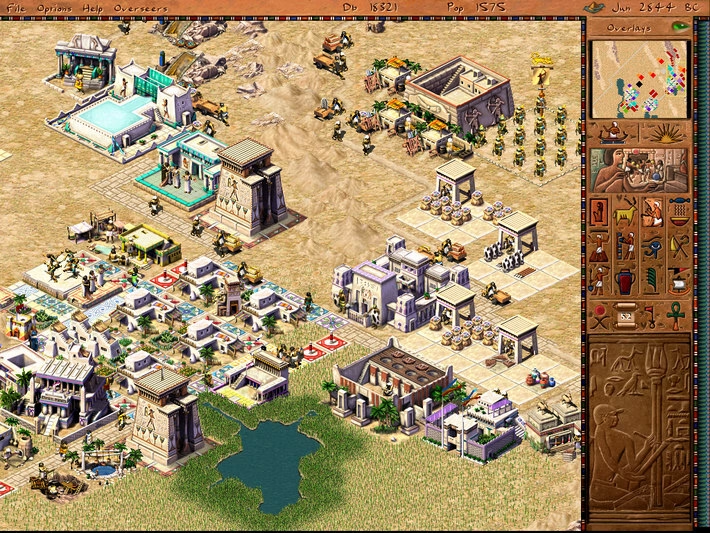
Retro Replay: Why do you think those old city builders remain so appealing when modern games can simulate vastly more complicated worlds?
Chris Beatrice: It’s crazy, isn’t it? Those games hit on a formula that seems to have gone unnoticed by much of the gaming world. I blame myself for some of that—when I left Impressions to found Tilted Mill in 2001 I was very focused on visual brilliance. Everything was pushing to full 3d and I wanted to deliver a gorgeous looking Egyptian setting, and I wanted the people in the game to act like people, not mindless walkers. I, and Jeff Fiske, and the whole team are enormously proud of Children of the Nile, as well as SimCity Societies, both of which introduced big innovations that we see in all sorts of games now and take for granted. BUT, we lost the simple clarity of 2d isometric, and walkers that DON’T act like real people. David Lester left game development entirely; Simon Bradbury moved on to found Firefly and focused on the Stronghold series; Impressions folded without us, so I and the team that came from Impressions were the ones left carrying the city-building banner. Sometime in the last 15 years or so I came to believe that the Impressions city-building model was underappreciated (by me and others) and that it could have a place in modern gaming.
The People and Culture Behind Impressions
Retro Replay: What was the internal culture at Impressions like during the studio’s strongest period?
Chris Beatrice: Pretty darn amazing. I don’t think there are studios now like we used to have then. Back then everyone was an employee, and as the person in charge you were expected to provide steady, full time work, indefinitely. And everyone was in the same building all the time. No remote work, no freelancers, no contract work. We built a time of engineers, artists, writers, sound effects people, composers/musicians, designers, producers, playtesters, marketing and sales people. We all had job security and a great place to work. The main reason I founded Tilted Mill was to continue that, to provide a great place to work for people. I hate how big studios now treat their teams like widgets, letting them go after a successful release. Game development still hasn’t figured this out yet like Hollywood kind of did, and yet we’re now much bigger than them.
Retro Replay: Were there certain people at Impressions whose influence on those games you think does not get enough recognition today?
Chris Beatrice: I think probably Simon Bradbury. He was officially “just” the programmer (of all three Caesar games, plus Lords I and II), but he was also what we would now call a systems designer as well. David Lester, the official designer, was much more high level, conceptual, though he would get pretty specific on the basics he wanted to see in terms of what the player did, the feedback, etc. He might say something like, the gods are all jealous, so they want to be treated equally, so if one is underserved they’ll get angry, etc., but Simon would come up with the simple system to make that work. I think I learned 60% of what I know about game design from Simon. From David I learned how to treat people who work for/with you, which, as I said, is something I feel is sorely missing in the larger studios today.
Retro Replay: How much freedom did artists have to suggest gameplay or interface ideas rather than simply producing artwork from a design document?
Chris Beatrice: Very little. But, as I said, for most of the Impressions hey day there still weren’t many “game artists.” There were artists, and there were gamers, mostly. We had one artist who was a gamer and he was amazing for that. But, he would often get into sidebars with an engineer and before the designer knew it the game was going off in an entirely different direction.
Retro Replay: Was there a lot of experimentation that never made it into the finished games?
Chris Beatrice: Oh, yes, a lot of games that never got released as well. We didn’t do as much experimentation in terms of prototyping because, again, there were no game engines. Today anyone can make a game. Back then we had to do most of the work in our heads, using a white board, etc. I have made so many charts and diagrams of game systems I’ve lost track. So it was much more in pictures and writing, then realizing, “oh, this isn’t going to work…” and starting over. Plus we had some titles I cancelled. That made a big splash with Sierra/Universal: a studio that cancels its own project?! Most studios tried to convince the parent company to keep projects going no matter what, but I was focused on remaining profitable as well as making great games because, again, I wanted my people to have jobs indefinitely.
Retro Replay: Are there cancelled Impressions projects, abandoned ideas, or early versions of games that you wish people knew more about?
Chris Beatrice: See above… except I don’t wish people knew more about them. We had a few that went on longer than they should have (sunk cost fallacy). Ugh.
Retro Replay: Looking back, was there an Impressions title you worked on that you think deserves more attention than it received?
Chris Beatrice: Definitely Detroit. I’m kidding, no, I don’t think so. Because, some games we did that did not do great in the marketplace but were great ideas, like Lords of Magic, we didn’t deliver on. We didn’t push it over the top. So maybe to twist your question I’d say some games deserved more respect and attention from us. That said, we did pour our heart and soul into that game, we just lacked some resources.
The Move to 3D and What Small Studios Meant
Retro Replay: How did your work change as the industry moved from primarily 2D PC games toward 3D graphics?
Chris Beatrice: There was so much pressure from publishers in the early 2000s to make everything 3d and visually splendid I feel that strategy game suffered a lot. Making Caesar IV, for example, everything was difficult. So, often you just couldn’t have certain gameplay, because it was too costly or technically unfeasible to make it look good. In the early days, whatever you wanted to include conceptually or gameplay-wise, you could. You could have weather effects, god events, blah blah, and you didn’t need to show that all visually.
Retro Replay: Was that transition exciting for you as an artist, or was there anything about traditional pixel and 2D artwork that you felt was being lost?
Chris Beatrice: It was, and as an artist I did not miss the 2d stuff. I do NOW though. I kind of hate 3d now.
Retro Replay: Modern game development teams can involve hundreds or even thousands of people. What do you think was special about creating games with the comparatively smaller teams of the 1990s?
Chris Beatrice: It really was magical. I am so fortunate for having been a part of that, and there is no way to explain to people today what it was like. It wasn’t just the smaller teams—there are plenty of small, indie teams working today. It was the small team that had the stability and security and camaraderie of a real company. We were building companies back then. Not teams. We had a receptionist for goodness sake! We all spent long hours in a cool office, eating dinner together every night from August through November… with a pool table (which became a tradition from Impressions to Tilted Mill). “Developer” meant everyone working on the game, not just the engineers as some people use that word today. Each department had their own expertise and intra-departmental bonding, as well as being bonded to the rest of the company. We made games and saw them on store shelves in the mall. Our games were reviewed by journalists in print magazines. We had online forums well before social media, so we were able to communicate directly with our fanbase, and involve them in what we were doing. We had money in the bank, health insurance and other benefits… David Lester wore a suit to work every day over the seven or eight years I worked with him.
Returning to the City Builder
Retro Replay: If you could go back and revisit one of your Impressions-era games today, with modern hardware but the same basic design philosophy, which one would you choose?
Chris Beatrice: Pharaoh, and we are doing that (at Tilted Mill).
Retro Replay: What are you working on these days, and are there any current art projects, games, books, websites, or other work you would like Retro Replay readers to know about?
Chris Beatrice: Yes, Tilted Mill started work on a classic, Imp-style city building game last year. I’m looking for a publisher now. Can’t say much more.
For the wider story behind these games, explore Retro Replay’s history of Impressions Games, from its early strategy titles to the cities of Caesar, Pharaoh, and Zeus.
Thank You, Chris
Our thanks to Chris Beatrice for sharing such detailed and personal memories of Impressions Games. His recollections make it easier to see the work behind those familiar cities: the tiny visual decisions that helped players understand them, the collaboration that made limited hardware go further, and the people who gave the studio its character. It is especially fitting that this conversation ends with Chris looking toward another city-building project, carrying that experience into something new.
For more conversations with the people behind classic games, read our interviews with Philip Oliver, Louis Castle, and Steve Ince, or browse Retro Replay’s interview collection.