Retro Replay Retro Gaming History, Reviews & Emulation
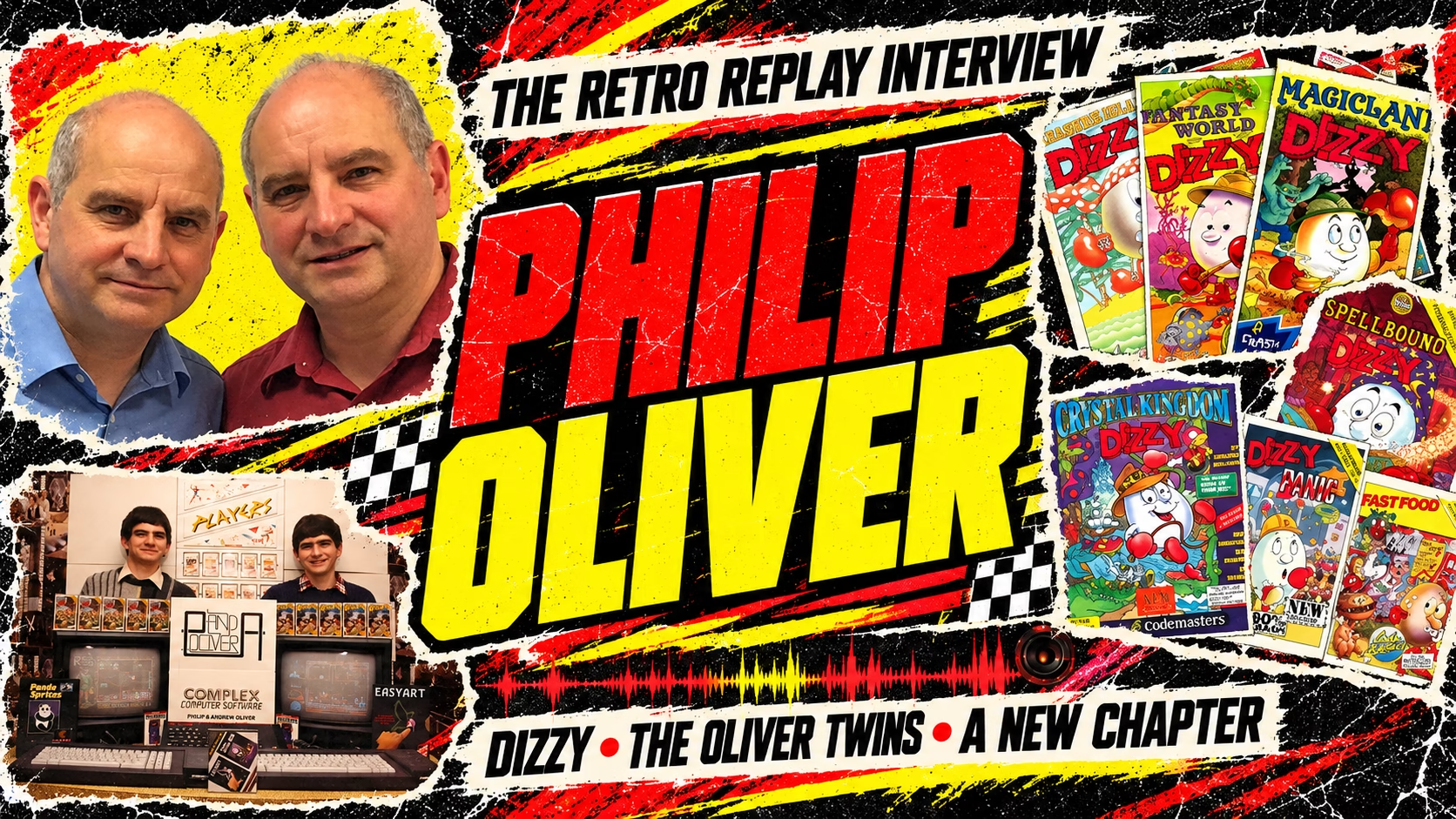
Interview by David, Retro Replay
Dizzy began with a problem small enough to fit inside a sprite: how do you give a game character a face that can actually express something? Philip Oliver’s answer became one of the most recognisable figures of the British home-computer era. With his twin brother Andrew, he built a world of enchanted forests, peculiar objects, needy neighbours, and puzzles that could turn a humble bean into a route to the clouds.
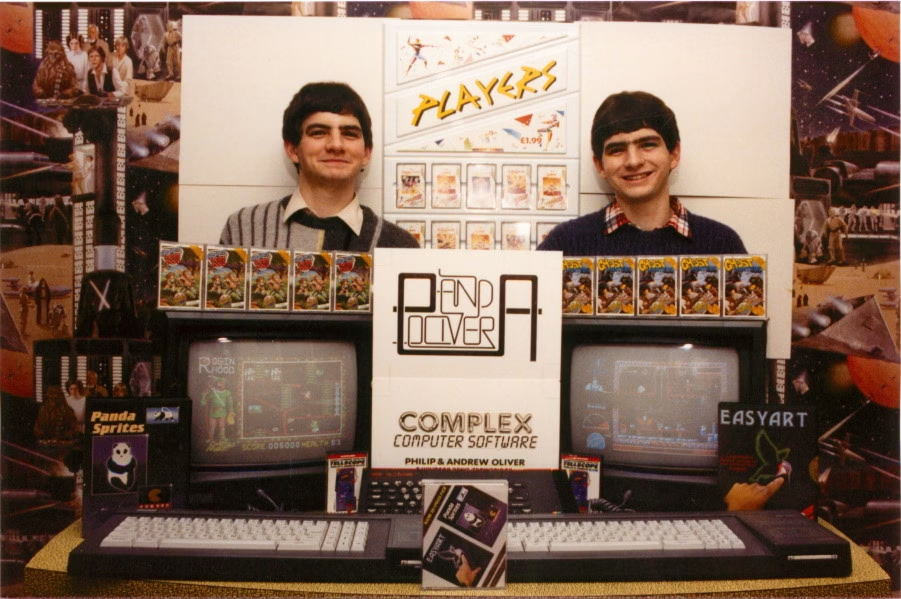
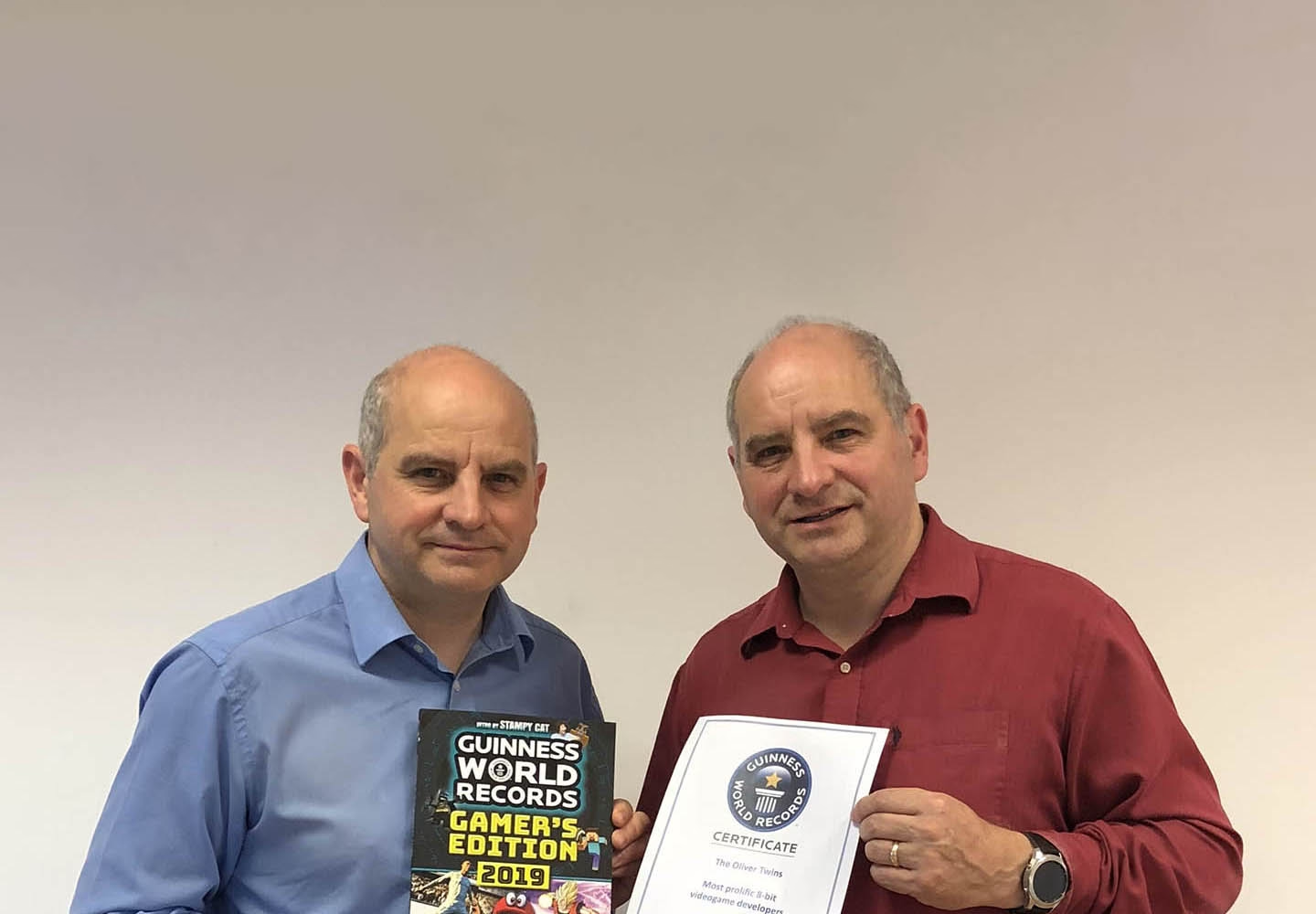
Known together as the Oliver Twins, Philip and Andrew made their early games at home before finding a publishing partnership with Codemasters. Their career grew from that close collaboration into the demands of running a much larger studio. The twins’ official account of their early years follows that journey from home computers and bedroom development to Dizzy’s success.
In this written interview, Retro Replay’s David asks Philip about those beginnings, the decisions behind Dizzy, and what changed when making games became the business of employing people and keeping a studio afloat. Philip also discusses the ambitions behind new Dizzy adventures and Journey to the Emerald City, a physical adventure that brings discovery, puzzles, and an inventory of cards off the screen.
The answers below are Philip’s own, rather than a joint response from both brothers. They offer a personal view of a shared creative history, with the same interest in making something people will enjoy running through the memories and the plans for what comes next.
This interview was conducted in writing. Philip Oliver’s answers are reproduced as supplied, with paragraph spacing normalized.
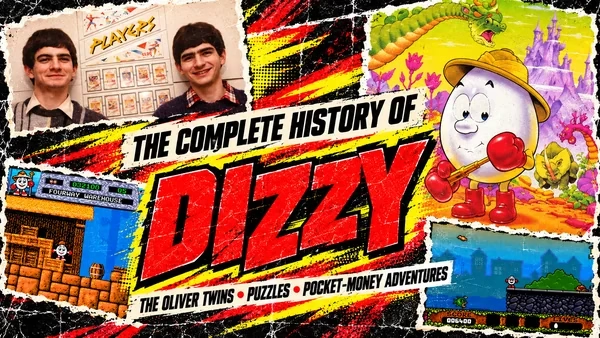
For the longer story behind these memories, our forthcoming feature, The Complete History of Dizzy: The Oliver Twins, Fairy-Tale Puzzles, and the Egg That Wouldn’t Quit, follows the games from their cassette beginnings through the console gamble, lost adventures and fan-led return. Philip’s answers here helped us trace the decisions behind the egg.
Two Brothers, Home Computers, and a Career in Games
Retro Replay: What first made you realise you could create games yourselves?
Philip Oliver: Playing games made us curious about how they worked. Having access to early home computers gave us a way to experiment, and getting something we had written to respond on screen was tremendously exciting. Our first attempts were very simple, but each small achievement encouraged us to try something more ambitious.
Retro Replay: Did you seriously consider the advice to get “real jobs”?
Philip Oliver: We understood why people were concerned, but making games was what we wanted to do. After our A levels, we persuaded our parents to give us a gap year to see whether we could make a business of it. That gave us a chance to prove it could become a career. We didn't think about or talk about anything except writing games. So no consideration for other jobs., or girl freinds or anything really – except making better games!
Retro Replay: What was the bedroom-development scene like?
Philip Oliver: It was much less organised than the industry people know today. You were learning as you went, often with very limited equipment, and trying to persuade publishers to take your work seriously. For us, a great deal of it really was two brothers working at home, determined to finish the next game. We couldn't see into the lives of other game developers; we had no idea what others were doing. The first time we met other game developers was in the offices at Interceptor Software.
Retro Replay: How did you divide responsibilities?
Philip Oliver: We both programmed and contributed creatively, so it wasn’t simply one programmer and one designer. I tended to do a little more of the design and art whilst Andrew focused on the programming. Later, I increasingly took on the business and organisational responsibilities, while Andrew continued concentrating on programming and technology.
Retro Replay: How were you able to produce games so quickly?
Philip Oliver: Very long hours, small projects by modern standards, and continually improving our tools and reusing useful code. We also had very little organisational overhead: decisions could be made immediately between us.
Retro Replay: Did the hardware limitations make you better designers?
Philip Oliver: They certainly made us disciplined. Every feature had a cost in memory, processing time and development effort, so you had to think carefully about what it contributed.
The important lesson was to make the player feel they were exploring a much richer world than the machine could actually hold. A few carefully chosen details, a character’s expression or a good puzzle could suggest far more than we could explicitly show.
Codemasters and the Birth of Dizzy
Retro Replay: How did your relationship with Codemasters begin?
Philip Oliver: We met Richard and David Darling at a computer show in September '86 while looking for a publishing opportunity. Super Robin Hood became our first Codemasters game. They understood the market and helped turn our development work into commercial success. Their ambition matched ours.
Retro Replay: Where did Dizzy originate?
Philip Oliver: While working on Ghost Hunters, I became frustrated by how little expression we could give a character with such a tiny head. I started drawing a character who was essentially a large face, with hands and feet attached.
He had much more personality, and we wanted to give him a world that suited him: something colourful, magical and cartoon-like, with puzzles as well as platforming.
Retro Replay: Was the egg shape a creative decision or a technical one?
Philip Oliver: Both, although the starting point was an expressive face rather than a plan to create an egg! The limited sprite space encouraged that shape, and it worked beautifully for the rolling and somersaulting animation. The character’s identity grew out of those practical decisions.
Retro Replay: When did you realise he could sustain a series?
Philip Oliver: The first game’s sales grew over time rather than simply fading away. That told us people were discovering him and recommending the game. He had an appeal beyond a single adventure.
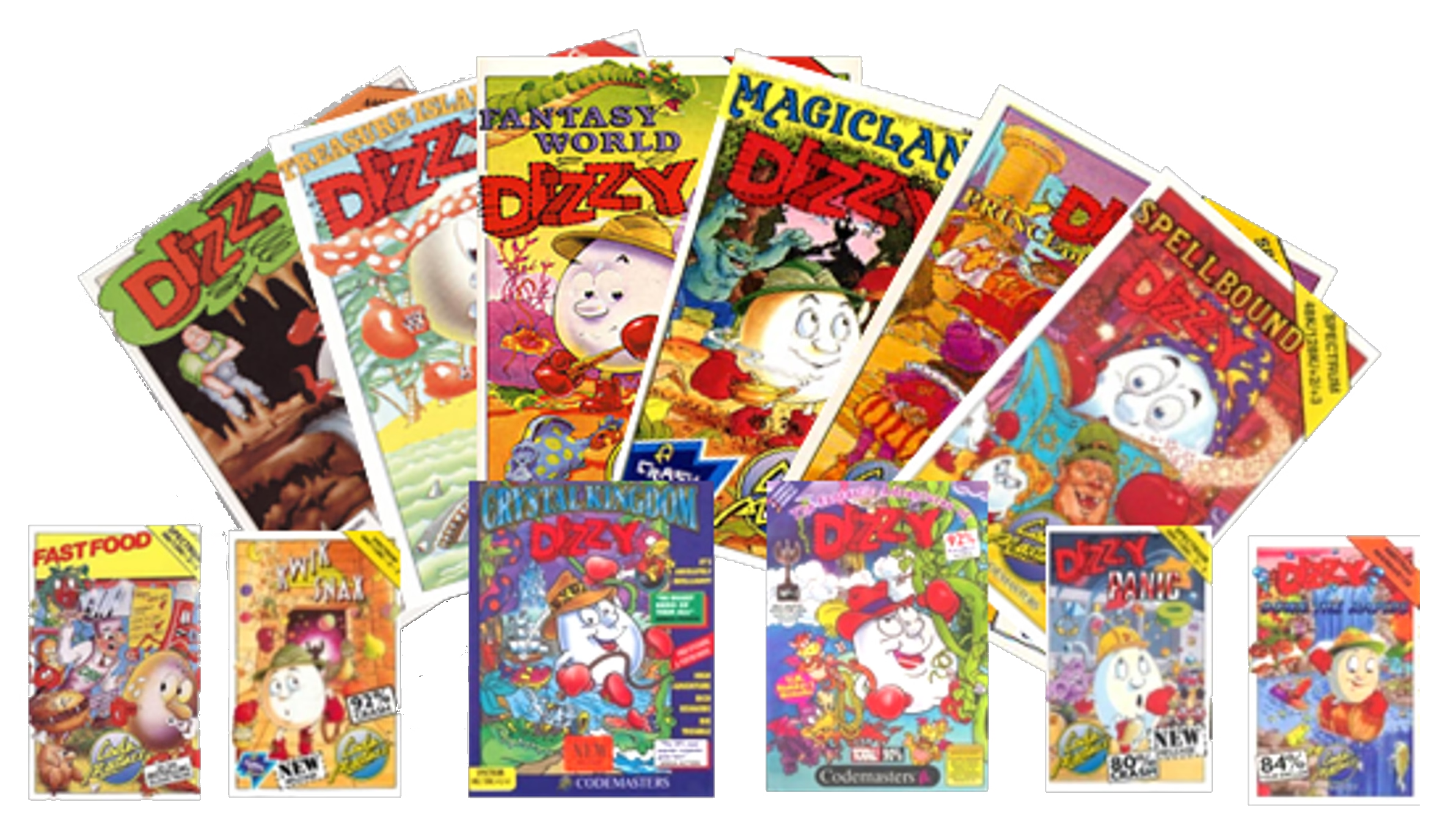
Fantasy World Dizzy: Characters, Puzzles, and Lasting Memories
Retro Replay: What came together in Fantasy World Dizzy?
Philip Oliver: For me, Fantasy World Dizzy, the third adventure, was where everything really gelled. We wrote it in September 1989, and it brought together the exploration, puzzles, humour and fairytale atmosphere particularly well.
Introducing the Yolkfolk as characters you could meet and talk to made a huge difference. They gave the world personality and gave Dizzy reasons to help people. They were admittedly quite a needy bunch, but that provided a very useful supply of missions!
Retro Replay: How did you devise the object-based puzzles?
Philip Oliver: There wasn’t one compulsory starting point. An object, a situation or a familiar story could suggest the connection.
The beanstalk sequence in Fantasy World Dizzy is a good example. Finding a bean, working out what to do with it and watering it turns a familiar fairytale idea into something the player makes happen. Ideally, solving a puzzle should change the world or open somewhere interesting to explore.
Retro Replay: Which puzzle makes you proud, and which was too cruel?
Philip Oliver: The beanstalk is a favourite. Growing it and climbing towards the clouds and the castle captured the magic of Jack and the Beanstalk in a way that worked wonderfully within Dizzy’s world.
At the other extreme, the first Dizzy game had an invisible trigger in the middle of the pit just to the right of the starting screen. Looking back, that was unfair and a mistake. A puzzle should challenge your thinking, rather than depend on discovering something you had no reasonable way of knowing was there.
Retro Replay: Did you imagine people would still be discussing Dizzy nearly 40 years later?
Philip Oliver: Certainly not on this scale. Hearing how much those games meant to people, and how vividly they remember them, is extraordinary.
Some people tell us Dizzy helped inspire their own creative careers. That is a wonderful thing to hear about something we made when we were so young.
Retro Replay: Which game best represents the series?
Philip Oliver: Fantasy World Dizzy. Other games developed particular aspects further, but that is the one where I feel the essential ingredients came together most successfully: the world, the characters, the conversations and the puzzles.
From Developers to Studio Leaders
Retro Replay: Was becoming a studio executive harder than becoming a developer?
Philip Oliver: In many ways, yes. The sheer volume of administration was enormous: premises, rent, utilities, staffing and all the responsibilities that come with running a company. It left much less time to be creative.
The financial pressure was also completely different. Working from our parents’ home, a disappointing month was something we could survive. Running a large studio meant substantial commitments to other people, with sums involved that we could never personally cover.
Keeping income ahead of expenditure was a constant balancing act. Eventually, we couldn’t sustain it and had to put Blitz into voluntary liquidation. That was profoundly stressful and upsetting.
Retro Replay: Did you miss having direct creative control?
Philip Oliver: Absolutely, although there are two sides to it. When you employ talented people to work creatively full time, they understandably want ownership of their work.
Andrew and I might have founded the company as creatives, but dropping into a project between business responsibilities wasn’t the same as working on it every day. We could understand why additional input might sometimes feel disruptive. Balancing those perspectives was difficult.
It is lovely now to be more directly involved in making things again.
Retro Replay: What was different about working with major entertainment companies?
Philip Oliver: The scale of coordination and responsibility. Working with an established character or world means understanding what makes it distinctive, collaborating with its owners and delivering within an agreed commercial framework.
That can be creatively rewarding, but it is very different from two people deciding what they want to make and getting on with it. You are contributing to something that already has an audience, expectations and a wider business around it.
Retro Replay: What did the industry gain as development became more professional?
Philip Oliver: The ability to create experiences that would have been unimaginable when we started. Specialist teams can achieve extraordinary things in art, animation, sound, storytelling and technology.
We had the privilege of working with many talented people. Building a studio allowed us to attempt projects that two people could never have delivered alone.
Retro Replay: What did it lose?
Philip Oliver: Some freedom to take creative risks. As budgets grew, the consequences of failure became much greater, so financial considerations inevitably had more influence over what received approval.
In the early days, we could make something because we thought it was a good idea. Later, much of our creativity had to fit within the projects we could secure funding to make. Original opportunities still existed, but getting them financed was much harder.
Dizzy's Next Chapter
Retro Replay: Why does now feel right for new Dizzy games?
Philip Oliver: The 40th anniversary gives us a wonderful focus, but we want this to be about making things people can enjoy today as well as celebrating the past.
We have an enduring community, a workable agreement allowing us to create new games, and the enthusiasm to get directly involved again. We would love to create something that means as much to a new generation as the original games meant to theirs.
Retro Replay: Was the rights agreement the final obstacle?
Philip Oliver: It was an important practical step. We have reached an agreement that allows us to create new Dizzy games without seeking approval for each one, while paying royalties.
I’d rather keep the contractual details private, but it gives us a basis on which to move forward.
Retro Replay: What are you asking yourselves about a modern Dizzy game?
Philip Oliver: There has been a little progress since the material you saw: we have now shown Treasure Island Dizzy Ultra.
A central question is how to preserve the recognisable adventure while presenting it in a way that feels appealing today. That includes celebrating the older versions, their graphics and music, while offering an Ultra presentation for players expecting more modern visuals and audio.
We also want to build our ambitions sensibly. We will begin with 2D games and increase the complexity of what we tackle. Moving into 3D remains an ambition, but we aren’t promising a timetable for it.
Retro Replay: How do you modernise Dizzy without losing his charm?
Philip Oliver: The personality and the pleasure of solving puzzles have to remain central. Better presentation should help people connect with the character and understand the world.
We also need to distinguish between things people loved and things they merely tolerated because that was how games worked at the time. My example of the invisible trigger is a useful reminder that preserving the spirit of Dizzy doesn’t mean preserving every old frustration.
Retro Replay: How do you serve existing fans and new players?
Philip Oliver: The original games were primarily aimed at children around eight to twelve, although plenty of older players enjoyed them. We prefer “eight plus” because there should be no upper age limit on enjoying a good adventure.
We want longtime fans to recognise what they loved, while giving today’s children something that feels made for them too. The different presentations in Treasure Island Dizzy Ultra are part of that approach. It is a balancing act, and we hope to get it right.
Retro Replay: How much influence will the community have?
Philip Oliver: We want to hear feedback and are open to ideas. The community has kept Dizzy alive in people’s hearts for decades, and we value that enormously.
Ultimately, Andrew and I have to take responsibility for the creative decisions. We need to consider both the established fans and people who have never encountered Dizzy before. Listening is essential, but so is having a coherent vision.
Retro Replay: Is his visual identity particularly difficult to modernise?
Philip Oliver: It is certainly an important consideration. Dizzy needs to remain immediately recognisable and expressive, whatever the technology.
Higher-quality visuals give us more possibilities, but simply adding detail isn’t enough. The character and the world still need that approachable, playful quality. We want people to feel they are meeting Dizzy again – or meeting him for the first time – rather than just looking at a technical upgrade.
Retro Replay: Could this become an ongoing new era?
Philip Oliver: That is very much the hope. We would like to make multiple Dizzy games during 2027 and beyond, building on what works and increasing our ambitions as we go.
The anniversary is a great opportunity to begin that next chapter.
An Adventure Away from the Screen
Retro Replay: Where did the screen-free game idea begin?
Philip Oliver: The immediate spark was a BBC breakfast television discussion I watched on 15 June about children, social media and screen time. Parents and children were talking about the need for appealing entertainment away from screens.
It made me wonder whether we could apply our experience of video games to a physical experience. I wouldn’t claim we can match everything that makes video games compelling, but I felt there was room for an interactive book presented with some of that same sense of adventure and discovery.
Retro Replay: What appealed to you about making a “video game without a screen”?
Philip Oliver: It was a fresh creative challenge with a clear purpose. We know how much children enjoy discovering things, solving problems and feeling involved in an adventure. Could we encourage those same responses through something they could hold and explore?
It also takes us into new territory as a business: physical design, manufacturing, logistics and retail. We are learning a great deal that should help with future titles.
Retro Replay: Which adventure-game lessons transferred into the physical format?
Philip Oliver: Giving players things to discover and use is a natural connection. Cards can make an inventory tangible, a map helps establish the world, and puzzles and the cipher wheel give readers something to work out.
I also want to be honest about the limits of this first title. Following an existing, largely linear story meant the interactivity was shallower than I would ultimately like. The story takes just under two hours to play, and we haven’t added alternative endings.
We therefore put considerable thought into the wider package. The cards support 14 games for one to six players, including 12 traditional card games, and the activity book contains close to 100 puzzles. There is a lot of entertainment in that small box beyond completing the story once.
Retro Replay: Why return to Baum’s original book?
Philip Oliver: The Wonderful Wizard of Oz is a story we know well and one that has influenced our games before, particularly Wonderful Dizzy. Returning to the book gave us a clear foundation and the opportunity to explore its own characters and details.
That was helpful for a first project in a new format, but it also imposed boundaries. Staying faithful to an established story limits how far you can change events or introduce branching possibilities. An original story gives us more freedom, and that is something I am exploring for a future title.
Retro Replay: How important is the physical box?
Philip Oliver: Very important. There is something satisfying about holding a box, owning it, opening it and giving it to somebody. That physical connection can become part of the memory of the experience.
We have also been conscious of the materials involved. For this product, we have designed the box and contents around FSC paper or recycled paper, avoiding plastic. We want it to be an appealing physical gift while being thoughtful about how it is produced.
Building Active Brain Games
Retro Replay: Does Kickstarter restore a direct connection with players?
Philip Oliver: Yes. It gives us a way to show people what we are making, hear their responses and establish whether there is enough demand to justify production.
With a physical product, it also helps us decide how many copies to manufacture. Most development expenditure comes before the campaign money arrives; the funding is intended for producing the physical goods.
Kickstarter is our first sales channel, rather than the only one. We intend to make the games available online and in shops as well. We are very grateful to everyone who has backed the campaign and helped us take that first step.
Retro Replay: Is this the beginning of a larger Active Brain Games range?
Philip Oliver: That is the intention. Journey to the Emerald City is a substantial first step, but we aren’t claiming it is the final word on what this format can do.
I am already working on an original story that gives me more freedom to introduce interactivity. We expect to learn from each release and develop the mechanics and complexity over time. I’ll save the details of that next story for another announcement.
Retro Replay: Why introduce One for Ten?
Philip Oliver: For every ten boxes sold, through any sales channel, we will allocate one box to donate to a childrens charity.
Initially, we can work with charities we know. We also have an application form on our website so children’s charities can provide their contact details, delivery address and charity number to request a box from that allocation.
We want the business to be commercially sustainable, while also doing something useful for the wider community. These are educational, entertaining activities, and sharing them with children who could benefit feels like a practical contribution we can build into the business.
Creative Tools and What Comes Next
Retro Replay: How do you balance generative AI with human creativity?
Philip Oliver: We know this is a contentious subject, and we understand that people have strong views. Our position is that these tools can make creative projects economically possible that otherwise wouldn’t happen.
We use generative AI to support our work across development, rather than restricting it solely to artwork. The concepts, design choices, creative direction and responsibility for the finished product remain ours.
The artwork also involves much more than typing a prompt and accepting the result. The process includes designing, prompting, editing, reviewing, reworking and compositing. It still demands judgement, skill and considerable effort.
Our estimate is that developing something as comprehensive as Emerald City without these tools could have cost £50,000–£100,000 before manufacturing, marketing and inventory. For an experiment in a new format, that would have been very difficult to justify.
Having spent years managing large development budgets, I take that seriously. Lower production costs give smaller teams more room to experiment and explore new ideas. If the resulting business succeeds, that can create opportunities for more projects and more employment. What excites us is the possibility of bringing more creative ideas to life.
Retro Replay: What would you like readers to follow or support?
Philip Oliver: The immediate thing to look at is Journey to the Emerald City on Kickstarter. The campaign finishes on 21 October 2026. We are delighted it has reached its funding target, and further support will help us build on that start.
For our history and news about what comes next, including Dizzy’s 40th anniversary, please visit OliverTwins.com.and sign up for the newsletter.
What keeps us motivated is the opportunity to make things people enjoy. Hearing what the old games meant to people is wonderful; having the chance to create new experiences and new memories is equally exciting.
Thank You, Philip
Our thanks to Philip for sharing these memories and giving such a generous look at the work still ahead. His recollections bring the Oliver Twins’ story back to the people making the decisions: two brothers learning together, finding a character’s personality inside tight technical limits, and later carrying the responsibilities of a studio. It is encouraging to hear that making new things remains the part he enjoys. We wish Philip and Andrew every success with their next adventures. Readers can explore their history, games, and news at OliverTwins.com.
For more conversations with the people behind classic games, read our Steve Ince interview on Broken Sword and game writing, our Louis Castle interview on Westwood, or our Barry Leitch interview on the music behind Lotus and Top Gear.