 Retro Replay Retro Gaming History, Reviews & Emulation

A bad idea in a very good suit
Larry Laffer thinks the evening is going beautifully. He has the suit, a practiced line, and what he takes for irresistible confidence. The player can see the disaster coming from the other side of the screen. Larry cannot. That gap is the joke that carried a computer-game character through text parsers, sound cards, CD-ROMs, company upheaval, crowdfunding, and dating apps.
His reputation as the naughty Sierra game only tells part of it. Behind the white suit stood a former music teacher, an artist who had to make a hapless man funny at a glance, the people who built Sierra’s adventure tools, and later teams asking whether Larry was a character, a kind of comedy, or simply a familiar name on a box.
The answers changed with every generation of computers. The story began when Al Lowe picked up an old text adventure and decided that its idea of seduction was already a joke.

Before Larry: Chuck Benton’s text adventure
In 1981, On-Line Systems, the company that became Sierra On-Line, published Chuck Benton’s Softporn Adventure for the Apple II. This was a text adventure: locations and encounters existed in prose, and the player supplied commands. There was no animated Larry marching across the screen because Larry had not been invented.
In Lowe’s account of Softporn’s origins, Benton began the project while exploring what the Apple II could do with database-style programming. The eventual game supplied the locations and puzzle framework that Lowe would revisit several years later. It is an important distinction: Benton built the predecessor; Lowe created the comic protagonist and the new game’s voice.
The distance between the two projects is revealing. A text adventure can ask a player to imagine being an anonymous participant. Put an awkward little man on screen and the same actions acquire a different meaning. Now the audience can watch him misunderstand a situation. He can become the joke.
This is the transformation that matters more than the addition of graphics. Larry was an interpretation of an earlier game, with its premise turned back on itself. He made the fantasy look faintly ridiculous before the player had even typed a command.
Al Lowe: the teacher behind the punch lines

Lowe did not arrive at Sierra through a university computer-science department. He was a music educator who taught for fifteen years and played jazz. His official-site biography places his arrival at Sierra in 1982, after the beginnings of a career that combined teaching, performing, and learning to make things with a home computer.
That background is worth sitting with. A teacher has to hold a room’s attention. A musician learns timing, repetition, and when to leave space. Neither profession automatically produces a good game designer, but both offer ways of thinking about an audience. Lowe would eventually work across writing, programming, music, and design, rather than treating those as unrelated jobs.
He explained to Adventure Classic Gaming in 2006 that he taught himself programming and produced three games before meeting Ken Williams. One was an educational game he made for his young son. Ken and Roberta Williams offered a practical bargain: Sierra would handle publishing so that Lowe could spend more time creating.
His early Sierra work included Disney-related projects such as Winnie the Pooh in the Hundred Acre Wood, Donald Duck’s Playground, and The Black Cauldron. He also programmed King’s Quest III. Larry’s creator had already spent time helping children explore stories and helping Roberta Williams turn an adventure design into working software.
The apparent contradiction is half the fun. The man associated with Sierra’s most conspicuously adult comedy had substantial experience making games for children. His career was not a straight march toward increasingly outrageous material. It was a search for different audiences, with humor as a recurring tool.
Ken Williams makes a suggestion; Mark Crowe makes a man
When Ken Williams suggested revisiting Softporn, Lowe went back to the old game. His response became the franchise’s origin story: the material felt so dated that a leisure suit seemed like the appropriate costume. The joke supplied a character, a title, and a way to approach the assignment.
As Lowe recalled in his Hugi interview, he could make the idea work if he was allowed to make fun of it. Artist Mark Crowe supplied the backgrounds and animation while Lowe handled the writing, programming, music, and sound. Crowe’s contribution came through an intense stretch of evenings and weekends alongside other Sierra work.
Crowe deserves more than a passing credit beneath the words “an Al Lowe game.” In his own Adventure Gamers interview, he described starting in Sierra’s marketing department, making packaging, logos, and documentation, before moving into game graphics. His partnership with Scott Murphy produced Space Quest. Larry therefore emerged from some of the same creative surroundings as Roger Wilco.
Both characters are wonderfully unsuitable heroes. One is a janitor wandering into science-fiction catastrophe; the other is a would-be romantic leading man whom the scenery seems determined to embarrass. Crowe’s art had to communicate that mismatch quickly, using small figures and limited animation.
Look at early Larry beside the people he wants to impress. The silhouette does much of the writing. He is recognizable before he speaks. That clarity would survive several drastic changes in art style, even when later games gave him very different proportions.
It would be misleading, however, to imagine two people creating every underlying technology from nothing. Sierra already had an adventure-game production system. The visible creative partnership depended on the engine and tools that made animated characters, room changes, objects, and scripted responses possible.
1987: a night in Lost Wages
Leisure Suit Larry in the Land of the Lounge Lizards arrived in 1987. Its setting, Lost Wages, promised adult excitement with a name that quietly warned the player how the evening might end. Larry moved between a bar, a shop, a casino, a disco, and other locations in pursuit of the life he believed he ought to be having.
The game belonged to Sierra’s AGI generation. Movement and typed commands worked together: you positioned Larry in the room and then asked the game to interpret what you wanted. The resulting conversation was part puzzle solving, part negotiation with the software, and part comedy routine.
A useful response might advance the plot. A useless response might still be funny. That second possibility is essential to understanding why people remember these games. Looking at the wrong object or suggesting a foolish action could produce a small reward even when it achieved nothing practical.
The narrator also gave the player a companion. Larry could believe his own sales pitch while the text maintained a healthier skepticism. You were helping the protagonist and laughing at him at the same time. The game could offer a fantasy and immediately puncture it.
Its world was compact enough to become familiar. A few repeated destinations acquired personalities, and the distance between Larry’s ambitions and his actual resources became part of the structure. Money, transport, inventory, and timing mattered. The night had a practical underside beneath the neon.

The quiz at the door
Before the adventure, there was another performance: the age quiz. Players answered questions about older popular culture in a supposedly adult test of knowledge. Lowe has preserved the original question-and-answer material, which now reads like a second historical artifact inside the first.
In MEL’s oral history, Lowe connected the quiz to the team’s enthusiasm for Trivial Pursuit and acknowledged its ineffectiveness at excluding children. It was an attempt at a gate, but also another place to put jokes.
With time, its assumptions become almost upside down. An adult encountering the game decades later may know less of the expected trivia than a determined youngster once did. The questions test familiarity with a particular cultural moment rather than age itself. That makes them useful evidence of the audience Sierra imagined in 1987.
They also helped frame the game as forbidden territory. Getting past the quiz could feel like entering somewhere you were not meant to be. The reputation sometimes overshadowed the comparatively modest images actually produced by the hardware.
A tune with a crooked grin
Larry’s musical signature belongs in the origin story too. On his page about composing the theme, Lowe remembers hearing a radio item about Irving Berlin’s birthday on May 11, 1987. The old-fashioned energy of “Alexander’s Ragtime Band” suggested a direction. He says he wrote Larry’s theme at the piano in about twenty minutes.
The important connection is the spirit, not a claim that the melodies are identical. Larry needed something jaunty, slightly misplaced, and easy to recognize. A tune that sounded delighted with itself was a good companion for a man with precisely the same problem.
As sound hardware improved, the melody could acquire better instruments without losing its identity. Listen across versions and the technology changes around a recognizable comic gesture. Music gave the franchise continuity that did not depend on Larry’s face looking exactly the same.
The slow arrival of an unlikely hit
The opening sales story is less triumphant than the character’s later fame suggests. In a 2004 interview excerpt preserved by Adventure Gamers, Lowe recalled a first month of approximately 4,000 copies and his belief that the project had failed. He moved on to programming work while Larry gradually found an audience.
His accounts describe sales accelerating over subsequent months. They are recollections, not a complete audited sales ledger, and the often-repeated “doubling every month” line should not be turned into a precise calculation of lifetime revenue. The defensible story is a weak start followed by a much stronger life.
Contemporary coverage helps place that memory in context. The November 1987 issue of Computer Gaming World included Larry among its reviewed games. The joke had entered the regular conversation about computer entertainment rather than remaining an obscure curiosity.
Larry’s survival depended on time to be discovered. A box could circulate by recommendation, a friend could demonstrate a favorite gag, and a title could become familiar months after its arrival. That slower rhythm is part of the history, particularly when contrasted with the expensive relaunches that came later.
1988: a bigger journey, one floppy at a time

Leisure Suit Larry Goes Looking for Love (in Several Wrong Places) expanded the journey in 1988. Lost Wages gave way to a much broader itinerary involving travel, a cruise, and an island adventure. Sierra’s SCI technology supplied a new foundation, although players still typed commands.
The sequel is a good example of technology shaping a story in a way that can disappear when you play from a modern drive. Lowe explained that its sequence of regions was arranged around floppy storage: finish an area, move on, and avoid repeatedly swapping disks to revisit earlier locations.
That choice made geographical progress feel decisive. It also intensified a familiar adventure-game anxiety. Had you taken everything you needed before leaving? A trip forward could close a route behind you. The convenience of less disk swapping did not necessarily translate into a more forgiving puzzle structure.
The period’s ordinary play habits followed from that uncertainty. Multiple saves were a form of insurance. A player might keep a file from before a journey, another after arriving, and another before experimenting. Saving was part of learning how the world behaved.

Seen today, the sequel’s scope is as interesting as its difficulty. The first game had developed comedy through the repeated humiliation of a man in a small nightlife circuit. The second tried to give him a larger adventure plot. Larry could travel almost anywhere, but that did not guarantee he was equally suited to every kind of story.
That tension would keep returning. The series was strongest when its locations created opportunities for character and comic experimentation. Scale alone could not supply those things. A smaller setting with more responsive detail might serve Larry better than another improbable destination.
1989: Passionate Patti gets a turn
Leisure Suit Larry III: Passionate Patti in Pursuit of the Pulsating Pectorals arrived in 1989. Its title was already a workout, but the more interesting change was structural: the player eventually controlled Patti, turning Larry into someone who could be searched for and rescued.
The shift did not erase the series’ dated sexual politics. It did, however, change who could act. Patti was more than a destination at the end of Larry’s efforts. Giving her a playable portion of the adventure let the relationship occupy both sides of the screen.

The island setting also made visible the consequences of the previous game’s events. Rather than simply resetting the first night’s premise, the third installment tried to build a continuing life around its protagonist. For a comic character designed to stumble from failure to failure, success posed an awkward writing problem.
Lowe eventually resolved the adventure with an extravagant break in the fiction: Larry and Patti escaped into Sierra’s own world, and Larry began making a game. In his later explanation of the series, Lowe described this as a deliberate ending to a trilogy. A character built around frustrated desire had apparently found a conclusion.
That is why the missing fourth game is more than a numbering gag. Before Sierra could sell another Larry adventure, somebody needed a reason to disturb that ending.
Seventy-two rooms, one background
One of Larry III’s most interesting development stories is hidden in its bamboo maze. In Lowe’s explanation of his favorite programming trick, seventy-two maze screens were assembled from one background, with overlays blocking different exits and horizontal reversals changing the appearance.
A small bit array recorded which routes were open. The technique reduced storage and disk access while making one piece of scenery stand in for many rooms. As Lowe put it, “the hack was much more interesting than the maze itself.”
That is a refreshingly useful distinction. Clever engineering and enjoyable play are related, but they are not the same achievement. The maze could be economical in memory and expensive in patience. Its construction nevertheless reveals how much invention sat behind a screen that a player might dismiss as repetitive.
When old adventures are judged only by their plots and puzzles, work like this disappears. Someone had to make the illusion fit inside the machine. Sometimes the solution was grand new technology. Sometimes it was turning the same picture around.
The fourth game that became an online experiment
There are two stories here, and they are often crushed into one. A conventional Larry 4 was not completed and then lost when somebody misplaced the disks. But Lowe also describes a genuine attempt to build a multiplayer Larry adventure.
In his account of that abandoned project, Lowe worked with Jeff Stephenson and Matthew George on a system that would connect players through modems. Large assets would remain on local disks while smaller pieces of information traveled over the telephone connection. Stephenson handled system technology; George worked on communications; Lowe designed and programmed at the application level.
Simple board games proved easier to get working than a shared graphical adventure. The experiment fed into what became The Sierra Network, with social interaction and familiar games offering a more manageable starting point. Lowe credits his wife, Margaret, with suggesting an early name, Constant Companion.
It is a marvelous detour. Trying to find Larry another adventure helped send his designer toward a different question: how could people play together when they were sitting at different computers?
The later numbering decision was separate. In Lowe’s explanation of why Larry 5 followed Larry 3, skipping a number freed him from the previous ending and made people curious. The missing installment became an implied adventure that nobody had played.
This is a case where an untidy development history produced a cleaner joke. The audience did not need a technical explanation of modems or a careful reconstruction of Larry’s relationship. It needed to wonder what on earth had happened to number four.
1991: new colors, fewer typed commands
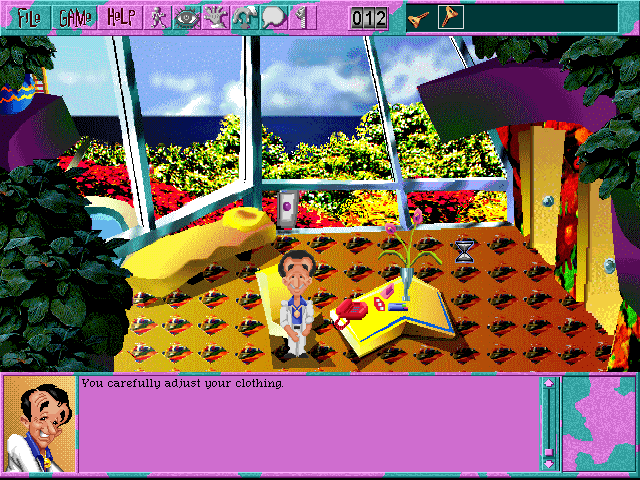
Sierra revisited the first game in 1991 with a VGA remake. The locations and underlying premise were familiar, but the presentation belonged to a different moment: richer color, redesigned graphics, and an icon-based interface changed the texture of the experience.
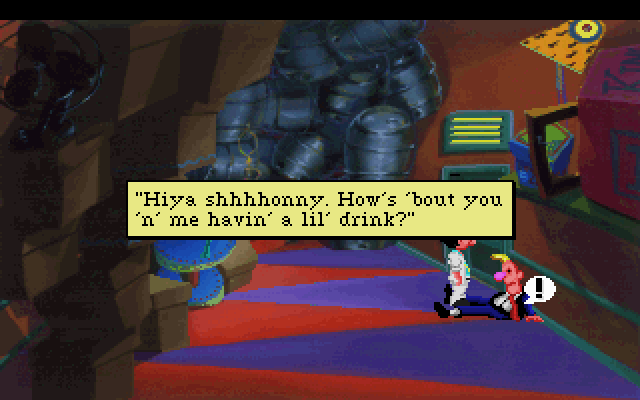
Compare the original and remade bathroom scenes rather than just counting colors. In the original, the room has to declare itself through a handful of large shapes. The remake can pile on ornament and distortion. Both are cartoons, but they communicate with different visual vocabularies.
The interface change matters just as much. A parser lets a player propose an action the designer may never have anticipated. An icon tells the player which broad kinds of actions the game recognizes. One invites open-ended conversation; the other makes the available grammar easier to see.
Neither automatically makes an adventure better. A parser can offer a wonderfully personal put-down and then fail to understand an ordinary verb. An icon interface can remove that frustration while also narrowing the apparent space for improvisation. Larry’s later games would keep wrestling with that tradeoff.
Leisure Suit Larry 5: Passionate Patti Does a Little Undercover Work, also released in 1991, carried the series into this newer style. Larry and Patti followed alternating paths through a plot involving entertainment, investigation, and Larry’s convenient memory problems.
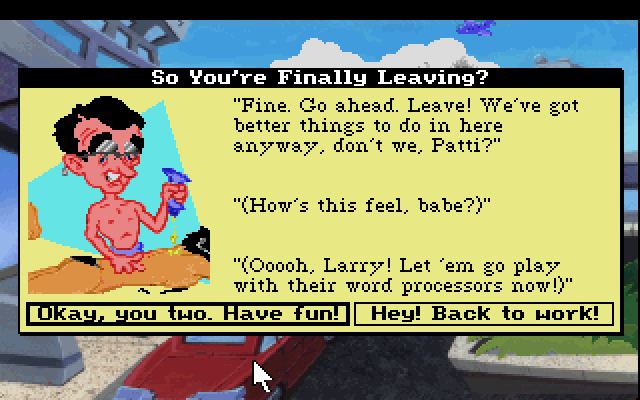
Its design shifted toward a more forgiving adventure than the punishing early installments. The absence of a fourth game became part of the fiction, while the change in interface helped make the fifth feel like a fresh beginning rather than an ordinary continuation.
Lowe has made the Larry 5 design document available, and it is valuable precisely because a design is different from a finished game. Character descriptions, planned interactions, and structural decisions show the work before the final dialogue and implementation have made it feel inevitable.
His accompanying notes on the surviving designs explain that the documents stopped tracking every change once production moved into code, and that dialogue was written in Sierra’s Message Editor. A design document is evidence of intention. It is not proof that every proposed scene shipped.
The other Larrys hiding in the catalog
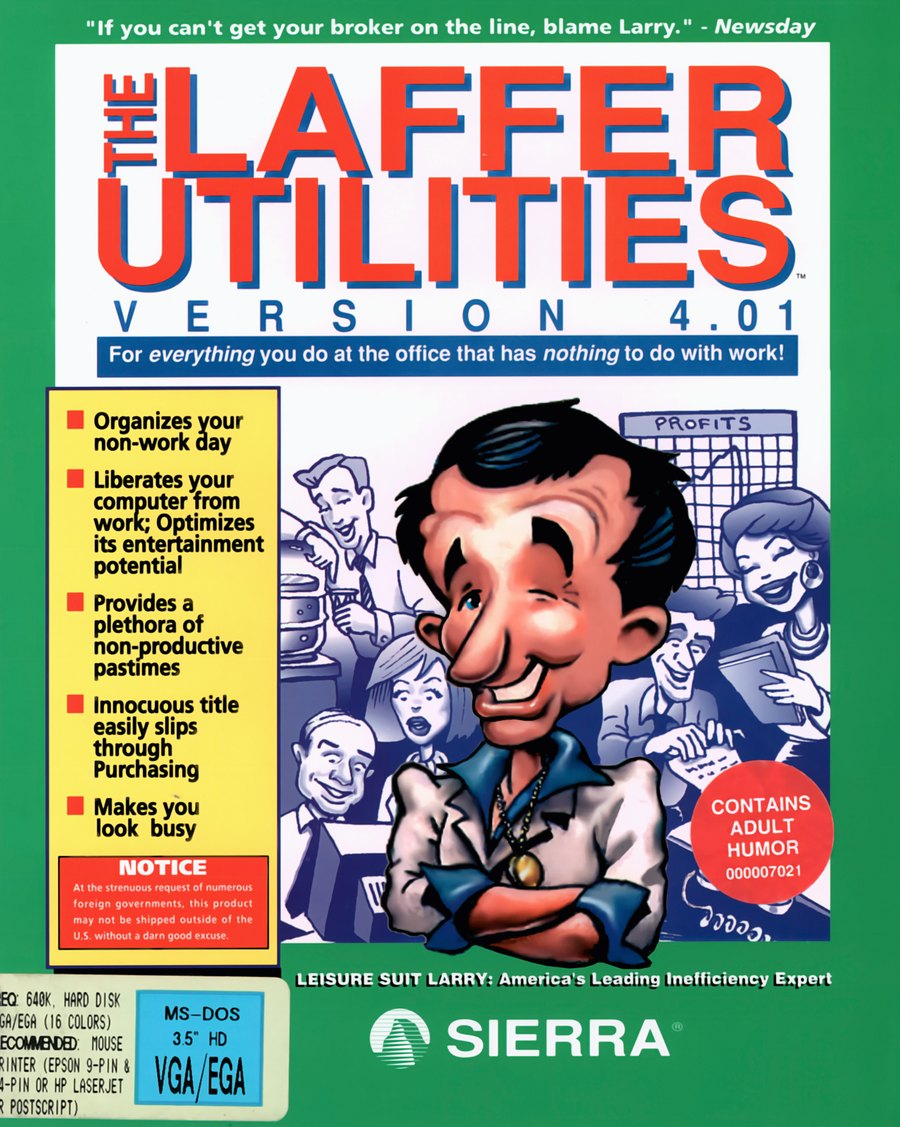
The numbered adventures were not the entire franchise. The Laffer Utilities took the character into a novelty-software format, parodying the serious business of computer utilities. Its existence makes more sense when remembered alongside an era in which buying a computer also meant learning a peculiar new office culture.
A software box could promise to improve productivity. Larry could promise to undermine it. Even the packaging joke depended on the audience recognizing the visual language of useful, respectable software. The preserved Sierra packaging belongs to that history as much as to Larry’s.
There is another trap in the catalog: similar names do not always mean identical games. The casino material associated with Greatest Hits and Misses! should not be confused with the separate 1998 Leisure Suit Larry’s Casino. The latter belongs to the later story of networked social play.
Compilations complicate the numbering further by mixing adventures, remakes, bonuses, and different editions. A package labeled with a range of numbers does not magically produce the missing fourth adventure. This is where a franchise timeline earns its keep: it separates actual works from the way publishers bundled them.
1993–1994: the spa, the team, and the voice
Leisure Suit Larry 6: Shape Up or Slip Out! brought Larry to La Costa Lotta, a resort whose promise of luxury made it an excellent place to disappoint him. The initial 1993 release and the enhanced CD-ROM edition belong to the same game, but they should not be treated as technically interchangeable.
The enhanced CD edition offered speech and higher-resolution presentation; a low-resolution CD version also exists. Larry did not first acquire a 256-color world in part six: the 1991 remake and Larry 5 had already made that transition. The distinction is between color depth, image resolution, and recorded audio, three improvements that are too often bundled into the vague phrase “better graphics.”
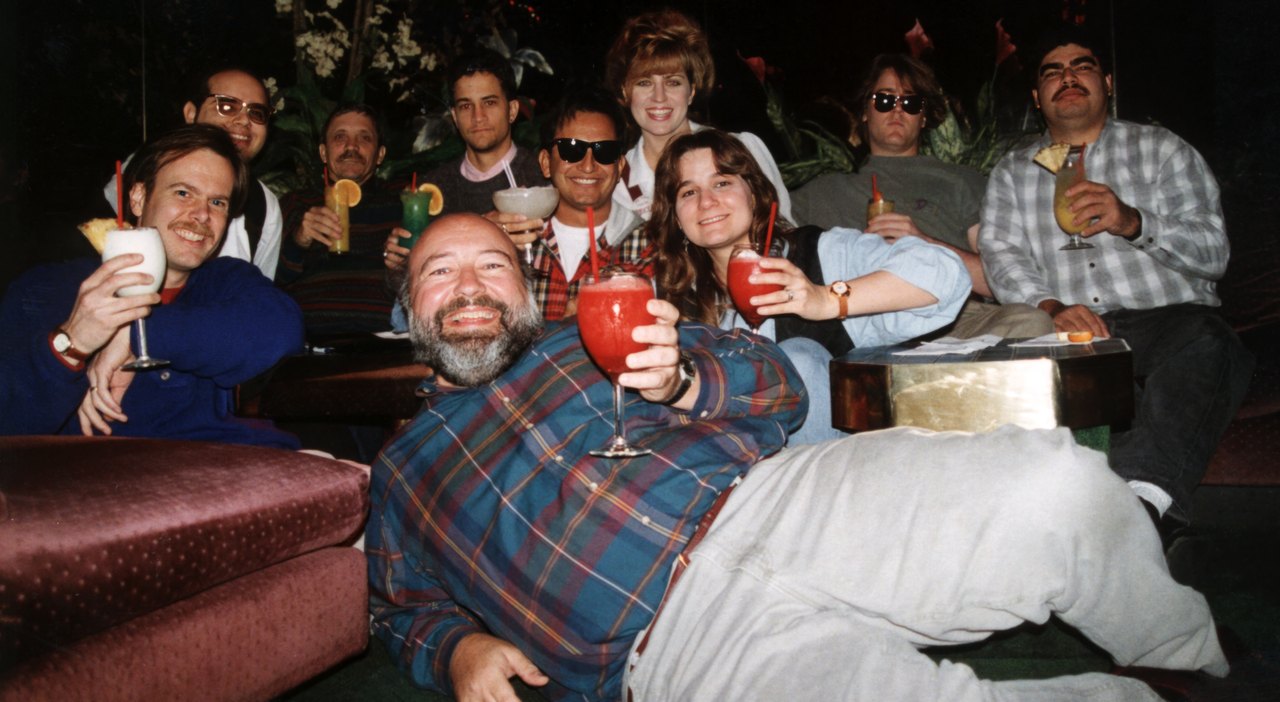
By now the credits also told a different production story. The documented Larry 6 credits identify Juan Carlos Escobar as lead programmer, William D. “Bil” Skirvin as art director, Ruben Huante in character design and background work, and Dan Kehler for music and sound effects. Animators and additional programmers helped turn the resort into a place.
These people are not decorative additions to a famous designer’s biography. The expression on a face, the response of a cursor, the pace of an animation, and the sound under a scene all affect whether a joke lands. A larger game requires coordination between those contributions.
A surviving 1993 team photograph, credited to Sierra On-Line and released through Wikimedia Commons under a Creative Commons license, provides a welcome counterweight to the familiar picture of Lowe alone. There was a roomful of people behind Larry’s latest humiliation.
The resort itself was a productive constraint. Its rooms and facilities could become familiar while new items and conversations changed what the player could do there. A spa is already a machine for selling improvement: a better body, a better mood, perhaps a better social life. Larry was an ideal customer for promises he could misunderstand.
The game’s retry approach also softened the relationship between experimentation and punishment. A comic death need not demand a lengthy replay. Allowing a player to recover quickly makes a foolish action easier to try, which gives the writer more chances to reward curiosity.
For a closer look at the setting, our Larry 6 database entry sits alongside the historical material. The key development is how the series was learning to preserve its pratfalls while reducing the price of seeing them.
1996: Love for Sail! turns the adventure into a cartoon
Leisure Suit Larry: Love for Sail!, generally known as Larry 7, arrived in 1996. A cruise ship supplied another bounded playground, but its animation and presentation pushed much further toward an interactive cartoon.

The change was more than a prettier Larry. Characters needed performances, and conversations needed timing. The original manual’s credits identify Jan Rabson as Larry and Neil Ross as the narrator. Their separate voices made the distance between Larry’s optimism and the game’s commentary audible.
Rabson’s Larry could sound pleased with a line that the surrounding scene had already demolished. Ross could deliver the reply with the ease of someone who had seen this disaster before. Voice acting turned an imagined rhythm into a performed one, while also reducing the reader’s freedom to set the pace.
The manual credits a broad production team, including producer Mark Seibert and writer Don Munsil. In a period interview preserved by Just Adventure, Lowe contrasted the informality of the first game’s two-person creative partnership with the extensive design and text required for Larry 7. He said that he and Munsil added hundreds of pages of writing as the game took shape.
That is an enormous amount of material to coordinate around jokes that may last seconds. Optional responses make the world seem generous, but somebody must write, implement, test, record, and edit them. The ease of the finished cartoon conceals a much less spontaneous production process.

Bringing a little typing back
One particularly smart choice was the mixture of contextual menus and typed input. Larry 7 did not simply return to the old parser, nor did it confine every interaction to the same small set of icons. It allowed the interface to respond to the object and left room for more specific suggestions.
In his Verbosity interview with Jess Morrissette, Lowe praised the flexibility of those menus and the return of opportunities for the game’s familiar verbal put-downs. He also valued a map that reduced unnecessary walking. Both choices addressed the rhythm of playing: get the player to the interesting interaction, then let the writing do its work.
This was an evolution of adventure design from someone who had lived through its awkwardness. The goal was not to preserve every inconvenience because it had once been traditional. Larry could remain Larry while the game became easier to navigate.
The surviving Larry 7 design adds another layer to that story, showing how characters, performances, and interaction were planned. It is especially useful alongside the finished credits: one records intended production, the other records the people attached to the shipped work.
Yes, there really was a scratch-and-sniff card
Love for Sail! also shipped with the CyberSniff 2000 card, a physical scratch-and-sniff companion to an otherwise increasingly digital production. At appropriate moments, the software could send a player back to the box.
It is a perfect Larry object: silly, memorable, and just plausible enough to be sold as a technological advancement. It also makes an important preservation point. A collection of game files cannot completely reproduce an experience that depended on printed material with an actual smell.
The same distinction applies, less dramatically, to manuals, maps, jokes in installation guides, and packaging. For players who bought boxed adventures, the game began before the executable ran. Preserving only the program can preserve the plot while losing part of the performance.
The sequel that never left Earth
The late 1990s brought a different kind of uncertainty. Sierra’s corporate changes after its acquisition by CUC altered the surroundings in which Lowe had worked. A familiar creative relationship could no longer be assumed to carry over into the next contract.
On his page about the proposed Larry 8, Lowe says management wanted him to begin without an agreed contract. He declined to develop the full design on those terms. The extraterrestrial storyline he describes was an idea for where the series might go, not evidence of a completed sequel waiting in an archive.
That difference matters. A premise, some exploratory work, a production-ready design, and a nearly finished game are four different things. Retellings of canceled games often slide from the first to the last because a lost masterpiece is more exciting than an unresolved business arrangement.
Lowe’s version is interesting enough without that embroidery. Larry’s future depended on an agreement about work, ownership, and payment. The character could survive on paper while the relationship that produced the games fell apart.
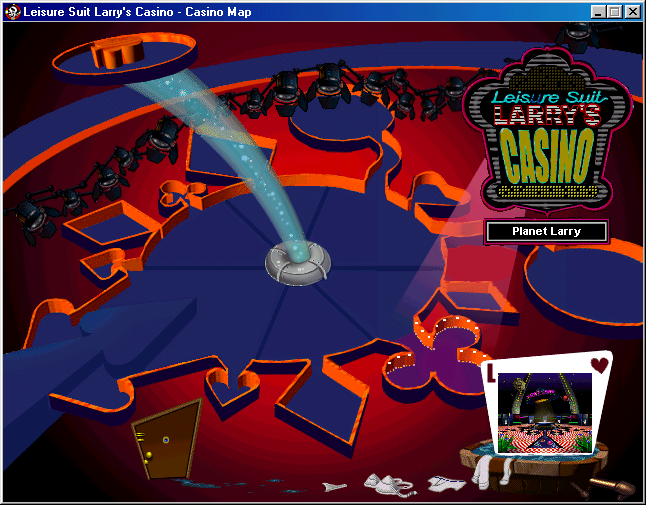
The 1998 Leisure Suit Larry’s Casino offered another direction, combining casino games with opportunities for online play and conversation. It is a reminder that Lowe’s interest in social gaming did not end with the abandoned multiplayer adventure.
It also marks a boundary. The original numbered run had ended with Love for Sail!. Future products could use Larry without automatically extending the same creative lineage.
2004: selling Larry to a different audience
Leisure Suit Larry: Magna Cum Laude arrived in 2004 from High Voltage Software under Sierra’s publishing umbrella. It put Larry Lovage, the original character’s nephew, at the center of a campus comedy and shifted the structure toward minigames.
The most revealing source is not a retrospective complaint. It is Sierra brand manager Alex Rodberg’s 2003 development diary. Rodberg described a recognizable name, an older audience asking for its return, and a younger audience that might not even know what a leisure suit was. He pitched the revival as comedy rather than as a traditional adventure.
That explains the change more clearly than the idea that everyone involved simply forgot what Larry had been. The team was trying to solve a commercial problem. It believed the humor could move into a different format and reach players on consoles as well as PCs.

The risk was that format and humor were more closely linked than the pitch allowed. In the earlier games, comedy often rewarded looking carefully, making an unexpected suggestion, or pursuing a pointless conversation. Repeated minigames create a different relationship between the player and the joke.
Lowe was not part of the shipped game’s creative team. His account of intermittent discussions about involvement documents his frustration, but it should be read as his perspective rather than an omniscient record of every production decision.
Our Magna Cum Laude entry covers the resulting game. For the franchise’s history, the crucial point is that Larry had become something a new studio and publisher could redefine. Familiar branding no longer guaranteed a familiar designer or style of play.
2009: Box Office Bust and the trouble with a name
Leisure Suit Larry: Box Office Bust, developed by Team17, continued with Larry Lovage in a film-studio setting. It passed through the disruption surrounding the Activision–Vivendi merger before Codemasters brought it to market in 2009. Contemporary reporting on Codemasters taking over publication captures that transition.
Lowe again had no creative involvement. The game moved further into three-dimensional movement, tasks, and action-adventure territory. The name survived while the experience attached to it became increasingly distant from the parser and point-and-click comedies that had established it.
This is where franchise history becomes business history. A publisher can acquire rights, commission a studio, and put a recognized title on a box. None of those steps recreates the working relationships or editorial instincts behind an earlier success.
It is also worth resisting the temptation to make every later developer a villain in a nostalgia story. Studios work within schedules, budgets, contracts, and approved concepts. Without good evidence, criticism of a finished game should not become an invented account of who cared, who interfered, or who sabotaged the result.
The reliable conclusion is narrower and more useful: Larry had undergone two major reinventions without his creator. The next attempt would sell the return of that connection.
2012–2013: the fans pay for another night out
Replay Games’ Kickstarter campaign offered a return to the first adventure with Lowe involved. Between April and May 2012, 14,081 backers pledged $655,182 against a $500,000 goal. Those are campaign pledges, not a statement of profit or the entire cost of production.
In the campaign’s published FAQ, the organizers said their agreement with Codemasters covered remakes. That helps explain why the revival began with Lost Wages rather than a brand-new numbered sequel. Creative ambition still had to fit the rights that had actually been licensed.
The funding model changed who could say yes. Instead of relying entirely on a publisher’s forecast of an old adventure audience, the project could ask that audience to make its interest visible in advance. Our history of ToeJam & Earl follows another classic series whose later revival depended on renewed support from fans.
Leisure Suit Larry: Reloaded shipped in June 2013. Lowe’s release announcement records the return; the game involved Replay Games, N-Fusion Interactive, and veteran Sierra writer-designer Josh Mandel.
Bringing people back did not mean reproducing a 1987 development process. New art, sound, voice work, and additions to the adventure still required a modern production. Nostalgia supplied a destination, not a shortcut around the work.
The soundtrack gets a new room to play in
Austin Wintory composed the new score. His official soundtrack release records the music and its performers, making it a useful companion to the game rather than merely a promotional footnote.
The choice offers a satisfying connection back to Lowe’s musical beginnings. A series introduced through a jaunty computer melody could now support a much fuller musical performance. The setting still needed to sound welcoming enough for Larry to believe in it and sly enough for the audience to hear the joke.
A remake makes those balances unusually visible. Too little change and the project can feel redundant; too much and it loses the object of the affection that financed it. Reloaded tried to make a familiar place available again while acknowledging that the people returning to it were older and their computers very different.
It did not launch the complete sequence of remakes the campaign had discussed. Lowe’s departure from Replay Games was reported in December 2013. A successful funding campaign and a shipped game had not guaranteed a lasting reunion.
2018–2020: a man from the wrong decade meets a phone
CrazyBunch and publisher Assemble Entertainment took the next major turn. Wet Dreams Don’t Dry was released for computers on November 7, 2018. It brought Larry Laffer back to a point-and-click adventure, with a premise that made his old-fashioned outlook collide with contemporary technology.

A dating app called Timber translated his pursuit into ratings and digital approval. The joke was well suited to him: here was a machine that seemed to turn romantic desirability into a score. Of course Larry would assume it could explain how to succeed.
The revival did not have to pretend that the decades between games had never happened. Being out of step had always been the character’s defining condition. Bringing him into a changed world gave that condition new objects to misunderstand.
It also required a new creative team to choose what to preserve. A white suit alone would not be enough. The recognizable element was the relationship between an optimistic fool, an uncooperative world, and a player who could see rather more than he could.
Wet Dreams Dry Twice followed on October 23, 2020, continuing CrazyBunch’s version of the character. Its island journey extended that revival rather than returning to the original Sierra production team.

There were smaller branches along the way, including mobile games and products that reused familiar names. Those should be identified by platform and developer rather than automatically treated as ports of a Sierra original. The phrase “Love for Sail!” on a small-screen product is not, by itself, proof that it contains the 1996 computer adventure.
The people behind the punch lines
Al Lowe’s career went well beyond Larry. He and Josh Mandel made Freddy Pharkas: Frontier Pharmacist; Torin’s Passage reached for a different, family-oriented audience. In an Adventure Classic Gaming interview, Lowe put distance between himself and his hero: “I’m the narrator.” The voice that teases Larry and the man stumbling through the joke are separate performances.
Mark Crowe, whose art helped give the character a face, moved through Dynamix and Pipeworks and worked on games far from Lost Wages, including Godzilla: Destroy All Monsters Melee. Later Larry games brought in writers, artists, musicians, performers, programmers, and revival teams with their own instincts. The credits make it impossible to tell the franchise as the work of two men alone, even while Lowe and Crowe remain central to its beginning.
Keeping Larry playable, and keeping the history straight
Modern preservation involves more than finding an old executable. Sierra’s early games depend on particular interpreters, data files, sound arrangements, and sometimes edition-specific behavior. The ScummVM compatibility list distinguishes the AGI original, the SCI remake, the later SCI adventures, and separate low- and high-resolution versions of Larry 6.
Those distinctions are historically useful even before troubleshooting begins. They prevent a screenshot from one edition from being used to make claims about another. They also explain why two people can remember the same title looking or sounding different without either memory being invented.
ScummVM supplies a way to run supported game data; its compatibility listing is not a grant to redistribute the commercial games. Manuals, saved designs, period coverage, and properly sourced artwork remain separate pieces of the preservation puzzle.
Our Star Control history follows a different route through authorship, rights, and continued access. Larry’s case makes the same broad question unavoidable: what survives when the original company, the original team, and the original hardware are no longer together?
Sometimes the answer is a working interpreter. Sometimes it is a designer uploading an old document. Sometimes it is a licensed photograph that finally puts faces beside a list of credits. Each preserves something the others cannot.
Why Larry keeps getting another chance
Not every joke has aged well. The games’ treatment of women and reliance on stereotypes deserve a clear-eyed reading. The affection players have for Sierra’s wit does not make every gag equally clever or harmless.
At its best, though, Leisure Suit Larry made failure part of the performance. The software could answer an absurd command, tease the person at the keyboard, and let an awkward little man stumble into another room believing he had finally solved romance. The suit was easy for later teams to copy. The timing between character, narrator, puzzle, and player was much harder.
That is why Larry’s history is an adventure-game history as much as an adult-comedy history: from Chuck Benton’s text original through Sierra’s changing tools, abandoned experiments, corporate handoffs, and modern point-and-click revivals. Nearly four decades of developers have tried to make the same confident fool worth following. He still walks into the next room certain it will go well. We keep following because we know better.




Thank you for the write up my friend!
The old visuals and strange humor really show how much personality classic PC games could fit into simple graphics.
Theo, that gap between Larry’s confidence and the player’s view is exactly what makes the simple visuals work. Even a small animated figure can carry a joke when the game lets us watch him misunderstand the situation.
That detail brought back a great memory. I’m adding this to my weekend reading list.
Pixel Archivist, that sounds like a good weekend plan. The contrast between Softporn Adventure’s text-only setup and Larry becoming visible on screen seems especially worth reading about, since it changed the player from an anonymous participant into someone you can watch make bad decisions.
The distinction between Chuck Benton building the predecessor and Al Lowe creating Larry’s voice is especially important. Turning an anonymous text-adventure role into someone whose bad decisions are visible was more than a graphics upgrade; it changed the joke’s entire point.