 Retro Replay Retro Gaming History, Reviews & Emulation
Retro Replay Review
Gameplay
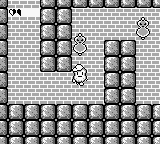
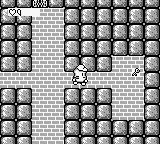
The first few floors establish a straightforward but effective rhythm: guide Spud through maze-like rooms, look for the exit, and shoot whatever is blocking the route. Contact with enemies drains life energy, so movement matters as much as firing. You are not simply clearing a room at leisure; getting crowded or taking careless routes can turn a simple search into a scramble for survival.
Then the game makes you slow down. Its puzzle floors use a Soko-Ban-style rule set in which blocks must be pushed onto marked spaces and cannot be pulled back. That single restriction creates the familiar, satisfying tension of having to think ahead: a block shoved into the wrong corner may leave you with no path to finish. Thankfully, resets cost nothing, which makes trial and error a sensible part of solving rather than a punishment.
The two styles complement each other better than either would alone. Combat floors ask for alertness and careful navigation, while block puzzles reward patience. Defeating enemies also earns experience, eventually increasing Spud’s health, so the action has a useful sense of progress instead of functioning only as an obstacle between puzzles.
Expect a deliberate game rather than a breezy action romp. If you enjoy old-school maze shooting but get bored when every stage asks the same thing, the regular shift to block-pushing puzzles is the reason to try it. If Soko-Ban puzzles make you impatient, however, the tower climb may feel more stop-start than adventurous.

Graphics
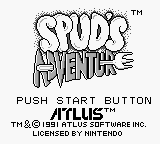
Spud’s Adventure uses a top-down, 2D scrolling Game Boy view for its tower floors. You guide a potato hero through maze spaces populated by enemies, movable blocks, marked puzzle destinations, and friendly sprites, with the overhead angle making the essentials of enemy positioning and block movement easy to parse.
The fantasy setup is delivered through small-scale Game Boy imagery rather than elaborate scenes. Its strongest visual hook is simply the absurdity of a potato protagonist undertaking a royal rescue, a playful image that gives the familiar tower quest a little personality.

Story
This is an unapologetically simple rescue tale: the king’s daughter has been kidnapped, and Spud has to climb a many-floored tower to bring her back. The stakes are clear immediately, which suits a game built around short, distinct stages rather than long stretches of narrative.
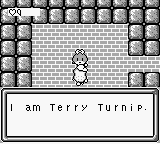
Friendly sprites add some texture along the way. You can talk to them for hints, giving the tower a few moments of guidance amid the enemies and puzzles. That matters in a game whose block-pushing rooms can demand a more methodical approach than its comic premise initially suggests.
Do not come expecting a dense fantasy yarn. The story works as a clean excuse to keep ascending, but the memorable part is the contrast between that traditional princess-rescue setup and the fact that its hero is a potato.
Overall Experience
Spud’s Adventure is easy to like when you accept its odd little mixture of genres. One floor can have you cautiously shooting through a maze and protecting your health; the next can make you stare at a few blocks and reconsider every move. That variety gives the climb a welcome unpredictability.
Its frustrations are also part of its old-school character. Enemy contact has real consequences, and irreversible pushes can force a restart. Yet the no-penalty reset is an important kindness: you can test an idea, learn why it fails, and immediately take another run at the room without losing broader progress.
Give it a chance if you want a compact Game Boy curio with equal interest in action and thought. The experience is more than a novelty potato joke, although that joke remains a big part of its charm. For background on its release history, see Spud’s Adventure’s game history.


Reviews
There are no reviews yet.