 Retro Replay Retro Gaming History, Reviews & Emulation
Retro Replay Review
Gameplay
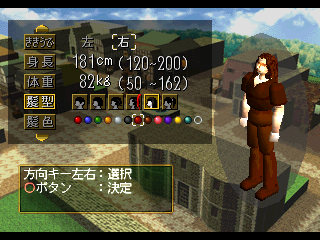
The first stretch of Weltorv Estleia is compelling because it treats you less like a chosen hero and more like a newcomer trying to find work in a strange city. After building your adventurer’s look, you reach Farbell, join the Adventurers Guild, and can begin picking through a large set of scenarios instead of being funneled down one obvious path. That freedom is the point: this is a Japanese-made RPG with a notably Western-style taste for open-ended wandering and self-directed quests.
The scenario system is where that freedom becomes either absorbing or demanding, depending on your mood. NPC conversations hand over keywords and phrases, and you use those clues to track down the places and conditions that trigger an active scenario. You can pursue multiple jobs simultaneously, and more than a hundred scenarios of differing size, difficulty, and possible outcomes make the journey feel broader than a single straight campaign. When the clues line up and a thread finally advances, it has the pleasing feeling of having figured something out yourself.
It also means you need to listen and remember. Weltorv Estleia does not sound built for anyone who wants every objective spelled out immediately. If you lose track of a phrase or fail to connect it with the right location, the openness can turn into aimless travel. Still, the structure gives your choices room to breathe, and the possibility of gaining party members through scenario outcomes makes the world feel responsive rather than merely full of errands.
Character growth has a similarly flexible bent. You manually raise spirit, technique, and vitality at level-up, while other physical-condition attributes determine what equipment you can use. Rather than locking into a role on the character-creation screen, you can work toward monk, magician, or thief specialization by completing missions for their guilds. Experience comes from both combat and quests, which suits a game that wants exploration and scenario-solving to matter alongside fighting.
Combat is turn-based and tactical without being a constant interruption. Hostile creatures can be approached in the wilderness, while other battles arrive through scenarios; once engaged, you move across the battle screen and attack when enemies enter your weapon’s range. Companions are AI-controlled, so you are chiefly responsible for positioning the lead character well. The fights seem most at home as a consequence of exploration and quest progress, not as a relentless leveling treadmill.
Graphics
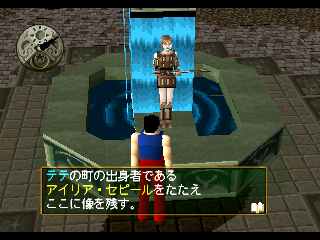
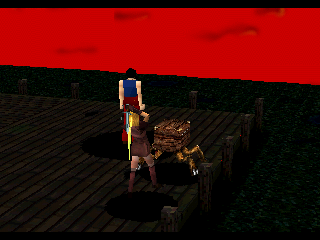
Weltorv Estleia uses 3D characters, enemies, towns, wilderness, and dungeons, viewed from a third-person perspective. That choice gives the connected world a more grounded look than the anime-heavy RPGs many players may expect from its era and origin; there are no character portraits, either.
Smaller interiors—shops, guilds, bars, homes, and similar locations—switch to pre-rendered backgrounds. The contrast between those fixed indoor scenes and the 3D outdoor spaces gives each type of location a distinct texture, even if the overall look is rooted firmly in late-1990s PlayStation design.
Story
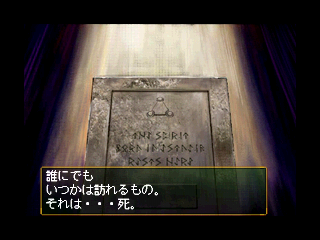
The central conflict draws on Estleia’s old legend: seven warriors led by the young magician Ten once fought an evil dragon, and dark forces now threaten the land again. Your hero begins as an unnamed male or female adventurer rather than a prewritten personality, which puts the emphasis on discovering this world’s trouble through the work you choose to take.
That setup benefits from the scenario format. Instead of treating the larger threat as the only thing worth doing, the game lets local jobs, guild ties, wilderness excursions, and dungeon trips build your connection to Estleia. The story’s momentum is therefore less about racing from one mandatory scene to the next and more about deciding which problems deserve your attention.
The conversation options add a small but welcome role-playing wrinkle. You can have your adventurer smile, cry, or get angry while talking to NPCs, and those reactions may change how people respond. It is a neat fit for a protagonist without a fixed identity: even within a defined fantasy plot, you get some say in how this wandering adventurer comes across.
Overall Experience
Weltorv Estleia is most interesting when you meet it halfway. Its rewards come from chasing clues, juggling scenarios, and gradually shaping a character through earned specializations and chosen attributes. The game’s open structure is not just a decorative feature; it asks you to be an active investigator in its towns and wilderness rather than a passenger following a prescribed route.
That same quality can make it frustrating. The keyword-driven progression demands attention, AI-controlled allies limit direct party management in battle, and a sparse encounter rate means you should not expect combat to carry every stretch. If your favorite RPGs keep you constantly pointed at the next destination, this can feel stubbornly opaque.
For patient RPG fans, though, the trade is worthwhile. There is a particular charm in beginning as a nobody in Farbell and letting a web of quests determine what kind of adventurer you become. Give it a chance if you value agency, tactical turn-based encounters, and the satisfaction of uncovering progress through your own curiosity; skip it if you need a tightly directed story and constant mechanical guidance.


Reviews
There are no reviews yet.