 Retro Replay Retro Gaming History, Reviews & Emulation
Retro Replay Review
Gameplay
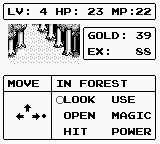
The first stretch of The Sword of Hope feels less like charging into a fantasy war and more like feeling your way through an unfamiliar forest. You choose actions such as looking, opening, using items, speaking, and casting magic, so progress comes from paying attention to what is around Theo and trying the right response. That deliberate rhythm is the game’s strongest hook. Every useful clue can make you feel as though you earned the next step rather than simply walked into it.
Combat interrupts exploration with traditional turn-based battles. Theo grows through experience and can use magic, giving the adventure a welcome RPG backbone instead of making it entirely about selecting verbs. The fights are simple in the classic handheld-console sense, but they add stakes to wandering and make the journey feel like more than a chain of puzzle prompts.
Frustration sets in when your idea of what should work does not match the game’s command logic. This is from an era when trying “look” or “use” in several places is often part of the solution, and that can turn a clever roadblock into a slow bout of experimentation. Still, if you like early RPGs that make you engage with their world rather than rush through it, the blend starts to click.
Graphics
The original Game Boy forest view is stark and easy to parse: a narrow white path winds ahead between heavy black foliage and outlined tree trunks. Sparse stippling breaks up the ground, while the trees create a strong frame around the route. It is clean enough for navigation, but the monochrome scenery has little depth or variety, so the atmosphere depends more on your imagination than on the screen itself.
Story
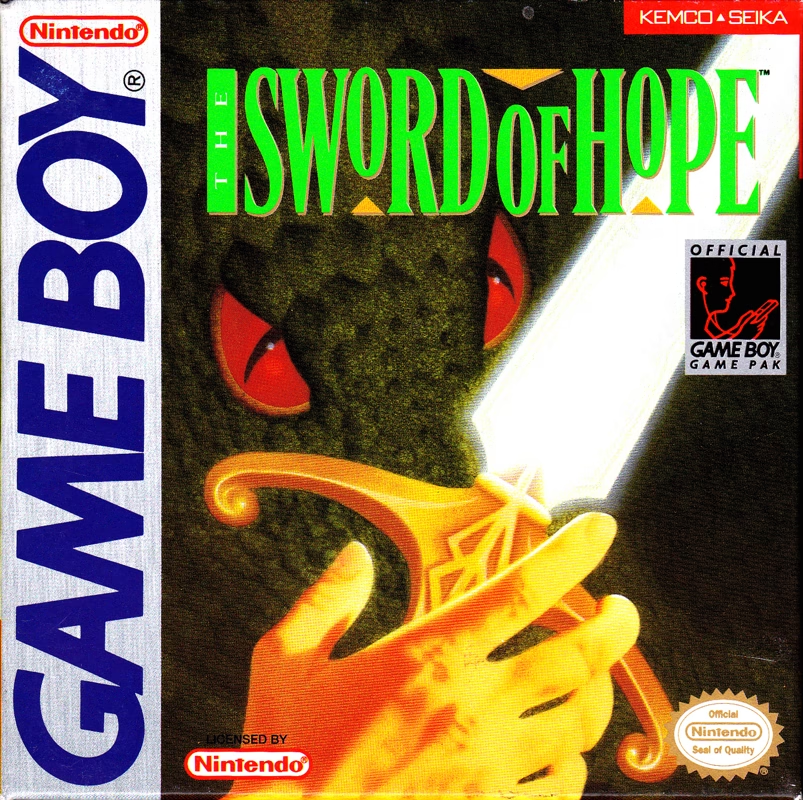
This is a properly grim little fantasy setup. A dragon corrupts the king of Riccar, the Sword of Hope’s curse is unleashed, and the kingdom’s people are transformed into trees. Prince Theo survives only because the knight Pascal carries him away as an infant, leaving him to grow up hidden in the forest with three magicians.
Fifteen years later, Theo sets out to recover the Sword of Hope and end the dragon’s reign. The goal is direct, but the curse gives it more weight than a standard “save the kingdom” assignment. You are not just pursuing a legendary weapon. You are trying to restore a place and its people from a genuinely bleak fate.
The story works because it gives the adventure-game structure a reason to exist. Talking, searching, and solving obstacles feel appropriate for a young prince piecing together a path toward an underground castle and a buried evil. Do not expect a sprawling character drama, but the premise is strong enough to carry the journey.
Overall Experience
The Sword of Hope is a curious, sometimes stubborn Game Boy RPG that rewards a patient mindset. Its adventure commands make exploration more involved than in many contemporaries, while turn-based battles and experience growth keep Theo’s quest grounded in familiar RPG territory. The combination is unusual enough to remain memorable.
It will test your tolerance for old-fashioned puzzle design and a slow, text-driven pace. If you want immediate action or constantly changing scenery, the early forest wandering may wear thin. If you enjoy taking notes, revisiting clues, and discovering the one interaction that unlocks the route forward, its rough edges become part of the appeal.
Give it a chance as a compact relic of a time when handheld RPGs could be stranger and more adventurous than their hardware suggested. The payoff is not polish, but the satisfaction of untangling an offbeat fantasy quest on its own terms. If Theo’s journey lands for you, the Game Boy sequel, Sword of Hope II, continues his adventures and the menu-driven RPG/adventure approach.


Reviews
There are no reviews yet.