 Retro Replay Retro Gaming History, Reviews & Emulation

Retro Replay Review
Gameplay
The first hour has the right kind of pull for a mystery adventure. You begin with a missing friend’s diary and a murder that arrives too late to prevent, then Jerry Randolph’s investigation pushes you toward a time machine and a trip to 1916. It gives your poking around a purpose: you are not merely collecting objects, but following a trail left by criminals across time.
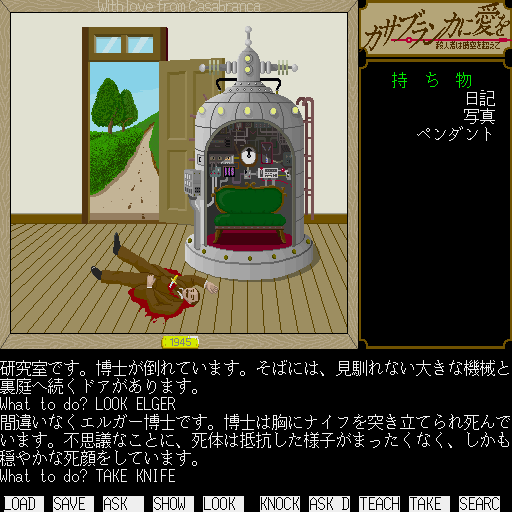
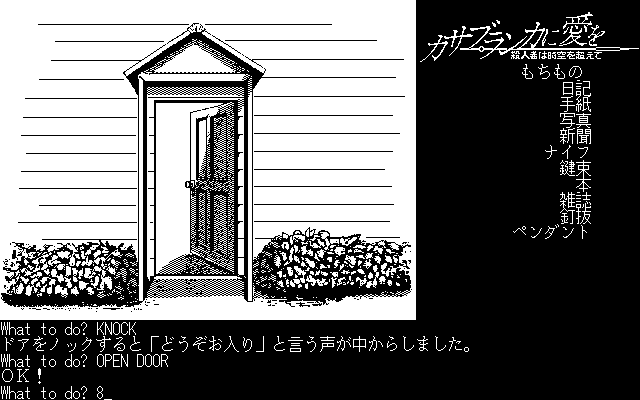
In practice, this is a classic text-parser game, so progress depends on typing commands and paying close attention to locations and descriptions. Look, Search, Take, and Knock are important enough to receive function-key shortcuts, which is a welcome concession in a game built around repeated investigative actions. Directional arrows also handle limited movement between screens, letting you spend less time entering basic navigation.
That convenience does not turn it into an easygoing adventure. The central rhythm is still one of trying commands, examining the environment, and working out what the game wants from you. English command input has some support, but the descriptive text is Japanese only. If you can read Japanese, or are comfortable working through it, the interface has a pleasingly direct, hands-on detective-game feel. If not, the language barrier makes an already exacting style of adventure much tougher to enjoy.
Graphics
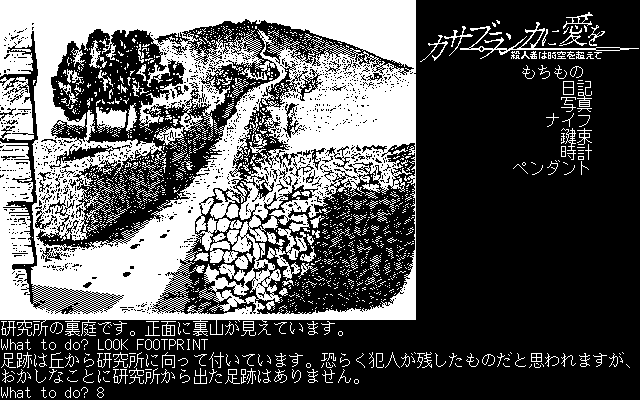
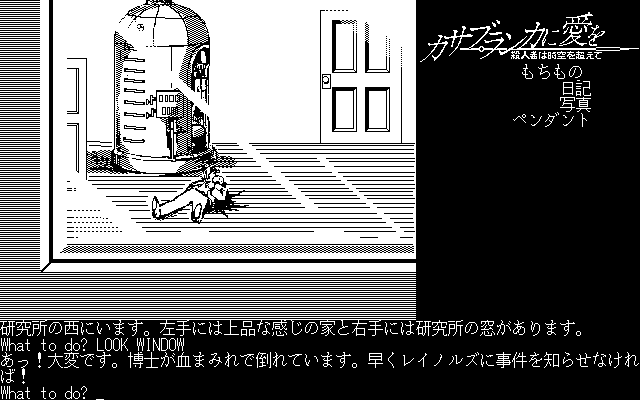
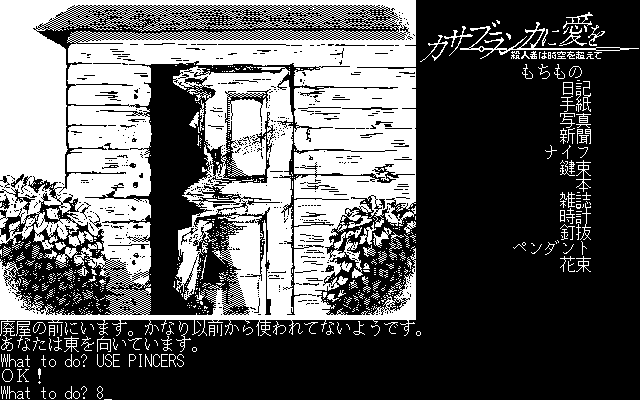
This is a first-person text adventure with graphics, built around individual screens rather than a freely moving world. The images give your investigation places to examine while the Japanese text carries the bulk of the detail and context.
Story
The story earns attention because it starts personal. Jerry is not chasing an abstract historical conspiracy; she has found the diary of May Elgar, a high school friend who disappeared years earlier. That immediate connection gives the mystery a human center before the scientific-project angle opens the plot outward.
Dr. Elgar’s work turns the investigation into a time-travel pursuit. Jerry cannot save him from his death, so she uses his machine to travel to 1916 and trace the people responsible. That is a clean, compelling detective structure: evidence from one era becomes the route into another, and the player gets to pursue a crime from an unusually distant angle.
Do not come expecting a game adaptation of the famous film. Despite the name, Casablanca itself is only loosely referenced. The real draw is the missing-person case, the murdered scientist, and the chance to investigate their connection across two periods.
Overall Experience
Casablanca ni Ai o: Satsujinsha wa Jikū o Koete is easy to respect and harder to casually recommend. Its mystery has genuine momentum, and the time-machine premise gives it more flavor than a routine locked-room investigation. When you are in the right mindset for old adventure-game problem solving, Jerry’s search can feel satisfyingly purposeful.
The caveat is substantial: this is parser-driven interactive fiction from an era that expects patience, experimentation, and careful reading. The shortcut keys help, but they do not remove the need to think in commands or ease the Japanese-only descriptions. Frustration can set in when you know what you want to investigate but cannot smoothly express it, especially if you are relying on the limited English-input support.
Give it a chance if vintage Japanese computer adventures, detective stories, and time-travel puzzles sound like a rewarding combination rather than homework. The payoff is the unfolding case and the pleasure of manually prying it open. For anyone wanting a frictionless mystery or a Casablanca-focused story, this is likely too demanding and too tangential to the title’s promise.



Reviews
There are no reviews yet.