 Retro Replay Retro Gaming History, Reviews & Emulation

Game Overview
Gameplay
Little Magic is at its most interesting when a careful tactical decision suddenly puts you in a 30-second duel. You can move and attack in the same turn, but closing on an enemy means you must also handle the side-view fight that follows. That switch makes every encounter feel less automatic than in a typical turn-based tactics game. A unit can survive the timer with partial health, and that remaining health carries back to the map, so you are not merely trying to knock out an opponent. You are trying to avoid leaving your own piece too battered to matter next turn.
Once the basics click, the map objectives give your moves purpose. You can win by taking the enemy castle or defeating its leader, which creates useful pressure on both fronts. Capturing towns, churches, and hexagram circles opens up recovery and deployment options, so advancing is not just about pushing toward the enemy. The campaign also lets unit levels carry over, giving the Sun Prince’s war a little more continuity than a string of disconnected maps.
The naval rules are where Little Magic can be particularly tense. Ships carry troops, fire their own cannons, and can be repaired and rearmed at captured docks. Your transported ground units recover health and can still act from aboard, but a sunk ship instantly takes every passenger with it. That is a harsh penalty, yet it gives water crossings real stakes. Magic users add another worthwhile constraint because they must choose between moving and casting, rather than doing both.
The rough edge is that the game asks you to accept two very different skill sets. Strong positioning will not completely rescue a poor showing in a duel, and a good duel does not erase bad map planning. If that hybrid sounds familiar, Archon Ultra is a useful comparison point for the strategic-movement-plus-one-on-one-combat structure, though Little Magic takes it in its own fantasy-war direction. War Mode and Battle Mode are welcome ways to focus on either the larger contest or the head-to-head fighting.
Graphics
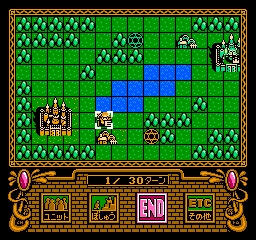
The tactical screens use a checker-like green field broken up by dark triangular forests, blue water squares, and gold-brown castles inside an ornate gold-and-brown border. The green and blue contrast makes the terrain easy to pick out at a glance, which matters when you are deciding where to send a unit. The tiny unit symbols are much less impressive, with little visible detail, so the battlefield reads clearly without looking especially lively.
Story
The campaign begins with a clean fairy-tale conflict: the Sun Prince’s planned marriage to the Moon Princess is shattered after the Moon King dies and a wizard seizes the kingdom. When the wizard’s proposal is rejected, he turns the dispute into war against the Sun Kingdom and the prince he sees as a rival.
It is not a complicated setup, but it gives the campaign’s leader-versus-leader objectives an appropriate personal edge. The Sun Prince is always your starting unit, so he is not just a figure in the premise. His survival is tied directly to how you play the campaign.
The story works best as a reason to keep moving through the tactical battles rather than as the main attraction. The wizard’s conspiracy supplies a clear villain and a simple rescue-the-kingdom kind of motivation, while the persistent unit leveling gives the campaign a bit of forward pull.
Overall Experience
Little Magic is a scrappy, memorable experiment. The tactical layer has real decisions in its capture points, unit hiring, leader targets, spell restrictions, and dangerous naval transport. Then it throws you into direct combat before letting you settle into a safe routine. That combination can feel awkward at first, but it is rarely dull.
Frustration can set in when you want a pure strategy game and the duel demands quick reactions, or when you want a fighter and the match ends on the clock with both units alive. Yet that unresolved damage is exactly what makes the two halves connect. You bring the consequences of the fight back to the board instead of treating it as a separate minigame.
Give it a chance if you enjoy old tactical games that are willing to be strange and demanding. The visuals are modest, and the hybrid structure will not suit everyone, but there is a satisfying tactical logic underneath the novelty. For the right kind of player, Little Magic earns its name by making every contested square feel like it might become a duel you have to personally finish.


Reviews
There are no reviews yet.