 Retro Replay Retro Gaming History, Reviews & Emulation



Retro Replay Review
Gameplay
Breath: Toiki wa Akaneiro is built around reading a visual novel-style adventure, then breaking that rhythm with a large assortment of mini-games. That structure gives it a more hands-on feel than a story that only asks you to advance dialogue. If you like a romantic comedy premise but need occasional activity between scenes, the format has an immediate advantage.
The catch is that mini-games can pull you out of a story just when its characters and situation are supposed to carry you forward. This is not a game to pick solely for a seamless, uninterrupted novel experience. You need some tolerance for changing gears, because the variety is clearly a major part of its identity rather than a tiny side distraction.
There is at least a useful bit of replay-minded design in the album of extras. You can revisit the CG gallery, listen again to music, sound effects, and voices, and return to the mini-games from a dedicated list. That makes it easier to enjoy a favorite diversion or revisit collected material without restarting the whole adventure, which is a sensible fit for a handheld game.
Graphics
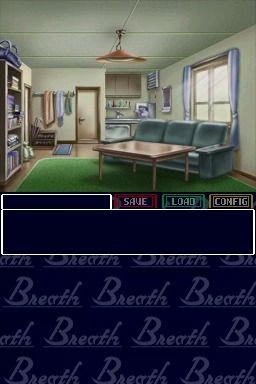
The in-game backgrounds have a clean, soft anime look. Hibiki’s apartment is the strongest example: the green rug, dark couch, coffee table, crowded shelves, clothes rack, and bright window make it feel like a modest place actually lived in, not a generic blank room.
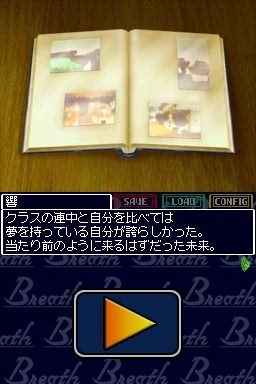
The photo-album scenes are pleasantly tactile, with small snapshots resting on cream-colored pages or a blue book sitting on a wooden table. They are simple images, but they suit a story interested in recalling earlier moments and give the DS screens a cozy domestic texture.
Story
Hibiki begins in a convincingly low place for this kind of upbeat turn. He has finished high school without a plan, bounces between depressing part-time jobs, and has settled into a pessimistic routine. That makes the arrival of Akane, an idol he knows nothing about, feel less like a random romantic reward and more like a disruption he badly needs.
The inciting incident is direct: Hibiki sees Akane in trouble, helps her escape an unknown man, and reluctantly lets her hide at his home. From there, the story’s central hook is the odd-couple pressure of sharing a small space with somebody from a completely different life. It is an inviting setup because Hibiki has to confront another person while he is still unsure what to do with himself.
Do not expect the premise alone to make every scene feel fresh. The real draw is watching whether this temporary arrangement can move Hibiki out of his brooding rut, while Akane’s celebrity status adds a natural complication to their ordinary home life. If you enjoy character-focused romance with a light, everyday angle, it has a solid foundation.
Overall Experience
Breath: Toiki wa Akaneiro feels tailored to someone who wants a visual novel that does not stay still for too long. Its relationship story has an approachable emotional center, and the mini-games give the experience a more playful, less purely literary cadence. The shift between those modes will be either its charm or its biggest irritation.
The strongest reason to try it is Hibiki’s chance at a reset. A drifting young adult and an idol forced into his ordinary home is not the most unusual setup, but it gives the story room for warmth, awkwardness, and personal growth. The small-scale apartment imagery also helps the central living arrangement feel grounded.
I would recommend it to fans of anime-style romance adventures who enjoy mini-games as part of the package, not as an optional extra. If you want to settle into a long, uninterrupted visual novel and dislike being diverted from the dialogue, this one may test your patience. For everyone else, its mix of domestic romance and varied play is enough to make it worth a look.



Reviews
There are no reviews yet.