 Retro Replay Retro Gaming History, Reviews & Emulation
Retro Replay Review
Gameplay
Dragon Ball Kai: Ultimate Butōden gets its hook in early: you can jump into a match, use regular buttons for the core fighting, and still pull off the kind of oversized attacks you came for. The optional touch-screen shortcuts are a smart concession to the DS. If you want quick access to special moves, they are there; if you would rather stay focused on buttons, you are not forced to use the lower screen.
The fighting stays on a 2D plane even though the combatants are modeled in 3D, which keeps the action direct and easy to parse. That straightforward structure suits quick handheld sessions, and the large roster means you can spend a long time sampling matchups instead of exhausting the game after a few favorites. Practice and challenge modes are useful breaks from the story path, especially once you want to get comfortable with a character before taking them into a tougher fight.
Its most divisive idea is attached to ultimate attacks. Rather than simply letting a super move play out, the game launches a brief competitive minigame that determines its result. That can add tension when you are playing with someone nearby, but it also cuts across the rhythm of a normal fight. If you love every dramatic attack becoming a little contest, it is a memorable twist. If you want uninterrupted back-and-forth fighting, repeated interruptions can become a real irritation.
Graphics
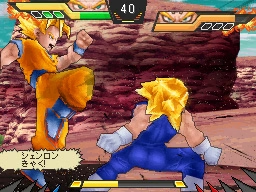
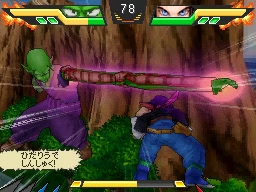
The battle screens have the chunky, exaggerated look of DS-era 3D Dragon Ball. Gold-haired Goku in his orange gi trading kicks with gold-haired Vegeta against huge reddish-brown canyon boulders is immediately recognizable, while Piccolo’s long reaching arm stands out nicely against a dense green forest. Bright yellow and pink attack streaks make the important hits easy to spot.
There is roughness in the small, angular character models and coarse rocky ground textures. Still, the saturated costumes, oversized heads, and bold outlines keep fighters distinct when the arena gets busy.
Story
Story Mode follows the Saiyan arc through the Majin Buu arc, giving the game a familiar Dragon Ball Kai backbone instead of treating its roster as a disconnected set of versus matches. If you want an excuse to move through battles with a sense of progression, this is the mode that supplies it.
Side stories and what-if missions open up as you advance, which is where the mode earns extra curiosity. They give you reasons to revisit the campaign beyond simply reaching the next major arc, without asking you to abandon the straightforward fight-by-fight format.
Battle rewards also unlock characters, costumes, and accessories that can be attached to fighters. That is a satisfying handheld loop: play a few fights, open up another reward, then take a newly customized character back into battle. The story itself is familiar territory, but the unlock structure gives it more staying power than a bare retelling.
Overall Experience
Ultimate Butōden is an easy game to recommend if you want a Dragon Ball fighter that meets the DS on its own terms. It is accessible without being locked into touch controls, packed with characters, and happy to let you chase rewards through story, challenges, and practice. Two-player DS wireless battles are also a better fit for its immediate pick-up-and-play spirit than treating every match as a serious tournament set.
There is a specific kind of player this may frustrate. You may appreciate the straightforward 2D fights and still wish the ultimate-attack minigames would stop barging into them. That issue is too central to ignore, because spectacular attacks are a big part of Dragon Ball and the game turns them into interruptions as often as highlights.
Even so, its oddities give it character. It is not the same experience as Dragon Ball Z: Supersonic Warriors 2, another DS Dragon Ball fighter with its own approach. Give Ultimate Butōden a chance if you want a colorful, content-heavy portable brawler and can enjoy a little arcade-game silliness between punches. For the original Japanese overview of its modes and features, see the official Nintendo page.

Reviews
There are no reviews yet.