 Retro Replay Retro Gaming History, Reviews & Emulation
Retro Replay Review
Gameplay
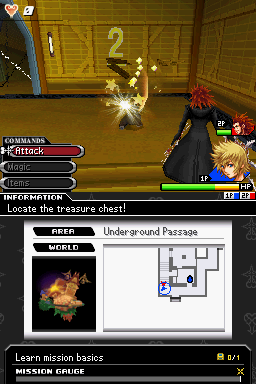
The first hour establishes a very clear rhythm: Roxas receives a mission from Organization XIII, heads out to a world, and comes home after gathering hearts, intelligence, or Organization Emblems. It is straightforward action RPG work, and that simplicity can be comforting if you want a portable Kingdom Hearts game built around short, discrete outings. You are not wandering toward a huge open-ended adventure; you are clocking in for another assignment.
What makes that routine more interesting is the panel grid in the Grey Area. Levels, abilities, magic, and consumable items all compete for room, so preparation is not just an excuse to tick through equipment screens. Spending Munny and Heart Points at the Moogle Shop for more panels gives your rewards a practical purpose, and rearranging the grid lets you tune Roxas before heading back out. It is a smart fit for a mission-based game because you can adjust your approach between jobs without drowning in a conventional RPG’s gear clutter.
The friction is that many missions are still missions. Defeat Heartless, gather a target, collect something, return. The repeated visits to places such as Twilight Town, Beast’s Castle, and Agrabah can start to feel like work before the story has fully paid off. Replay options help: completed jobs return through holo-missions, and challenge versions add conditions such as limiting jumps, collecting more rewards, or finishing quickly. These are good extras for anyone who enjoys mastering a route, though they do not transform every basic objective into a thrill.
Mission Mode is the best argument for treating 358/2 Days as more than a story stopover. Multiple players can collaborate or compete, use Organization members, and chase the highest point total for Crown Emblems. Even without making that mode your main reason to play, it gives the mission design a welcome second life. The core campaign is strongest when you accept its compact, repeatable structure instead of waiting for every assignment to feel like a major event.
Graphics
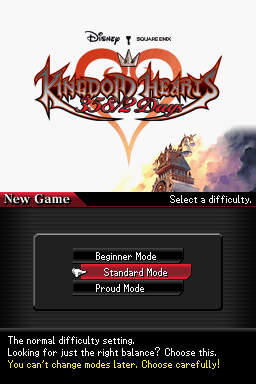
The behind-view perspective keeps Roxas and the action close during missions, while the Organization’s Grey Area serves as a recurring headquarters between excursions. On Nintendo DS, the visual emphasis is on seeing Roxas move through those familiar worlds and recognizing the Heartless he is sent to defeat, rather than on elaborate cinematic scale.
Story
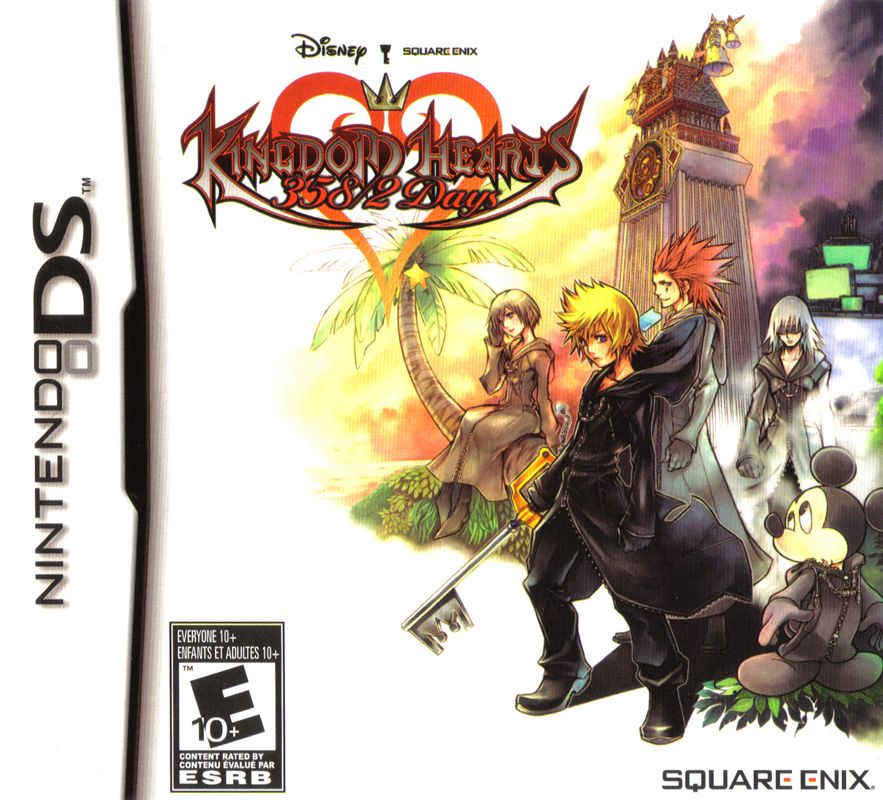
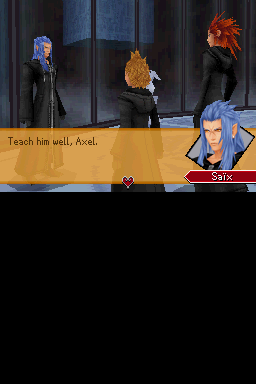
This is the reason to play. 358/2 Days follows Roxas from his creation at the end of Kingdom Hearts through the period in which he serves Organization XIII, eventually leading toward his placement in virtual Twilight Town before Kingdom Hearts II. That makes it a bridge, but not an empty one: the point is to spend time with Roxas rather than merely explain where he came from.
The day-to-day structure gives the narrative a particular flavor. Missions are errands for an organization with its own agenda, and the steady accumulation of ordinary work makes Roxas’s place within it feel more immediate than a rapid-fire sequence of plot revelations would. You may be performing familiar tasks, but you are doing them from a perspective that fills in a major gap in the larger series.
There is a trade-off. Because progress is tied to so many assignments, the story can feel as though it advances in bursts between stretches of routine. If you arrive only for plot, that pacing may test you. If you enjoy the Kingdom Hearts universe enough to linger with Roxas during the quieter parts of his life, the gradual approach has a real payoff.
Overall Experience
358/2 Days is a good Kingdom Hearts side story and a sometimes stubborn mission game. Its best quality is that its structure and subject fit together: Roxas is living through a sequence of Organization jobs, so the repeated brief deployments are not disconnected filler in the usual sense. Still, understanding the intention does not make every return trip or collection target exciting.
You should give it a chance if Roxas’s role in the series matters to you, or if you like action RPGs that let you revisit missions and optimize your loadout. The panel system adds enough planning to keep the basic loop from becoming completely automatic, and the optional challenges and multiplayer create value beyond one pass through the story. Gamers who need constant new environments or a fast-moving campaign may feel the repetition much more sharply.
Ultimately, the payoff is worth the rough patches for Kingdom Hearts fans. This is not the series at its most immediately dazzling, but it is one of its more focused character chapters: a portable game willing to let routine accumulate until Roxas’s story carries greater weight. Go in ready for a measured, mission-by-mission climb, and its 7.2-level strengths will land more reliably than its shortcomings.



Reviews
There are no reviews yet.