 Retro Replay Retro Gaming History, Reviews & Emulation

Retro Replay Review
Gameplay
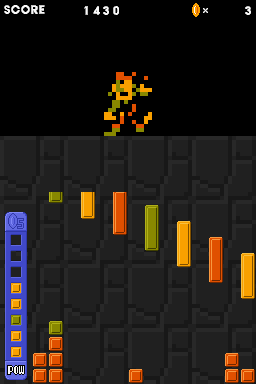
Pictobits starts with a wonderfully direct loop: tap up colored bits, carry them with the stylus, then set them down to make matches against the megabits falling from above. Matching four or more of one color in a row or column works, but squares and rectangles count too. That small freedom gives the puzzle more personality than a simple line-clearing game. You are not merely reacting to whatever drops next; you are trying to leave yourself shapes that can solve several problems at once.
The two-screen setup makes the objective immediately tangible. Your active board lives on the touch screen, while every cleared color contributes to an image taking shape on the top screen. It is a clever reward loop: clearing efficiently is satisfying on its own, but you also want to see what sprite is hiding above. That makes even a difficult board feel like it has visible progress attached to it.
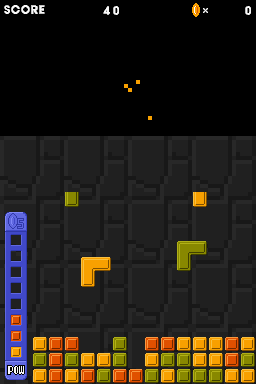
Pressure comes from the limit on how many bits you can pick up and from megabits steadily descending. POW can clear some clutter when you have painted yourself into a corner, but it permanently reduces your carrying capacity until you pay coins to restore it. That is a smart trade-off rather than a free panic button. Use POW too casually and later placements become more restrictive; hold it too long and the board can become difficult to untangle.
Coins also unlock music and Dark versions of cleared stages, so success has a practical afterlife beyond simply finishing a picture. The Dark stages are the right kind of extra for anyone who has internalized the basic rules and wants sharper pressure rather than a completely different game. If you enjoy puzzle games that reward planning but still demand quick cleanup when pieces pile up, Pictobits has a focused and durable little system.

Graphics
The pictures are built around crisp 8-bit Nintendo imagery. As colors accumulate on the top screen, the blank space resolves into sprites drawn from games including Super Mario Bros., The Legend of Zelda, Excitebike, Ice Climber, Balloon Fight, and Wrecking Crew. Watching a recognizable character emerge piece by piece is the game’s nicest visual trick.
On the lower screen, brightly colored bits and larger falling megabits keep the board easy to parse with the stylus. The split view is especially effective because you can glance upward for your reward without losing track of the immediate puzzle.
Story
Pictobits does not chase a conventional story. Its context is nostalgia: each stage is framed around reconstructing an 8-bit image tied to Nintendo’s NES and Famicom history. The uncovered sprite is the payoff, not a plot development.
That restraint fits the format. A falling-block puzzle can lose momentum when it stops to explain itself, whereas Pictobits lets the familiar imagery provide a light sense of destination. If you know these old games, identifying a sprite early adds a little extra motivation to finish the board cleanly.
The music deepens that connection. YMCK’s remixed themes keep the retro material active instead of treating it as a static museum piece, and purchased tracks let you take some of that reward outside the individual stages. You do not need attachment to the source games to understand the puzzle, but the references give its progression more warmth.
Overall Experience
Art Style: Pictobits is a compact puzzle game with a stronger strategic core than its toy-like pixel-art premise first suggests. The first hour pulls you in with recognizable sprites and simple stylus interaction, then the carrying limit, falling megabits, and costly POW recovery make careless placements matter. It finds a good balance between immediate satisfaction and accumulating pressure.
Its biggest strength is how neatly every part serves the same goal. Clearing shapes earns coins, cleared colors reveal art, and finishing stages opens Dark versions and music. Nothing feels detached from the central activity of arranging colored blocks. The game asks you to become more deliberate without burying that challenge under complicated rules.
The nostalgia is a genuine bonus, but it is not the only reason to play. Give it a chance if you want a puzzle game that rewards spatial planning, enjoys making you rescue a messy board, and offers visible progress with every successful clear. If the act of restoring old Nintendo sprites resonates with you, Pictobits becomes even easier to recommend.

Reviews
There are no reviews yet.