 Retro Replay Retro Gaming History, Reviews & Emulation



Retro Replay Review
Gameplay
Clannad is almost entirely about reading, listening to its characters through text, and deciding when Tomoya should take one path instead of another. In the first hour, you are settling into his cynical routine and meeting Nagisa, not solving puzzles or mastering systems. That can feel passive if you arrive expecting an adventure game in the conventional sense, but the lack of busywork is also the point: your attention stays on the conversations and the slow shift in Tomoya’s outlook.
The choices appear only at decision points, so each one carries more weight than a game that constantly asks you to steer. You are not building a character sheet or managing the drama club; you are nudging Tomoya into different relationships and subsequent events. The structure rewards paying attention to people, because a decision that seems casual can determine which scenario you see.
There is a real catch to that structure. Reaching the second part requires completing all of the first part’s scenarios, meaning replay is not optional if you want the full arc. That makes Clannad satisfying for anyone who likes mapping routes and revisiting earlier scenes with new context, but potentially exhausting for someone who wants one clean run and a final ending. Go in ready to replay choices rather than treating a first route as the whole game.
Graphics
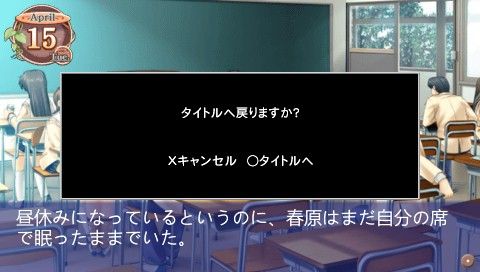
Clannad tells its story with still anime-style character images and text rather than animated action. The fixed images put the focus on faces, poses, and the emotional tone of a conversation; this is a game you read scene by scene, not one you watch for movement or spectacle.

Story
Tomoya is a stronger lead than the delinquent-schoolboy label initially suggests. His mother’s death, his father’s drinking and violence, and the injury left behind by their conflict give his detachment a painful foundation. The story does not begin from a blank-slate romance premise; it begins with a young man who has good reason to believe life will disappoint him.
Nagisa’s wish to reform the drama club gives that hurt a human-scale counterpoint. She is soft-spoken and often ill, yet she becomes the reason Tomoya starts participating in school life rather than simply drifting through it. Their connection works because the premise is not just that he meets a girl, but that helping her creates room for him to reconsider the life he has accepted.
Clannad’s two-part construction is where its ambition becomes clearest. The first half asks you to spend time across its scenarios; the second moves on to the main characters’ lives after those earlier events. That delayed payoff makes the story feel deliberately cumulative. It asks for patience, and its emotional force depends on you having put in that time.
Overall Experience
At its best, Clannad makes ordinary conversations feel consequential because Tomoya’s smallest changes in attitude matter. The game’s pull is not a rapid-fire mystery or a barrage of dramatic turns. It is the gradual realization that this guarded teenager is being drawn, route by route, toward people and responsibilities he once would have dismissed.
The route-completion requirement is the dividing line. For visual novel fans, it turns the full story into something you uncover piece by piece and gives the later material the sense of a destination earned over time. For anyone who dislikes retracing a narrative to find alternate branches, it can turn an affecting story into a demanding commitment.
Still, Clannad is worth that commitment if you want a character-focused visual novel with a serious emotional center beneath its school setting. Give it a chance when you are in the mood to read slowly and revisit decisions. It is less interested in dazzling you moment to moment than in making Tomoya’s eventual change feel deserved.


Reviews
There are no reviews yet.