 Retro Replay Retro Gaming History, Reviews & Emulation
Game Overview
Gameplay
The attacker-and-supporter rotation is a defining feature of Mana Khemia 2. You are not simply selecting an attack for the same lineup every turn. Attack and support actions let characters exchange roles, giving you a reason to think about who is currently exposed and who is waiting behind the scenes. It is a smart way to make a turn-based battle system feel more active without abandoning the deliberate pace that RPG fans want.
That system is the game’s strongest argument for your attention. When switching party members becomes part of the rhythm of combat, battles ask for more consideration than simple damage races. You can enjoy the game on the surface, but it has more to offer if you like learning how a party fits together instead of relying on one favorite attacker for everything.
Crafting is the other major commitment. You collect ingredients and can create more than 100 items, giving ingredient collection a practical purpose. That will click immediately if you like turning materials into practical results. If ingredient gathering and item creation have always felt like busywork in RPGs, this is the part most likely to test your patience, because it is clearly central rather than a throwaway side activity.
Graphics
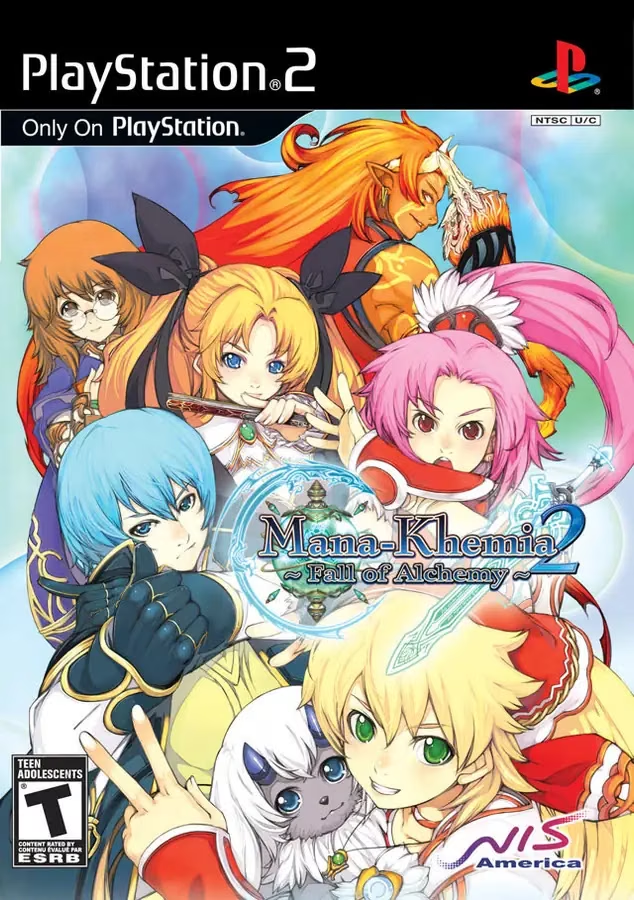
The original PS2 game combines 2D character art with anime-influenced 3D environments. That mix gives the cast a clean illustrated look while letting the locations have more depth than a fully hand-drawn backdrop. It is a fitting match for an RPG built around anime sensibilities, even if the blend of flat character graphics and polygonal spaces can look distinctly of its era.
Story
Rather than asking you to follow one fixed lead, Mana Khemia 2 gives you two protagonists with separate storylines. That is more than a cosmetic character choice: it gives the game two perspectives to pursue and makes a second playthrough feel like a chance to follow another protagonist’s storyline.
Your choices also affect the ending. That adds useful weight to the narrative without requiring the game to become an open-ended role-playing sandbox. You can make decisions knowing they have a destination, which is exactly the kind of consequence that encourages you to stay attentive through a long RPG.
The story structure is especially appealing if you value routes and alternate conclusions over a single definitive run. Do not rush through expecting one playthrough to exhaust what the game has to say. Its two-story setup is built to reward curiosity, and the branching endings give that curiosity a concrete payoff.
Overall Experience
Mana Khemia 2: Fall of Alchemy is most compelling when its systems overlap: battles keep the full party involved, ingredient collection has a clear purpose, and crafting offers a steady stream of things to work toward. It is not just an RPG with a crafting sidebar. The crafting and party-switching are the reasons its progression has texture.
There is also an unusually good case for replaying it. Separate protagonists and choice-based endings mean the second route has more value than a token alternate opening. If you are the sort of RPG fan who likes revisiting a game to see a different path, that structure can carry you past the point where a more linear adventure would have run out of steam.
Give it a chance if you want a PS2-era anime RPG with more tactical give-and-take than its anime presentation may suggest, and if making items sounds satisfying rather than distracting. For original-release details, the NIS America PS2 announcement is a useful companion. The game does not need to reinvent turn-based RPGs to be worth your time. Its rotating party battles, deep crafting focus, and genuinely replayable story structure make it an easy recommendation for the right crowd.


Reviews
There are no reviews yet.