 Retro Replay Retro Gaming History, Reviews & Emulation



Retro Replay Review
Gameplay
Angry Birds is an artillery-flavoured puzzle game built around a clear objective: use a catapult to launch birds into fortified structures and eliminate every pig inside. A level ends only when all of the pigs have been smashed, either by a direct hit or by debris from a collapsing building. That simple condition makes every shot easy to understand while leaving room for experimentation.
The practical challenge comes from lining up the catapult and judging how a bird will interact with the structure ahead. A direct strike can solve a problem cleanly, but a well-placed impact that weakens a building can be more effective. The game therefore rewards players who look at the whole construction rather than treating each pig as an isolated target.
With 105 levels, the format has enough room to test the same central idea across many situations. The inclusion of several bird species adds variety to the catapult lineup, while the destruction-focused objective keeps the game immediately readable. It is particularly well suited to players who want short puzzle stages with a satisfying cause-and-effect payoff.
Graphics
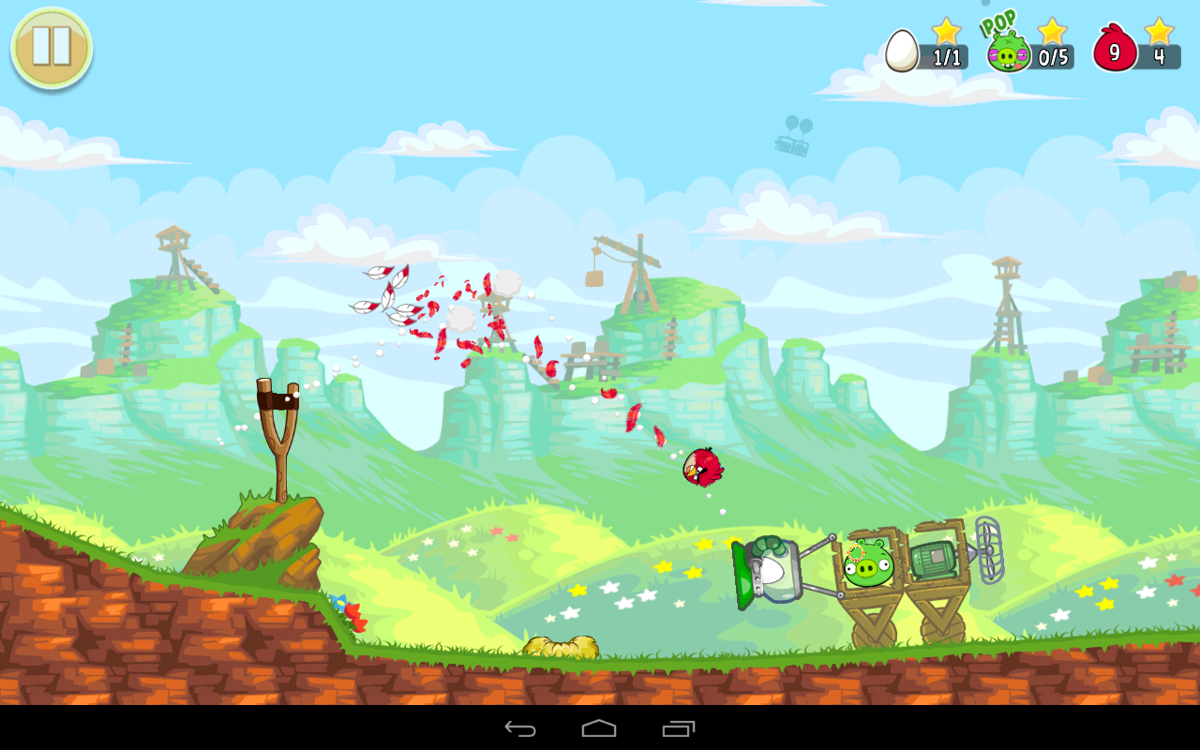
The game presents its action in a 2D side-view format, keeping the catapult, structures, birds, and pigs in a single readable play space. That perspective is a strong fit for the premise because it lets you assess the target construction before committing to a launch.
Its fantasy framing is light and accessible: angry birds are sent to reclaim stolen eggs from nasty green pigs. The pig-filled fortifications give each puzzle a clear visual purpose, and the spectacle of a building coming apart is central to how the game communicates success or failure.
Clarity matters more than ornament in this kind of game, and the side-on presentation supports the player’s decision-making. You can focus on trajectory, targets, and structural weak points without needing to parse a complicated environment. The visual design serves the puzzle action directly.
Story
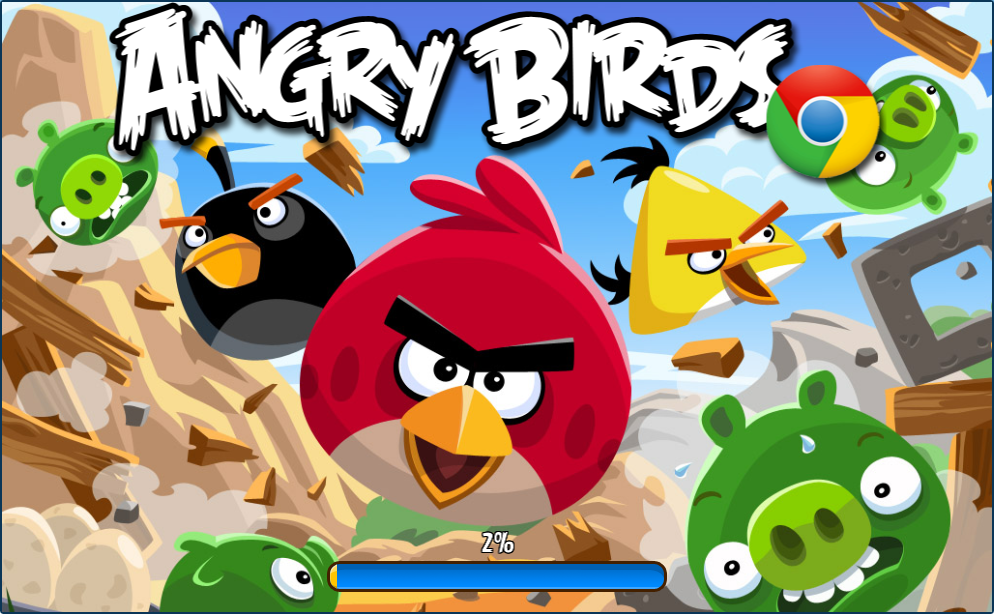
The story is deliberately lean. Green pigs have stolen the birds’ eggs, and the birds’ response is to assault the pigs’ fortified positions. It is a simple setup, but it gives the repeated level objective a consistent motivation.
Rather than interrupting the game with a dense narrative, the premise is expressed through the conflict itself: birds are launched, pigs are protected by buildings, and the player dismantles those defenses. This is a game where the plot functions as a clean excuse for the puzzle-solving rather than a major dramatic feature.
Players seeking character development or a complex storyline will find the narrative slight. Players who prefer a direct theme that immediately explains the action will find it effective. The egg-retrieval goal keeps the tone focused and easy to follow across the full run of levels.
Overall Experience
Angry Birds succeeds by pairing an intuitive catapult mechanic with destructible, pig-filled targets. Each level asks a compact question—where should the next bird land?—then lets the resulting collision and collapse provide the answer. It is an accessible formula with a satisfying emphasis on physical consequences.
The 105-level structure gives the game substantial room for repeatable puzzle play without changing its core identity. Because success can come from direct impacts or structural collapse, the experience is not only about raw precision; it also encourages players to think about how a fortified building can be turned against its occupants.
This is an easy recommendation for fans of 2D artillery and physics puzzles, especially those who value concise stages and immediately legible goals. Its premise is uncomplicated, its pacing is built around one challenge at a time, and its best moments come when a carefully aimed launch turns an entire defense into rubble.


Reviews
There are no reviews yet.