 Retro Replay Retro Gaming History, Reviews & Emulation
Retro Replay Review
Gameplay
Armored Core V feels most alive when a bad mission result sends you back to the garage with a theory. Maybe your machine is too heavy, maybe it burns through energy too quickly, or maybe the weapons that looked impressive on the parts screen simply are not suited to the enemy in front of you. Changing a head, core, arms, legs, generator, and armament is not cosmetic busywork. Each choice affects what your mech can carry, withstand, and do under pressure, so a successful rebuild feels earned.
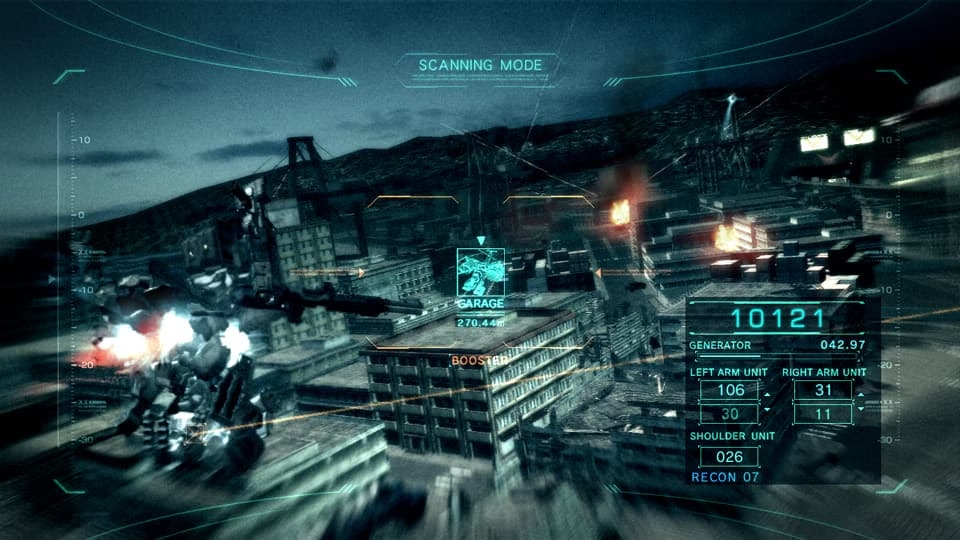
The first hour can be a blunt welcome. There is a lot to absorb, and the game expects you to care about damage types, enemy defenses, scanning, and positioning before it has fully made those ideas feel natural. Stick with it. Scan mode gives you a practical way to assess threats, while the compact city battlefields reward using cover, boosting between buildings, and taking advantage of wall jumps instead of charging down the middle. When the pieces click, fights become less about raw firepower and more about bringing the right machine to the right contract.
That grounded, urban approach sets V apart from the previous PS3 game. Compared with the broader, faster spaces in Armored Core: For Answer, this one makes you work around roads, structures, and tight industrial routes. Ten main missions and shorter order missions provide a solid reason to keep earning money for parts, though the campaign is not generous with easy victories. If you enjoy testing a build, failing, and identifying precisely why it failed, this has real staying power. If you want immediate action with little setup, the dense assembly systems can feel more like homework than customization.
Graphics
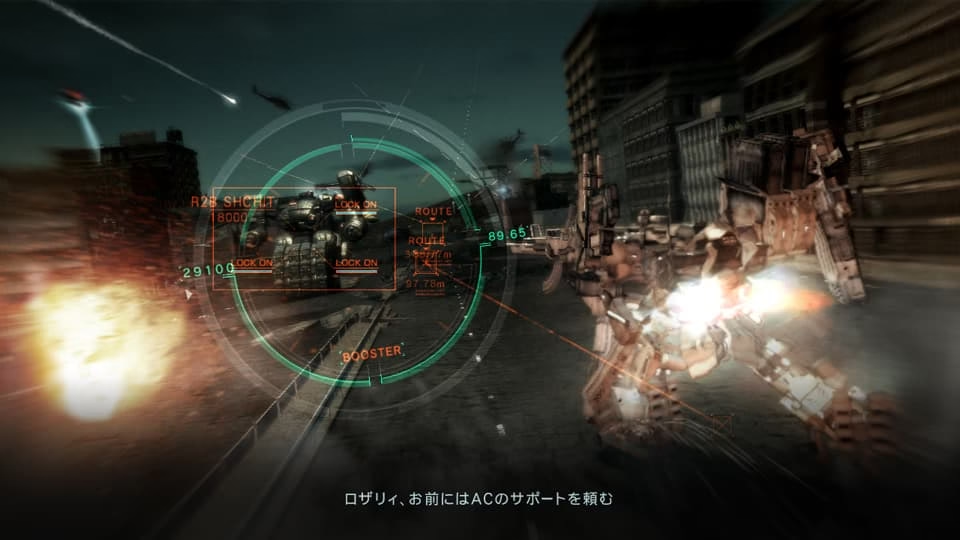
The PS3 battlefield visuals have a grim, industrial weight. A squat tan mech with oversized boxy shoulders looks imposing as it fires down a battered elevated road, orange explosions cutting through the dark brown concrete towers around it. Factory zones pack in scaffolds, cranes, smoke, metal walkways, and distant hills, giving the missions a convincingly hard-used war-zone look.
Chunky mech silhouettes stand out well against the city, especially when a gray machine boosts above tightly clustered buildings under a dark teal sky. The drawback is that dark surfaces and dense structures can run together in busier views, making it harder to separate every piece of the battlefield at a glance.
Story
You play a mercenary drawn into a resistance struggle against a ruler called Father, with corporations and rival factions pressing in around the conflict. It is enough of a frame to make contracts feel like pieces of a larger war, but Armored Core V keeps its storytelling spare and businesslike. The focus stays on the next job and the next machine adjustment rather than on making the cast or politics easy to embrace.
That restraint can work if you already like the series’ distant, militarized tone. The game leaves room for you to project meaning onto its conflicts, and the harsh industrial locations fit a world where power is contested by armed contractors. But the delivery is often difficult to follow, so the resistance plot rarely supplies the momentum that the garage and combat do.
Do not come expecting a sweeping character drama that carries every mission. The story is functional atmosphere, not the reason to keep playing. Its best moments are the ones where the political struggle gives your next sortie some tension; its weakest are the stretches where names and faction interests blur together without enough grounding.
Overall Experience
Armored Core V is an uneven but rewarding mech game whose best ideas are still intact offline. The loop of taking contracts, collecting money, revising your machine, and returning with a smarter plan can be deeply satisfying. It respects your ability to experiment, but it also demands patience and a willingness to learn systems that are not always inviting.
Its biggest present-day loss is the absence of the online team layer. At launch, cooperative teams, territory conflict, and an operator’s tactical role were central to the vision, as reflected in FromSoftware’s original Armored Core V announcement. Those services ended in 2014, so the game now feels like a strong single-player core around a missing larger structure. That does not erase the value of the campaign, but it does make the package feel smaller than its original ambitions.
Give it a chance if building a specialized mech sounds as exciting as piloting one. You will get the most out of it by treating early losses as diagnostic runs and letting the garage work inform your next mission. Skip it if you need clean story momentum, a gentle onboarding, or a complete online ecosystem. For a patient Armored Core fan, its tactical city fights and detailed build decisions are worth pushing through the rough edges.



Reviews
There are no reviews yet.