 Retro Replay Retro Gaming History, Reviews & Emulation
Retro Replay Review
Gameplay
The pleasure of Heaven’s Vault is that it lets you act like an archaeologist instead of simply handing you archaeology-themed puzzles. You travel the Nebula’s space-rivers, investigate ancient locations, collect artifacts, and gradually form an idea of what this world used to be. The missing roboticist gives the early journey a useful sense of direction, but the game is most compelling once your curiosity starts pulling you toward one more ruin or one more inscription.
Translation is the centerpiece, and it is smart because it turns uncertainty into the point. You assemble meanings from unfamiliar hieroglyphs, then live with the implications of your guesses. A correct reading can open up new understanding, while a mistaken one may send Aliya looking in the wrong direction. That makes each breakthrough satisfying in a way a standard locked-door puzzle rarely is, because you are not just solving a code. You are building a version of history.
The adaptive narrative gives that process real weight. People remember what you say and do, their attitude toward Aliya can change, and the order in which you pursue discoveries influences what follows. That freedom is a genuine strength, though it also asks for patience. You will not always have the comfort of knowing whether you chose the ideal route, and that uncertainty can frustrate anyone who wants every decision clearly labeled as right or wrong.
Still, the game earns its slower, more reflective rhythm. Its choices feel less like a branching-flowchart exercise and more like the consequences of being a particular kind of investigator: trusting the wrong person, risking a theory, or deciding which lead matters. For a closer look at the shared game details, the Heaven’s Vault publisher page is a useful companion.
Graphics
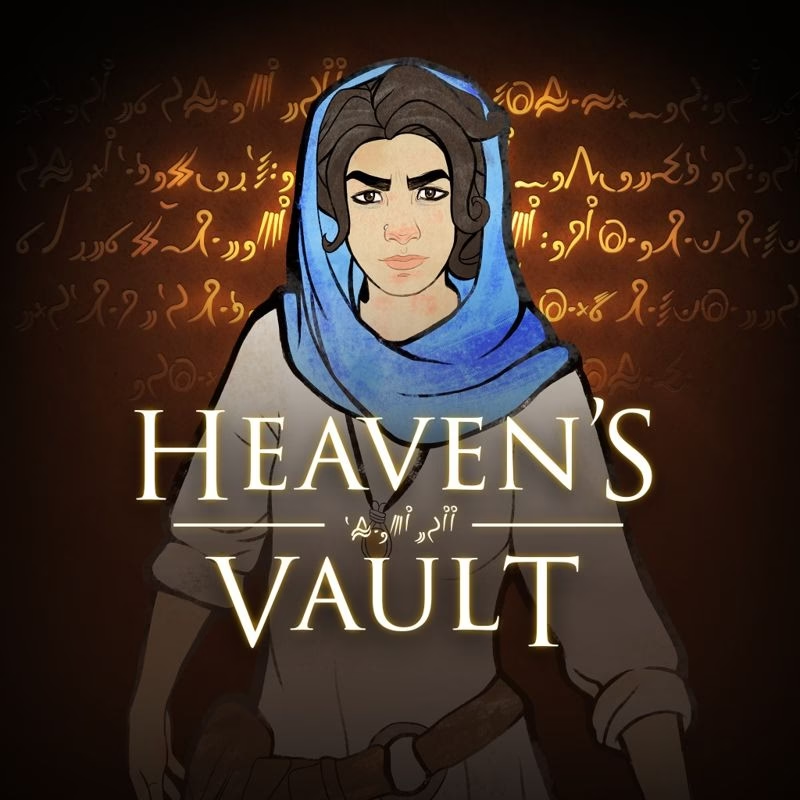
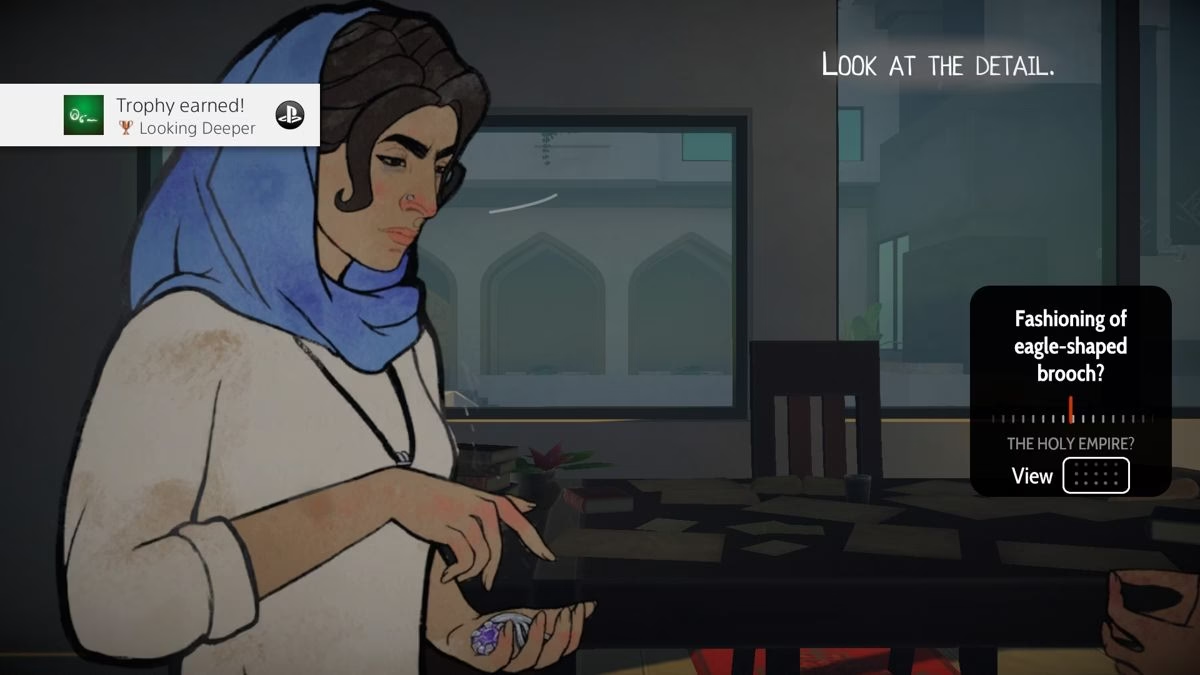
The game uses a clean, illustrated look with strong dark outlines and broad blocks of muted color. Aliya’s dark hair, blue scarf, and cream clothing stand out clearly against the subdued blue-gray interior shown during artifact examination, giving her an immediate, distinctive silhouette.
Close inspection scenes make small objects feel important. The artifact is held up against a spare background, and the restrained colors keep your attention on its markings rather than burying the moment in visual clutter.
Story
Aliya’s search for a missing roboticist from the University of Iox is a strong opening because it gives a huge mystery a human-scale entry point. From there, the story expands toward the lost past of the Nebula and the secret of Heaven’s Vault without abandoning the fact that Aliya is learning this history piece by piece.
Six is a welcome anchor for the journey, and the larger cast matters because conversations are not disposable. Friendly faces, wary figures, and potential deceivers all force you to judge motives rather than merely exhaust dialogue. The result is a story that puts trust alongside scholarship: deciphering an old phrase is one challenge, deciding who deserves to hear your conclusions is another.
What makes the narrative memorable is its willingness to let knowledge remain provisional. Your translations carry narrative consequences, so history does not arrive as a tidy lecture. You participate in reconstructing it, with all the risk of misreading evidence that entails. That is a more engaging fit for this subject than a conventional adventure-game plot that simply reveals answers on schedule.
Overall Experience
Heaven’s Vault is ambitious in the right way. It does not treat branching dialogue, exploration, and language puzzles as separate boxes to check. Each part reinforces the feeling that you are navigating an unfamiliar culture and making decisions before you can be sure you understand it.
Its biggest demand is also its defining virtue. You need to enjoy following hunches, accepting imperfect information, and letting a wrong turn become part of Aliya’s story rather than immediately treating it as failure. Gamers who prefer tightly guided mysteries may find the open order and uncertain translations tiring.
For everyone else, this is a thoughtful sci-fi adventure with a rare confidence in your curiosity. The Nebula becomes interesting not because it showers you with answers, but because every answer raises a sharper question. The payoff is a deeply personal investigation whose discoveries feel earned, not assigned.



Reviews
There are no reviews yet.