 Retro Replay Retro Gaming History, Reviews & Emulation


Retro Replay Review
Gameplay
The first few minutes make Titanfall 2 feel liberating. As a Pilot, you can run along walls, slide, double-jump, and chain platforms together at a speed that makes ordinary military shooters feel glued to the floor. It takes a little adjustment to stop treating every fight like a standstill gun battle, but once you begin using height and motion as naturally as cover, the game clicks hard.
Dropping into a Titan is still the signature moment. The shift from an agile Pilot to a slower, heavily armed machine changes the rhythm without making either half feel disposable. The six Titan types have clearly different specialties, from Northstar’s hovering rockets to Scorch’s flamethrower and Ronin’s close-range katana attacks. You are not merely getting a bigger gun. You are adapting to a new combat role, and enemy Titans remain dangerous enough to make on-foot encounters exciting rather than hopeless.
The campaign does a better job than most shooters of finding new ways to use its movement, guns, Titans, and environments. Open spaces leave room for stealth, long-range shots, or aggressive route-finding, while hidden areas and environmental puzzles reward you for looking beyond the obvious path. Later reality-shifting and portal sections add welcome variety. A few weapons and abilities are restricted by level, which can briefly make you wish for more freedom, but that structure also helps each mission retain its own character.
Multiplayer carries the same energy into modes that support up to sixteen players. Attrition remains a strong centerpiece because every successful fight pushes you closer to calling in a Titan, and the escape sequence after a match gives losing and winning teams something urgent to do. Bounty Hunt adds a smart risk-reward wrinkle by asking whether you should bank your earnings now or gamble on surviving longer. Pilot-only and Titan-only matches are useful alternatives when you want a more focused fight.

Graphics
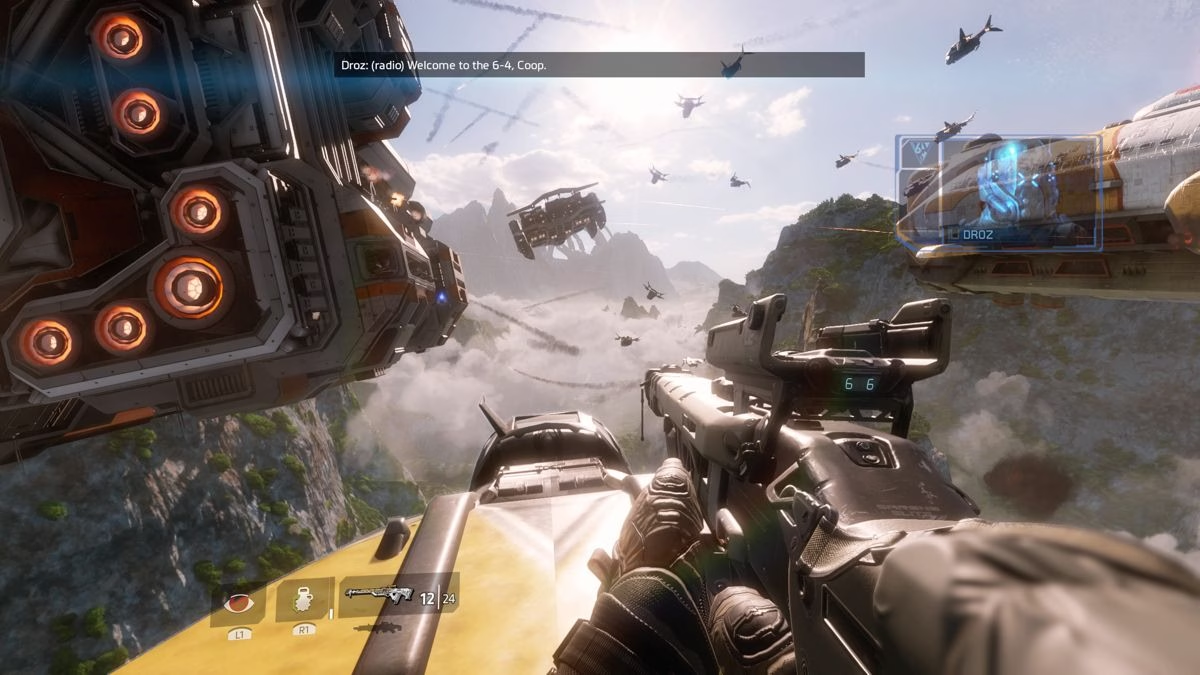
On PlayStation 4, Titanfall 2 moves between lush jungle paths, sunlit industrial platforms, mountainous skies crowded with aircraft, and darker military interiors without losing its clean sci-fi look. The jungle foliage and enormous crashed craft give the early outdoor scenes a convincing sense of scale, while the industrial arenas use pipes, tanks, gantries, and weathered metal to make combat spaces feel lived in.
The Titans are the visual stars. Their bulky frames look properly imposing from the ground, and cockpit views sell the change in scale with dense mechanical framing and huge weapons in the foreground. Blue electrical bursts from the Arc Tool, fiery damage on an enemy Titan, and warm sunset light over factory structures add punch, though some distant scenery and smaller soldiers look less detailed beside the machines.

Story
You play rookie Pilot Jack Cooper, a Militia soldier who dreams of commanding a Titan while fighting the IMC on Typhon. The setup is familiar military science fiction, but it gives the campaign a direct, easy-to-follow reason to keep moving through hostile territory. Cooper is inexperienced, so the game can introduce its ideas through his growing role without making the learning process feel forced.
The strongest relationship is between Cooper and BT-7274, the Vanguard Titan who becomes his ally. Their ability to communicate gives the campaign more personality than a chain of disconnected missions, and the partnership makes the moments spent outside or inside the Titan feel like two sides of the same journey. BT is more than a ride you summon when the action demands it.
The plot itself stays linear and straightforward, centered on the Militia’s struggle against the IMC and the threats scattered across Typhon. That simplicity works because the campaign’s real storytelling strength is momentum. Each new location and combat situation keeps pushing Cooper and BT forward, so even players who usually skip shooter plots have a reason to care about reaching the next mission.
Overall Experience
Titanfall 2 is the rare sequel that improves its foundation while also fixing its biggest absence. The original’s fast multiplayer formula is intact, but the full campaign makes the world and the Pilot-Titan contrast much easier to appreciate. It feels built by a team that knows speed alone is not enough, then keeps finding reasons to make that speed useful.
There can be a learning curve if you arrive from slower shooters. Staying grounded too often leaves you exposed, and Titan battles ask for more awareness than simply firing at the largest target. Give yourself time to experiment with routes, loadouts, and Titan styles. The reward is a shooter that feels unusually fluid once you stop fighting its momentum.
Come for the chance to pilot giant machines, but stay for how smoothly the game joins that fantasy to sharp first-person movement. The campaign is varied enough to stand on its own, and the multiplayer modes offer plenty of reasons to keep honing your Pilot and Titan skills. It is an excellent choice if you want a sci-fi shooter with both a satisfying solo run and competitive action that still feels distinct.


Reviews
There are no reviews yet.