 Retro Replay Retro Gaming History, Reviews & Emulation
Retro Replay Review
Gameplay
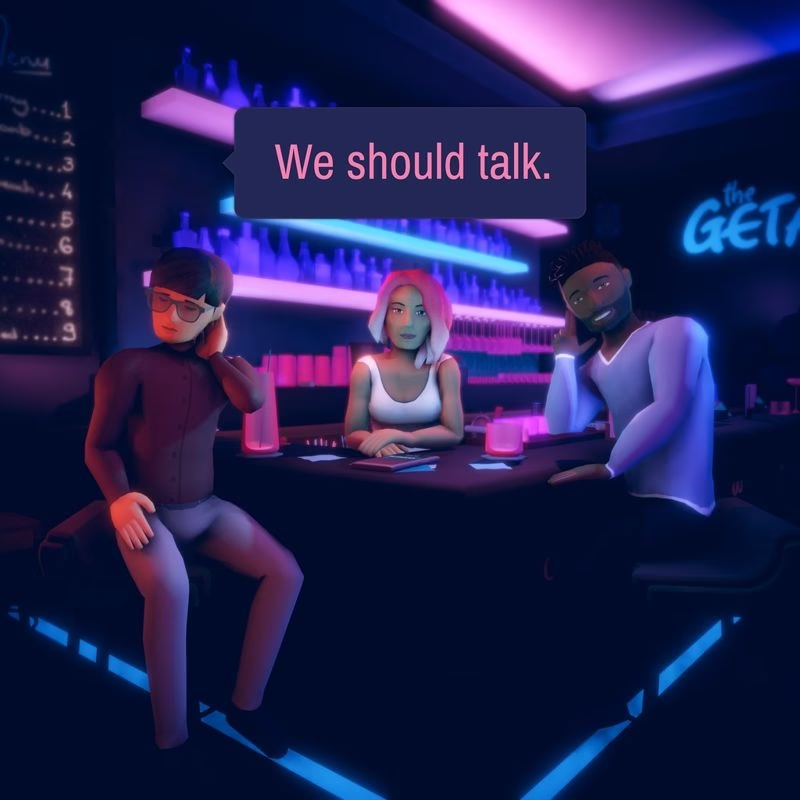
The first few replies in We should talk. feel almost casual. You are at your local bar, juggling chats with people nearby and messages from Sam, your partner at home. Then the sentence spinner starts showing its teeth. Rather than selecting a fully written response, you piece together modular parts of a sentence, deciding how accommodating, flirtatious, blunt, or guarded you want to sound.
That structure gives even small exchanges a welcome amount of tension. You may know the broad feeling you want to convey, but finding wording that expresses it cleanly is another matter. The game understands that real conversations are messy: people can misread you, and a reply intended as teasing or honesty can create friction instead. It is a smart fit for a story about relationships because the act of composing a message becomes the drama.
Replay value comes from tone rather than simply following an obvious good-or-bad route. Your responses shape individual conversations and eventually lead to one of nine endings, so you have a reason to revisit the night with a different attitude. That said, the same ambiguity that makes the premise compelling can be frustrating when you feel a phrase does not quite capture what you meant. If you like carefully managing dialogue consequences, that frustration is part of the point. If you want complete control over every nuance of your character’s voice, it may grate.
Graphics
The first-person framing keeps the focus close to the night at the bar and the text conversations competing for your attention. It suits a game built around social proximity: one relationship is physically distant, while the rest of the evening unfolds around you.
Story
We should talk. is interested in the emotional work behind seemingly ordinary communication. Sam’s messages carry the strain of ongoing life and romance problems, while friends and strangers at the bar pull you into their own conversations. The result is less about uncovering a big plot twist and more about navigating the uneasy overlap between what you say, what you mean, and what another person hears.
That grounded focus is the game’s strongest storytelling choice. A heavy text can create anxiety without needing melodrama, and a conversation with a creep can turn a social night sour in a way that feels instantly recognizable. The writing’s central question is not whether you can say the objectively right thing. It is whether you can communicate honestly enough, kindly enough, or clearly enough to preserve the connections that matter to you.
The multiple endings reinforce that idea well. They are determined by the overall tone of your responses, not by a single prescribed path, so the outcome reflects the personality you performed across the evening. That makes the conclusions feel like a judgment on your communication habits, which can be more memorable than a standard branching-narrative finale.
Overall Experience
We should talk. has a sharp, relatable hook and follows through on it with a dialogue system that makes word choice feel consequential. It is particularly easy to recommend if you enjoy visual novels that favor interpersonal discomfort, self-expression, and replaying scenes to see how a different attitude changes the emotional temperature.
The sentence spinner is not a flawless substitute for writing every reply yourself, and some of its power comes from making you accept that you cannot perfectly control how you are understood. But that limitation also gives the game its bite. You are not solving a conversation. You are living with it.
Go in ready to experiment, including with responses you would never send in real life. The worthwhile payoff is not just finding all nine endings, but realizing how quickly a night can change when your words repeatedly lean warm, distant, defensive, or playful. For more basic game information, see the official publisher details for We should talk.


Reviews
There are no reviews yet.